Category: Transcripts

  • The Controversy around Salem Witch Trial’s Rev. Samuel Parris – January 6, 1692

    The Controversy around Salem Witch Trial’s Rev. Samuel Parris – January 6, 1692

    Watch Salem Witch Trials Daily

    Show Notes

    Why was Salem Village minister Samuel Parris embroiled in controversy throughout his time there? In today’s episode of Salem Witch Trials Daily, we look into the reasons many people were angry at their pastor. We give his biography leading up to his time in Salem and discuss his tenure up to the start of the witch hunt. Why did he struggle to get villagers to join his church? Why did the villagers decide not to pay him?

    Links

    Select Salem Witch Trials Books:

    Transcript

    January 6, 2026 - Salem Village People
    Josh Hutchinson: [00:00:00] What if your minister demanded not just a salary but ownership of church property and got it through a vote that might have been rigged? That's how Samuel Parris began his ministry in Salem Village in 1689, claiming the parsonage and two acres in what may have been in illegal meeting. That land grab would become a lasting bone of contention, and the resentment it created never went away.
    Sarah Jack: For more than three years, between March 30th, 1690 and July 23rd, 1693, not a single man in Salem Village joined Samuel Parris' Church, not one. In a Puritan community where church membership was supposed to be at central to life, the men of the village were sending their minister a crystal clear message: we don't want you here.
    Josh Hutchinson: Samuel Parris [00:01:00] was the minister of the Salem Village Church from 1689 to 1696. His tenure in the village was marked by controversy, which we'll highlight in today's episode of Salem Witch Trials Daily. I'm Josh Hutchinson.
    Sarah Jack: And I'm Sarah Jack. First of all, who was Samuel Parris? Well, he was born in London in 1653. His father, Thomas, moved the family to Barbados in the late 1650s. Thomas Parris was a merchant and owned a sugar plantation.
    Josh Hutchinson: Samuel Parris's uncle, Thomas Oxenbridge, left Barbados in 1670 to minister to Boston's first church. Samuel entered Harvard at about the same time at age 17.
    Josh Hutchinson: In 1673 though, Samuel's father died, and Samuel was forced to abandon his schooling. As great consolation to him, he inherited an estate worth about 7,000 [00:02:00] pounds, which would've made him very rich in Massachusetts, but he chose to go back to Barbados and take over his father's holdings.
    Sarah Jack: Samuel did not end up having his father's level of success in Barbados. He moved back to Boston in 1680 or 1681 after selling the Barbados properties. In 1682, he had to take out a loan to set up a shop as a merchant and stock up on goods to sell. His warehouse happened to be next to that of William Phips, who would be the governor in 1692.
    Josh Hutchinson: As in Barbados, Parris proved to be unsuccessful as a merchant in Boston, and soon considered a career in the ministry. In 1685, he preached in Stow, a frontier town in central Massachusetts.
    Sarah Jack: Then on November 15th, 1688, he entered discussions to minister to Salem [00:03:00] Village. He preached in Salem Village on November 25th, after which the village voted to pursue him as their next minister. There were months of negotiations after that.
    Josh Hutchinson: The village made its first offer on December 10th, 1688. The offer was 60 pounds a year plus lodging in the parsonage. However, Parris did not respond to this offer until the villagers invited him to come personally to Salem to discuss it.
    Sarah Jack: At that meeting, Parris tentatively agreed to the salary of 60 pounds per year but submitted an additional list of conditions: A. A third of the pay in cold, hard cash, the rest in goods to be assessed at the current prices,so the inflation plaguing the colony would not reduce the amount of goods he received. B. Control of the nature of provisions he was paid. C. Possibility of a raise if the village prospered, reduction if [00:04:00] it struggled. And D. Free firewood. The villagers did not agree to the free firewood, instead increasing Parris' salary by six pounds per year so that he could buy his own wood, which they would sell to him at four shillings a cord.
    Josh Hutchinson: Parris began preaching in the village in July 1689. His salary started on the first of that month. On October 10th that year, at a meeting he had requested, possibly led by Putnams, some villagers voted to overturn a 1682 vote that had banned giving the parsonage to the minister. They then voted to give the parsonage and two acres of land to Parris. This would be the lasting bone of contention in the village.
    Josh Hutchinson: The vote was possibly illegal, as the fact that there was only one objection to the property transfer indicates that perhaps not all villagers were [00:05:00] informed of the meeting.
    Sarah Jack: Rev. Parris was ordained on November 16th, 1689. On the same occasion, the first members of the Salem Village Church signed the covenant. There were 17 men and 10 women who joined, including Parris and his wife. 12 of the new members were Putnams. Four were their allies, the Wilkinses.
    Josh Hutchinson: Parris was unpopular with many in the village from the start. As of December 17th, a month after he was ordained, 38 of the village's families still had not paid their portions of the minister's salary, and Constable Edward Bishop was ordered to collect the late taxes. He was unsuccessful.
    Sarah Jack: Parris made it difficult to join the Salem Village Church, whereas the Salem Town Church had eased membership requirements. Parris rejected the Halfway Covenant, which churches in neighboring towns had adopted to make it possible for the [00:06:00] grandchildren of members to be baptized, even if their parents were not full church members.
    Josh Hutchinson: So with these stringent requirements and his unpopularity, in Parris's second year as minister, only seven villagers joined his church, and by 1692, 2 1/2 years after he started preaching in the village, there were still only 61 members, total, 35 of them women, because no man had joined the church in two years.
    Sarah Jack: Every year, the village committee struggled to wrest Parris' pay from the villagers, and in April 1691, the committee found that only about 70% of Parris's salary had been collected for the year. The residents at the April 1691 village meeting decided to ask the Massachusetts General Court to force the withholders to pay Parris.
    Josh Hutchinson: Then on October 16th, 1691, a new [00:07:00] village committee was elected, made up of Joseph Porter, Joseph Hutchinson, Daniel Andrew, Joseph Putnam, and Francis Nurse, five men who opposed Parris. At the same time, the villagers at the meeting voted not to gather taxes to pay Parris.
    Josh Hutchinson: By November 1st, Parris was nearly out of firewood. 17 men met with him at the parsonage and created a three man delegation to beseech the village committee for help. After an unsuccessful plea at the November 10th village meeting, the men of the church voted to sue the village committee to force them to collect Parris's pay. Then the Village Committee announced a village meeting for December 1st, at which it planned to air its grievances against Parris. His contract was not legal, according to the village committee, he should not have been given the parsonage, and he should perhaps be paid voluntarily and not by taxes.[00:08:00]
    Sarah Jack: Unfortunately, the Village record book contains no entries from October 17th until January 8th, so it's not clear the December 1st meeting took place. Nevertheless, a contentious meeting was held around this time, and Parris was compelled to answer about his original contract.
    Josh Hutchinson: Throughout Parris's tenure, the number of church members remained low for a community of about 500 to 550 people. According to Professor Emerson Baker, some 400 villagers were neither baptized nor members of the church.
    Sarah Jack: Controversy would continue to swirl around Samuel Parris until he resigned from the Salem Village Church at the end of June, 1696. But first, a lot transpires.
    Josh Hutchinson: A lot that we'll be covering in the coming days, weeks, months. So stay tuned, and you learn all about this dramatic saga of Samuel Parris in Salem [00:09:00] Village.
  • Salem Town, Salem Farms, and Salem Village: A Tale of 3 Salems – January 5, 1692

    Salem Town, Salem Farms, and Salem Village: A Tale of 3 Salems – January 5, 1692

    Watch Salem Witch Trials Daily

    Show Notes

    Historians view the Salem of 1692 as being comprised of 3 neighborhoods: Salem Town, Salem Farms, and Salem Village. What were these communities, and how did contention for independence contribute to the witch trials? In today’s Salem Witch Trials Daily, we explore the early history of these neighborhoods and name prominent residents and landholders.

    Links

    Select Salem Witch Trials Books:

    Transcript

    January 5, 2026 Salem Town and Salem Farms and Salem Village: A tale of 3 Salems

    Sarah Jack: Why did Salem have three different Salems? How did that confusion help spark a witch hunt?
    Josh Hutchinson: That's right. There really were three Salems. Of course, there was the town of Salem that encompassed all of it, but within that town, there were distinct communities. We tend to distinguish Salem Town, the port city, from Salem Farms and Salem Village, which were to the west of that in the interior of the country.
    Sarah Jack: Much of the land in Salem Farms, which lay to the west of Salem Town, was granted to the elite men of the colony.
    Josh Hutchinson: John Endicott, once governor of Naumkeag, the predecessor to Salem, and also future governor of Massachusetts Bay, owned more land in Salem Farms than anyone else.[00:01:00]
    Josh Hutchinson: There were a lot of other prominent early landholders in the farms, including William Hathorne, father of witch judge John Hathorne, Richard Bellingham, future Governor of Massachusetts Bay, and John Winthrop's brother-in-law, Emmanuel Downing.
    Sarah Jack: These men did not remain long in the community, however. Attracted to opportunities on Salem Peninsula
    Sarah Jack: or Boston or London, they all either leased or sold their land, often dividing it into parcels for sale.
    Josh Hutchinson: Soon, men who would play roles in the Salem Witch trials and men who had children or wives who played roles in the witch trials were established in Salem Village and the surrounding farms. This included men like John Putnam, the father of Sergeant Thomas Putnam, who was wife to one Ann Putnam and father to another.
    Sarah Jack: Others who settled in Salem Village included Daniel Rea, Richard Hutchinson, and Bray Wilkins. John [00:02:00] Proctor leased Emmanuel Downing's land in 1666.
    Josh Hutchinson: Francis Nurse, husband of future accused witch, Rebecca Nurse, rented a good portion of the Endicott farm in 1678. With these men and their families in place, the Salem Village of 1692 was taking shape.
    Sarah Jack: In 1666, Salem Farms residents petitioned Salem for the right to have a minister of their own. Salem wasn't having it. A year later, men from Salem Farms asked to be exempted from night watch in the town, due to the great distances they had to travel from their homes. This proposal was rejected, as well.
    Josh Hutchinson: Residents of another neighborhood split off from Salem to form the town of Beverly in 1668. This seems to have encouraged many of the Salem Villagers to push harder for independence from Salem Town.
    Sarah Jack: In 1669, taxes were raised to fund a [00:03:00] new meetinghouse in the town. A group of 28 farmers balked at paying for a new meetinghouse in the town when they needed a meetinghouse of their own.
    Josh Hutchinson: The farmers asked the general court to allow them to have their own minister. The General Court did not approve the request until October 8th, 1672, in an order which also empowered the village to elect a five-member village committee to raise taxes to hire the minister.
    Sarah Jack: Then the village was at least recognized as a parish and allowed to have a minister, but not to form a church, meaning all the sacraments were still performed in the town church. Some who would attend the village meetinghouse remained members of the First Church of Salem and took communion there.
    Josh Hutchinson: Joseph Hutchinson, who's my ninth great grandfather who lived close to the center of Salem Village, donated the land for the meetinghouse. Yes, [00:04:00] this is the infamous meetinghouse where the Salem Witch Trials examinations were held, where afflicted people flopped and wailed and screamed and writhed.
    Sarah Jack: In December of 1672, the village voted to build a meetinghouse on the gifted land and set a budget of 40 pounds. The meetinghouse was built in the spring of 1673.
    Josh Hutchinson: That year, the village hired its first minister, James Bayley. He served until 1679, when a group of villagers, including Bray Wilkins and Nathaniel Putnam, pressured him to resign. The next year, this faction won most of the seats on the village committee and forced him to step aside.
    Sarah Jack: George Burroughs was the town's next minister. Hired in November of 1680, he had preached in Falmouth, Maine, now Portland, for several years until that town was destroyedin King Philip's War, and he was forced to relocate to Salisbury, Massachusetts.
    Josh Hutchinson: Burroughs [00:05:00] left Salem Village in the spring of 1683, after the village committee voted to stop paying him. He returned to Maine.
    Sarah Jack: It took a year for Salem Village to hire the next minister, Deodat Lawson, who was a controversial choice. One faction lobbied Salem Town in 1686 for permission to ordain him and form a church, while another petitioned Salem Town in 1687 not to ordain Lawson.
    Josh Hutchinson: Supporters included Captain John Putnam and Sergeant Thomas Putnam, while opponents were led by Joseph Hutchinson, Daniel Andrew, Job Swinnerton, and Joseph Porter.
    Sarah Jack: Joseph Hutchinson then fenced in the meetinghouse in a show of his disdain
    Sarah Jack: for Mr. Lawson.
    Sarah Jack: In February 1687, the Salem Town committee told the two factions that Lawson would not be ordained and urged his supporters to just shut up about ordination already.
    Sarah Jack: Lawson left [00:06:00] Salem Village less than a year after the town committee's decision.
    Josh Hutchinson: No new minister was hired until 1689. The previous November, villagers had opened discussions with Samuel Parris of Boston and formerly of Barbados.
    Sarah Jack: He gave one sermon on November 25th, 1688, and the town voted him to be the next minister. After months ofnegotiations, Parris started to preach in the village in July, 1689.
    Josh Hutchinson: He was ordained and the church was gathered on November 16th, 1689. This means all the covenanting members signed the contract that day and were able to then receive the sacraments.
    Sarah Jack: The hiring of Samuel Parris would go on to have the tragic outcome we all know about. Preaching constantly about the ever-present devil, he led his community down a road better left untraveled, and fueled the [00:07:00] witch trials.
    Josh Hutchinson: Thank you for enjoying Salem Witch Trials Daily with us. Tomorrow, we're going to break down the controversy surrounding Samuel Parris.
    Sarah Jack: This video is part of a larger series of videos that make up the Salem Witch Trials YouTube course. For information on how to take advantage of the course, go to youtube.com/@aboutwitchhunts.
  • Salem’s Founding – January 4, 1692

    Salem’s Founding – January 4, 1692

    Watch Salem Witch Trials Daily

    Show Notes

    In today’s Salem Witch Trials Daily, we discuss the founding of Salem, Massachusetts in 1626 and how the town was reshaped over the years leading up to the witch trials in 1692, as the population of New England surged.

    Happy birthday, Salem!

    Links

    Select Salem Witch Trials Books:

    Transcript

    January 4, 2026 - Salem's Founding
    Josh Hutchinson: The city of Salem, Massachusetts has its 400th birthday this year. Founded in 1626, Salem was the first English town in Massachusetts Bay. Its existence as Salem predates the founding of the Massachusetts Bay Colony itself.
    Sarah Jack: Of course, native settlements in the area date back much, much longer. The original inhabitants of what is now Salemcalled the area Naumkeag, which means fishing place.
    Josh Hutchinson: Naumkeag was a thriving settlement until European disease ravaged the eastern coast of New England from 1616 to 1619.
    Sarah Jack: In 1624, the Dorchester Company sent a mannamed Roger Conant to lead the colony they were trying to establish on Cape Ann, to the north of where Salem sits today.
    Josh Hutchinson: Conant and 20 families later relocated and settled in the fishing place in [00:01:00] 1626, so Conant is considered Salem's founder and a statue of him stands in the city, right in front of the Salem Witch Museum.
    Sarah Jack: In 1628, the Massachusetts Bay Company bought out the Dorchester Company's holdings on Cape Ann, and John Endicott was appointed governor of the Massachusetts Bay Colony. He sailed to New England with a hundred colonists and established his government in Salem.
    Sarah Jack: Roger Conant was granted 200 acres of land in exchange for surrendering leadership to Endicott. After this peace was forged, the story goes that the community was renamed Salem, a hellenized form of shalom, the Hebrew word for peace.The First Church in Salem was formed in August 1629. It's important to note that in colonial Massachusetts, a church was a body of people and not a building. The building didn't come until 1635. Until then, members met in private [00:02:00] homes.
    Josh Hutchinson: Samuel Skelton was elected to be the first pastor, and Francis Higginson was elected to be the teacher. Francis Higginson, by the way, was the father of John Higginson, who served as Salem's senior minister during the witch trials. Unfortunately, neither Francis Higginson nor Samuel Skelton lived to see the construction of the church's first building.
    Sarah Jack: In 1634, Roger Williams came to Salem to be the new minister.
    Sarah Jack: He served less than two years and was banished for his theology from the Massachusetts Bay Colony, going on to found Rhode Island.
    Josh Hutchinson: Then Williams' successor in Salem was Hugh Peter. He lasted five years and then returned to England where he became personal chaplain to Oliver Cromwell and was later beheaded and mutilated for his role in the killing of King Charles I. So they had a lot of luck with [00:03:00] these early ministers.
    Sarah Jack: In 1629, the Massachusetts Bay Company elected John Winthrop to succeed John Endicott as governor. A year later, in 1630, governor Winthrop and 700 colonists reached Salem in a fleet of 11 ships. However, Winthrop did not stay in Salem long. He and most of the new arrivals relocated and founded Boston, making it the capital of the new colony of Massachusetts Bay.
    Josh Hutchinson: About 20,000 immigrants poured into New England in the 1630s. As this Great Migration drew more and more people, new towns were created around Salem, which was soon ringed by Lynn, Reading, Andover, Rowley, Ipswich, and Gloucester
    Sarah Jack: Salem itself included. All are part of the modern towns of Beverly, Marblehead, Manchester, Wenham, Topsfield, Danvers, Middleton, Peabody, and Swampscott.[00:04:00]
    Josh Hutchinson: Within Salem's early boundaries, the town of Wenham split off in 1643, the same year that the Jefferies Creek community was incorporated as Manchester. Marblehead split from Salem in 1648 and Beverly spun off in 1668.

    Sarah Jack: Most of the population of Salem lived near the bustling port, while others resided to the West, and in an area known as Salem Farms,which included a small settlement called Salem Village. We'll discuss Salem Village's history and disagreements with the town of Salem in further detail tomorrow. This is important for understanding the local dynamics at the time of the Salem Witch-Hunt.
    Josh Hutchinson: Thank you for watching Salem Witch Trials Daily. As always, I'm Josh Hutchinson.
    Sarah Jack: And I'm Sarah Jack. Join us again tomorrow for that look at Salem Village's early history.

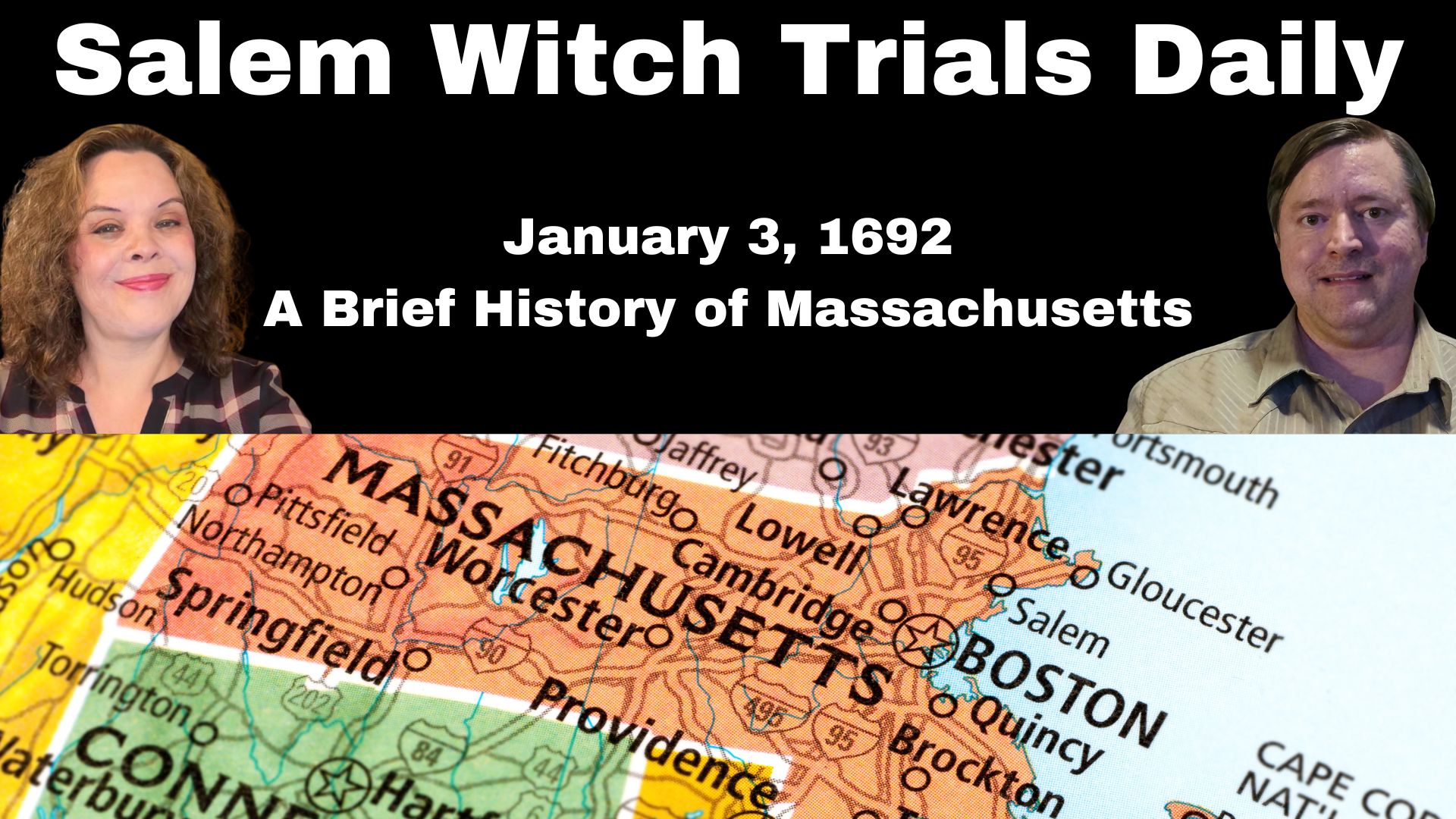
  • A Brief History of Massachusetts – January 3, 1692

    A Brief History of Massachusetts – January 3, 1692

    Watch Salem Witch Trials Daily

    Show Notes

    How did Massachusetts become what it was in 1692? We look into this question in today’s Salem Witch Trials Daily.

    We highlight the founding of Salem and Boston, the establishment of the Massachusetts Bay Colony, the colony’s first legal code, and more.

    Keep coming back every day as we continue to explore the witch trials and their context throughout the year.

    Links

    Select Salem Witch Trials Books:

    Transcript

    January 3 - The History of Massachusetts
    Josh Hutchinson: Salem, the Massachusetts Bay Colony's first city, celebrates its 400th anniversary this year, and this focus on the history of the city has us thinking, what about the history of the colony? How did Massachusetts become what it was in 1692? Welcome to Salem Witch Trials Daily for January 3rd. I'm Josh Hutchinson.
    Sarah Jack: I am Sarah Jack.
    Sarah Jack: For 10,000 years or more before the Europeans came, Massachusetts was occupied by Native Americans. In the 16th century, the Europeans came to New England to fish and to trap game where those Native Americans were living. A series of epidemics decimated the native population, especially along the coast where contact with the exotic, disease-carrying Europeans was very common.
    Sarah Jack: Then in the [00:01:00] 17th century, English colonists tried to start settlements in several locations. These ventures failed until 1620 when the Mayflower pilgrims landed at Plymouth.
    Josh Hutchinson: They formed Plymouth Colony and then in 1626 on Cape Ann, Salem was founded by Roger Conant, who had established a fishing village at Naumkeag, the site of a previous Native American settlement. Naumkeag means fishing place.
    Sarah Jack: You can see a statue of this founder of Salem Roger Conant, right outside of the Salem Witch Museum. People often mistake it for the statue of a witch or a generic puritan. It's specifically Roger Conant. In 1628, Massachusetts was founded by the Massachusetts Bay Company. So, at this point in time you had the Plymouth Colony in the South and Massachusetts Bay [00:02:00] Colony to the north of that. In 1629, King Charles I issued a charter so that the Massachusetts Bay Colony could govern itself. The town of Boston was founded in 1630 and it was made the seat of the colonial government, authorized by that charter.
    Josh Hutchinson: Yes. This was when they moved the capitol away from Salem, where they initially set up camp. And then in the 1630s, there was an explosion of immigration to New England, as approximately 20,000 Europeans came over to settle the colonies. In 1641, the first New England legal code was set down. This was called the Massachusetts Body of Liberties, and it set out the rights of the residents of [00:03:00] Massachusetts. Then in 1648, this book and other laws were put together into The Book of the General Laws and Liberties Concerning the Inhabitants of Massachusetts.
    Sarah Jack: And it wasn't long. Before there were accused witches between 1648 and 1691, many people were indicted in Massachusetts on witchcraft charges. Eight were convicted, five were executed, and two women were jailed or placed under house arrest.
    Josh Hutchinson: The one man who was accused, his conviction got overturned and then he fled to Rhode Island with his daughter. That was Hugh Parsons of Springfield. In 1684, the cherished charter of Massachusetts Bay Colony was revoked by King James II, throwing the colony into some [00:04:00] disarray.
    Josh Hutchinson: Then two years later, King James II established the Dominion of New England, which was a supercolony that ran all the way from what's now New Jersey, up to Nova Scotia, and included all of the New England colonies and New York under one royally appointed Governor, Edmund Andros, who was a very unpopular figure in New England, because he was very harsh on Massachusetts, in the opinions of the leaders and residents. He got overthrown two years later. The Glorious Revolution happened in England. This is when King William and Queen Mary came from the Netherlands to take the throne away from King James II. And while that was happening there, once the colonists got word of it, several weeks later, they stormed the Capitol in Boston and arrested Edmond Andros and [00:05:00] sent him back to England.
    Sarah Jack: From that time, 1688 to 1692, Massachusetts was led by an interim government resulting in jail overcrowding as the colony lacked courts to try suspects.
    Josh Hutchinson: In 1691, Massachusetts finally got the charter it had been working for years to regain, but this new charter was controversial.It included clauses like Massachusetts had to be tolerant of other religious beliefs. In addition to Puritanism, they had to tolerate the Anglicans and the Baptists and the Quakers, who they did not tolerate at all before this. So they were very upset.
    Sarah Jack: him.
    Josh Hutchinson: They were persecute, they executed Quakers just for being Quakers.
    Josh Hutchinson: But finally this charter, it was issued by King William in October, and then it arrived in the colony of Massachusetts the following [00:06:00] February. So February to May, you still have this kind of quasi legal status, because the new governor, he doesn't arrive until the middle of May, after the jails were already packed with witchcraft suspects. This is just a little introduction to the history of Massachusetts. I know we didn't go into a lot of detail, but tomorrow you can come back and we're gonna dig into the founding of Salem.
    Sarah Jack: The Salem Witch Trials Daily is presented by The Thing About Salem and The Thing About Witch Hunts podcasts. Join us every Sunday and Wednesday for deeper explorations of the Witch trials of the past and the witchcraft persecution of today.

  • What Caused the Salem Witch Trials? – January 2, 1692

    What Caused the Salem Witch Trials? – January 2, 1692

    Watch Salem Witch Trials Daily Course Introduction

    Show Notes

    Join us for this second episode of Salem Witch Trials Daily. Today, we highlight 5 of the key factors which contributed to the start of the witch hunt and its rapid spread. Tune back in tomorrow, when we explore a 6th factor.

    Salem Witch Trials Daily is the daily show that highlights key events in the witch-hunt as they happened and analyzes their significance. We go beyond the typical on this date programming to bring insights into key topics of interest.

    The Thing About Salem is the weekly podcast dedicated to revealing another “thing” about the Salem Witch Trials every week.

    The Thing About Witch Hunts is the weekly witch trial podcast bringing historical accounts and analysis, as well as actionable information on the witch hunts still occurring today.

    Links
    The Thing About Salem
    The Thing About Witch Hunts
    People Accused of Witchcraft in 1692

    Select Salem Witch Trials Books:
    Bernard Rosenthal, ed., Records of the Salem Witch-Hunt
    Emerson W. Baker, A Storm of Witchcraft: The Salem Trials and the American Experience
    Marilynne K. Roach, The Salem Witch Trials: A Day-by-Day Chronicle of a Community Under Siege
    Mary Beth Norton, In the Devil’s Snare: The Salem Witchcraft Crisis of 1692

    Transcript

    January 2, 2026
    Josh Hutchinson: So we've been podcasting about witch trials for about three and a half years now, and people are always asking what caused the witch trials, particularly the Salem Witch Trials. Was it this ergot poisoning that we hear about with the LSD-like substance, or did everybody catch hysteria and just lose their minds? We'll discuss some of the key reasons in today's episode of Salem Witch Trials Daily. I'm Josh Hutchinson.
    Josh Hutchinson: And I'm Sarah Jack. As of January 2nd, 1692, the Salem Witch Trials were not yet underway, so we'll be bringing you topical episodes until the action picks up.
    Josh Hutchinson: To set the stage for when the trials do happen, here are five of the most significant factors that led to the saga.
    Sarah Jack: The belief in witchcraft was nearly [00:01:00] universal. Even trial critics did not refute the existence of witches. Those defending accused witches believed in witchcraft.
    Josh Hutchinson: They did, and I want to point out here, too, that this belief in witchcraft was not just limited to people in Massachusetts. It wasn't limited to Puritans. It was nearly universal in all of Europe at the time that this was happening, regardless of which denomination the people involved were. Then the second factor that led to the witch trials or contributed to the rise and spread of the witch trials was war and the accompanying sickness that came along with it. King Philip's War had been fought in the 1670s and was the deadliest war per capita in the history of what is now [00:02:00] the United States. And King William's War was now being fought in 1690s, primarily in Northern New England.
    Sarah Jack: So that was the experience of those that were involved in witch trials, these wars.
    Josh Hutchinson: These wars and King William's war was when a large smallpox outbreak occurred, started with soldiers who were trying to invade Quebec, and they came home, hundreds of them sick with smallpox, and we'll see later down the road that that smallpox did contribute to some witchcraft accusations.
    Josh Hutchinson: Hint.
    Sarah Jack: The economy is the third factor we're gonna talk about.
    Josh Hutchinson: Yeah, the economy was ravaged by colonial debt, because these wars were so expensive. They literally had to start [00:03:00] printing money for the first time in Massachusetts to pay for this debt. So the taxes were very high. There's a high burden on the residents. And residents and the colony itself had suffered direct financial losses heavily due to these wars. You know, you think about the destruction of property, the loss of income.
    Sarah Jack: Loss really seems to contribute to witchcraft accusations.
    Josh Hutchinson: Indeed.
    Josh Hutchinson: The fourth factor we wanna talk about today is social tensions. Of course, you have the usual tensions between neighbors, but these were heightened by the anxieties being felt at the economically precarious time. It was a precarious time in general for the colony. We'll talk about that more in later episodes, why the colony itself was [00:04:00] on edge.
    Sarah Jack: And there were increased social tensions because war refugees had moved to Massachusetts, mostly to Essex County, which is the northernmost county in the Massachusetts Bay Colony, and that's where Salem is. So they had all this influx of people come down to Salem and surrounding towns. The last factor that we're gonna touch on today is religious anxieties.
    Josh Hutchinson: A feeling had been growing among many of the Massachusetts ministers that the colony and its residents were backsliding on Christianity, that they didn't have the faith of the founders who had first settled in the 1620s and 30s. That this generation by 1692, it's the third generation of people, some people are even fourth generations being born, and [00:05:00] the ministers just thought that these aren't the men that founded this colony that we revered because their faith was so strong. We feel like the faith is crumbling away. So that was big source of religious anxiety throughout the colony.
    Josh Hutchinson: And then locally in Salem Village, there was intense controversy over the minister. For two decades, they squabbled over who to be minister. Nobody lasted more than a few years. And in 1692, Samuel Parris was the minister, and it seemed like at least half of the community was against him.
    Josh Hutchinson: And these five factors that we've talked about today aren't the only things that we're contributing to fueling the witch trials. There was this anxiety I alluded to a minute ago that was political in nature, [00:06:00] because the status of the colony was up in the air.
    Josh Hutchinson: Salem Witch Trials Daily is presented by The Thing About Salem and The Thing About Witch Hunts podcasts. Tune into those every week.

  • Salem Witch Trials Daily Course Introduction – January 1, 1692

    Salem Witch Trials Daily Course Introduction – January 1, 1692

    Happy New Year! And happy 400th birthday (2026) Salem, Massachusetts.

    In the first episode of Salem Witch Trials Daily, Josh Hutchinson previews the new series, which discusses each day of the Salem Witch Trials and searches for meaning behind the events.

    Every day in 2026, we will bring you key details and discussion of the events of 1692. In 2027, we will continue to bring you the events of 1693 and beyond.

    Salem Witch Trials Daily is hosted by Josh Hutchinson and Sarah Jack and presented by The Thing About the Salem Witch Trials and The Thing About Witch Hunts.

    We’ll have more in the next episode, when we begin to look into the factors which helped the witch-hunt form and spread.

    Watch Salem Witch Trials Daily Course Introduction

    Links
    The Thing About Salem
    The Thing About Witch Hunts
    People Accused of Witchcraft in 1692

    Select Salem Witch Trials Books:
    Bernard Rosenthal, ed., Records of the Salem Witch-Hunt
    Emerson W. Baker, A Storm of Witchcraft: The Salem Trials and the American Experience
    Marilynne K. Roach, The Salem Witch Trials: A Day-by-Day Chronicle of a Community Under Siege
    Mary Beth Norton, In the Devil’s Snare: The Salem Witchcraft Crisis of 1692

    Transcript

    The Salem Witch Trials were America's largest and most notorious witch panic, by a good measure. In 1692 and 1693, the Salem Witch Trials produced at least 156 formal accusations, 30 convictions, and 20 executions. In fact, Robert Calef, author of one of the very few 17th century books on the trials, said accusers named more than 200 people as witches. Not all of these individuals were prosecuted, however. 
    Happy New Year and happy 400th birthday to the city of Salem, Massachusetts, founded back in 1626. I'm Josh, and I'm excited to welcome you to Salem Witch Trials Daily, a new series exploring the Witch-Hunt of 1692 and 1693. This , is designed as a course.
    In 2026, we'll bring you a daily account of the [00:01:00] events of 1692, and next year we'll continue to cover the events of 1693 and beyond. In addition to the daily events, we'll discuss witch trial topics and debunk misconceptions. This course is for beginners first beginning to learn about the witch trials, people who know the gist of the history but want more details, and even seasoned Salem researchers who want to look at topics from different angles. You will all get something out of this series.
    We will learn what factors created an environment in which the witch panic was able to happen, how the witch trials were prosecuted, and how the witch trials finally ended, among much more.
    So tune in every day. You'll be immersed in Salem Witch Trials history and in-depth discussion of the witch trials and learn everything you want to know about the witch-hunt in a few minutes a day. So the events of [00:02:00] 1692 and 1693, they started in January, 1692, some point in the middle of the month, in the household of Salem Village Minister Samuel Parris. His daughter, Betty, and his niece, Abigail Williams, began behaving very strangely. There were barking like dogs and quacking like ducks and flapping around like geese, pretending to fly across the room, and nobody knew what was up with that. They seemed to be sick with some illness, but doctors couldn't diagnose what it was. And what one strange thing was that betty and Abigail were the only people in a household of eight to come down with this condition. Betty's sister, Susannah, and brother, Thomas, they did not come down with this. The parents, Samuel and Elizabeth Parris, did not come down with this. Tituba, an enslaved [00:03:00] woman in the household, did not come down with this. John Indian, however, the other enslaved individual in the house, he did eventually come down with this, but didn't get it right away when the girls did.
    So as we go through January and the rest of this year, we'll continue to walk a day by day through the events of the Salem Witch Trials. So come back every day for an all new episode. Salem Witch Trials Daily is presented by The Thing About Salem and The Thing About Witch Hunts podcasts. Tune into those podcasts for even more. The Thing About Salem is dedicated exclusively to the Salem Witch Trials, while The Thing About Witch Hunts covers more witch trials and more related topics.
    So we're gonna have more for you here tomorrow, when we begin to look into the [00:04:00] factors which helped the witch-hunt to form and spread. Until then, have a great today and a beautiful tomorrow.
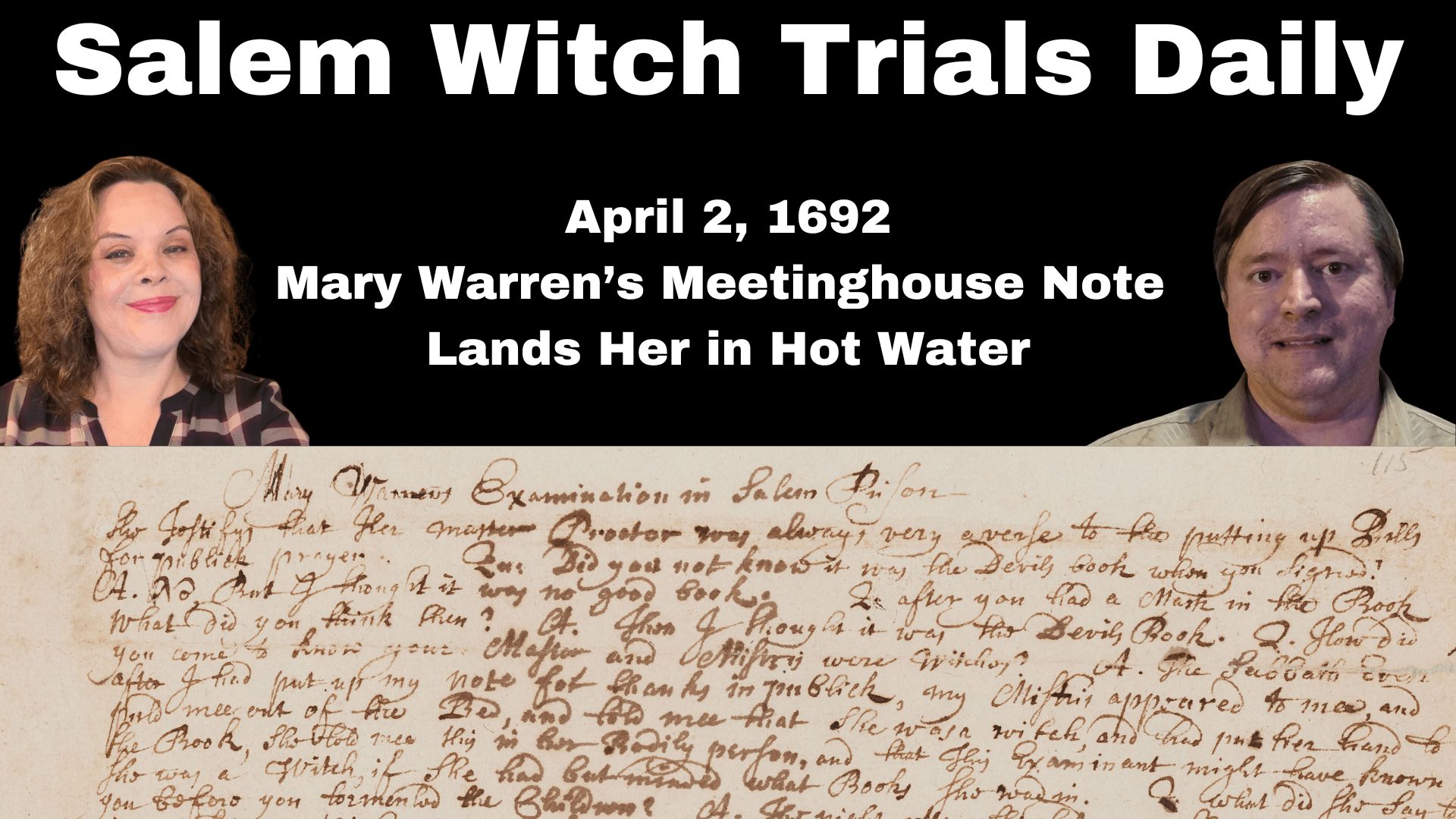
  • Mary Warren’s Meetinghouse Note Lands Her in Hot Water – Salem Witch Trials Daily – April 2, 1692

    Mary Warren’s Meetinghouse Note Lands Her in Hot Water – Salem Witch Trials Daily – April 2, 1692

    In this episode, we move beyond the fictionalized drama of Arthur Miller’s The Crucible to uncover the real Elizabeth Procter. Born into a family already shadowed by witchcraft accusations, Elizabeth faced the full weight of the 1692 panic. We trace her journey from a high-profile examination in front of the colony’s top officials to her harrowing months in prison.

    What You’ll Learn

    • The “Inheritance” of Suspicion: How Elizabeth’s grandmother, Ann Burt, influenced the community’s perception of her long before the trials began.
    • The High-Stakes Examination: Details of the April 11th hearing where Elizabeth stood her ground against the afflicted girls and the highest court in Massachusetts.
    • A Life-Saving Pregnancy: The legal reason Elizabeth survived the gallows while her husband, John, did not.
    • The Fight for Restitution: Elizabeth’s post-trial battle to reclaim her legal personhood and property after being declared “dead in the eyes of the law”.
    • Fact vs. Fiction: We debunk common myths regarding the Procter family’s ages and relationships that were popularized by 20th-century drama.

    Featured Quotes

    “I know nothing of it, no more than the child unborn.”


    Tune in to hear how one woman’s fierce determination allowed her to dismantle an unjust legal system and reclaim her life.

    Transcript

    Josh Hutchinson: Welcome to Salem Witch Trials Daily. I'm Josh Hutchinson.
    Sarah Jack: This is Sarah Jack. Today, Saturday, April 2, 1692. Elizabeth Procter and Rebecca Nurse's Spectors, allegedly afflict Abigail William's
    Josh Hutchinson: According to Abigail, this happened on several occasions in March and April. In testimony, accusers would often provide lists of dates like this when they had been attacked spectrally, just numbering the second, third, fourth, 17th of March, things like that. And this is one of the reasons why we go through the events day by day so that we understand what the daily life was like for those involved in the witch-hunt.
    Sarah Jack: Abigail describes these attacks saying she felt "grievously pinched" and "had also her bowels almost pulled out."
    Josh Hutchinson: The Elizabeth [00:01:00] Procter specter reportedly tempted Abigail with fine things in exchange for signing a book.
    Sarah Jack: Elsewhere in Salem Village, Mary Warren, who worked for the Proctors, had recovered from her affliction and now put a note at the meetinghouse asking for prayers of gratitude for her recovery.
    Josh Hutchinson: Stay tuned this month for the aftermath of Mary pinning this note. There will be serious drama.
    Sarah Jack: In the immediate wake of the note posting, according to Mary's later testimony, Elizabeth Procter appeared to Mary that night, pulled her out of bed and confessed that she was a witch and had signed the book.
    Josh Hutchinson: Mary said that quote, she told me this in her bodily person. This means that it wasn't Elizabeth's specter visiting her, it was Elizabeth herself.
    Sarah Jack: Occasionally, we see complaints referenced bodily attacks made by physical people, but as you'll see, [00:02:00] it is far more common to read of spectral assaults by the shapes of the witches.
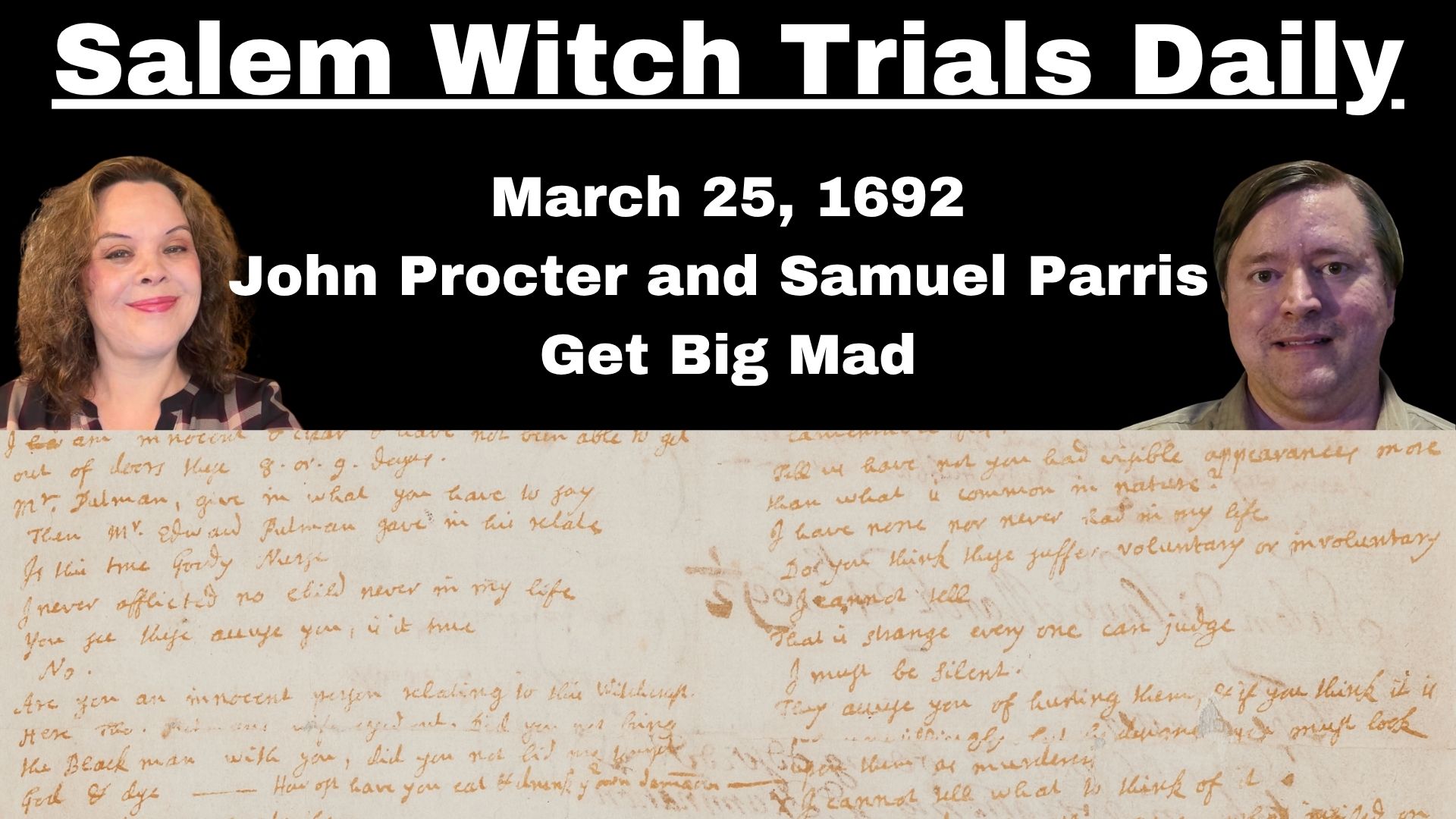
  • John Procter and Samuel Parris Get Big Mad: March 25, 1692

    John Procter and Samuel Parris Get Big Mad: March 25, 1692

    In this episode, we dig into Friday, March 25, 1692, as tensions surge in Salem Village and beyond. We discuss John Procter’s furious confrontation with Samuel Sibley at Walter Phillips’ Tavern over Mary Warren’s fits and his harsh skepticism toward the afflicted girls. Back in the village, we cover Ann Putnam Jr.’s reported violent spectral assault—attributed to Rebecca Nurse—with witnesses claiming visible bite marks and chain impressions, alongside Edward Putnam’s deposition against Nurse. In Salem Town, we examine Betty Parris’s severe seizures at Captain Stephen Sewall’s home and her account of a dark figure offering temptation, as well as the advice that seemed to end her fits. We also explore Rev. Samuel Parris’s discovery of Mary Sibley’s role in the witch cake and the church repentance he orchestrated.

    Transcript

    March 25, 1692: John Procter and Samuel Parris Get Big Mad

    Josh Hutchinson: Welcome to Salem Witch Trials Daily. I'm Josh Hutchinson.
    Sarah Jack: This is Sarah Jack. Today, we are diving deep into the events of Friday, March 25th, 1692. It's a day packed with terrifying spectral attacks, shocking physical evidence, and bubbling frustrations among the villagers.
    Josh Hutchinson: The day begins with some serious tension outside the village. Over at Walter Phillips' Tavern, right by the Cow House River, John Procter was on his way to Salem Village when he ran into Samuel Sibley. Procter asked how things were going at the village, and Sibley had grim news. Things were very bad last night.
    Sarah Jack: Is this Mary Sibley's husband?
    Josh Hutchinson: Yeah.
    Sarah Jack: Witch cake husband.
    Josh Hutchinson: Witch cake husband.
    Sarah Jack: And this directly impacted Procter, because his own maid, Mary Warren, was among those having fits. She had actually stayed [00:01:00] overnight in the village after attending court. Procter was absolutely furious. He rudely declared that he was going to "fetch the jade" and that he would have "rather paid 40 pence than let her go in the first place."
    Josh Hutchinson: Sibley was a bit surprised by this reaction, considering Mary was a witness, but Procter was having none of it. He warned that if the afflicted girls were allowed to continue their behavior, "we should all be devils in witches quickly." In his mind, the girls didn't need a court. He said they should rather be had to the whipping post.
    Sarah Jack: His anger didn't stop there. John Procter viciously fumed about the afflicted shouting, "hang them! Hang them!" He told Sibley his plan was to bring his maid home and literally thresh the devil out of her. He even bragged that when Mary's Fitz had first started, he kept her busy at the spitting wheel and threatened to beat her if she tried having fits again, which worked perfectly until he had to leave for a day.[00:02:00]
    Josh Hutchinson: It's a stark reminder that not everyone in the area was buying into the girls' claims, and some were becoming dangerously fed up. But while Procter was voicing his skepticism, things were getting violently physical back in Salem Village around 2:00 PM.
    Sarah Jack: The young Ann Putnam Jr. was allegedly attacked by a specter, but this wasn't just a invisible pinching or biting. The apparition of Rebecca Nurse supposedly lashed Ann with a chain. She was struck six times within half an hour.
    Josh Hutchinson: Her uncle, Edward Putnam, along with others witnessed actual bite marks and the physical impressions of chain links on the young girl's flesh. We also know that on this very day, Edward Putnam was formally deposed against Rebecca Nurse.
    Sarah Jack: Let's shift our focus away from the village and look at Salem Town. Betty Parris, the young daughter of Reverend Parris, was staying at the home of Captain Stephen Sewall. She was having [00:03:00] seizures so terrible that the Sewalls actually feared she was going to die.
    Josh Hutchinson: When she recovered enough from her fits to speak, Betty described being terrorized by the apparition of a great black man or a menacing dark shape. This entity was trying to bargain with her. He promised her that if she would be ruled by him, she could have absolutely anything she desired, and he would even take her to a golden city.
    Sarah Jack: Is this the first time we've heard Betty recount what she was experiencing directly?
    Josh Hutchinson: Yeah, this is the first we've heard from Betty. She hasn't done depositions. She had been in court early on, but we don't have any record of her saying anything in court.
    Sarah Jack: Yeah, This is a classic depiction of demonic temptation,but
    Sarah Jack: Minister Deodat Lawson reports that Mrs. Sewall stepped in with what he considered powerful advice. He said she explained to [00:04:00] Betty that that figure was the devil, that he was a liar from the beginning, and that Betty should tell him that exactly if he ever came back.
    Josh Hutchinson: This apparently worked, because we don't hear about Betty having fits again and she's not involved anymore in the trials or giving any testimony.
    Sarah Jack: I think it's interesting. If this is how it unfolded, here's Betty being given a defense instead of just panic. Oh, here's something in your tool belt you can use against the devil. Not just, oh, no, the devil's been here. You're harmed. I don't know.
    Josh Hutchinson: She basically banishes this, you know, probably, you know, imagined figure that she's seeing. She's able to tell it off and eventually it apparently goes away, 'cause she's not involved. But the real reason that she gets better is she's [00:05:00] isolated from the other afflicted people, so she's not influenced by them, and she doesn't feel like she has to conform to that group's behavior anymore.
    Josh Hutchinson: Back in Salem Village, Reverend Samuel Parris on this day finally uncovers who's responsible for the witch cake that was baked, the countermagic witch cake to identify the witch harming Betty and Abigail. He discovered it was Mary Sibley who was behind it, who's Samuel Sibley's wife, so we talked about him earlier, and now she's involved on March 25th as well. Parris brought her into his study and lectured her extensively, apparently, according to what he, he wrote in his own church record book. He rebuked her for her grand error of using diabolical means to find out the devil. [00:06:00] In Parris's eyes, even though his girls had been sick before, it was this witch cake charm that truly let all hell break loose in the community.
    Sarah Jack: Parris records that he drafted a paper describing the entire witch cake incident, the terrible effects it had, and her repentance.
    Sarah Jack: Yeah, so this document that Parris drafts, it's Mary Sibley's apology. He's the one writing it on her behalf, and he wants her to agree to it. So he gives her that opportunity. She cries, but she says yes, you can censure me in church, because that's what this is all about. He wants to publicly rebuke her behavior as a warning to the rest of his church that you don't play with the devil, because you're tempting him to come into the community and harm people.
  • Transcript: Is Superman your Salem Witch Trials cousin? Look! Up in the sky! It’s a bird. It’s a plane. No, it’s a descendant of a Salem Witch Trials victim.

    Transcript: Is Superman your Salem Witch Trials cousin? Look! Up in the sky! It’s a bird. It’s a plane. No, it’s a descendant of a Salem Witch Trials victim.

    View the episode page here.

    Is Superman your Salem Witch Trials cousin? Look! Up in the sky! It’s a bird. It’s a plane. No, it’s a descendant of a Salem Witch Trials victim.

    [00:00:00]

    Josh Hutchinson: Mary Bradbury was supposed to die on Salem’s gallows in 1692, but she pulled off the greatest vanishing act in witch trial history. Centuries later, her descendant Christopher Reeve would make another kind of magic, convincing the world that superheroes are real. Welcome to The Thing About Salem, where we discover that the real superpowers were in the family tree all along. I’m Josh Hutchinson, and I’m descended from several people involved in the Salem Witch trials, including victim Mary Esty, accused witch Mary Osgood, minister Francis Dane, and accuser-turned-defender Joseph Hutchinson.

    Sarah Jack: I am Sarah Jack. I’m also a descendant. Mary Estyand Rebecca Nurse are my ninth great grandmothers, and they were sisters who were both executed in 1692.

    Josh Hutchinson: Yeah, and guess what? Sarah and I are distant cousins because of [00:01:00] Mary Esty.

    Sarah Jack: And our friend Mary Bingham is also a Mary Esty descendant.

    Josh Hutchinson: And we had no idea about that when we met each other and started this show.

     I find that incredible that the three of us wanting to speak for our ancestors came together to work on exonerations, not even realizing that we were gonna have the connections. And you may have connections, as well. Dr. Emerson Baker says there are probably a hundred million descendants of the people accused of witchcraft in the Salem Witch trials, let alone everybody else who was involved in the Witch trials in other roles. We are just two of these people. You may be, as well. If you are, let us know.

    Sarah Jack: I think that is really powerful to realize when you consider how recent those witch trials really were, 1692, less than 400 years ago, and here we are [00:02:00] at over a hundred million descendants.

     And there are other Witch trials, of course. Salem’s not the only one, and you might be descended from someone involved in a witch trial in Connecticut or Europe or some other place. And we’re interested in knowing about those connections, as well, if you wanna share that on our Patreon.

    There are descendants that come from other witch trials in Boston. I had a 10th great grandmother, Mary Hale, who stood trial in Boston, and then her daughter and granddaughter were then tried later in Hartford, Connecticut. So a lot of us are descendants of women who were accused of witchcraft.

    Josh Hutchinson:

    Sarah Jack: One group of descendants that has come together for centuries, in fact, are descendants of Rebecca Nurse and Mary Esty. Their parents, William and [00:03:00] Joanna, came over from Great Yarmouth, England and had several children, and there is a Towne Family Association, and there are thousands of descendants, and we have a Facebook group, there are family reunions, and there’s a lot of those cousins who tie back to several of the siblings. I myself go back to both Mary and Rebecca. It’s so interesting to, look at all those family lines in the Towne Family Association. Back in the nineties when I was growing up, it was still your family who gave you an idea of your family history. Many of us had family historians, and I had one of those, her name was Darlyn, and she did research by writing cousins and going to archives and visiting [00:04:00] cemeteries. And I had a high school assignment to build out a family tree, and so she was the first one I went to on that side of my family, and she gave me one of these handy little, typed up pedigree charts, and at the very end it says, Rebecca hanged in 1692. That didn’t really mean much to me back in the nineties,but that’s the first time that I knew Rebecca Nurse’s name. I hadn’t read The Crucible. I wasn’t familiar with that story. It came from my own family history, just on a loose piece of paper of typed genealogy, and that was the beginning of this story.

    Josh Hutchinson: One day, I was at the Rebecca Nurse Homestead, when I was 16 years old, with my family. We had gone to my grandfather’s hometown of Danvers, Massachusetts, which used to be Salem Village. And so we were wandering around [00:05:00] the property of the Rebecca Nurse Homestead, and in the cemetery area, there’s a marker to Rebecca, but there’s also a little marker, a stone that lists the names of the people who defended Rebecca in a petition that was submitted to the court.

    And I was looking at this marker, and I saw my name on it. It said Josh Hutchinson. I was very sure it said Josh Hutchinson. Until I looked at the picture closely that I had taken of it, and I saw a little apostrophe, and it said JOS apostrophe H Hutchinson. And so I did some digging in family history materials and found out that there was a Joseph Hutchinson, who was my 10th great-grandfather, and he was involved in the Salem Witch Trials, and that was his name on that marker.

    So that meant that he defended Rebecca [00:06:00] Nurse, who, as it turns out, was his neighbor. They were cattycorner to each other, their properties, so they would’ve been close. And that’s probably why he came to her defense, because he probably knew her pretty well.

    There’s a funny story about Joseph Hutchinson. He had donated the land for Salem Village’s first meeting house, but he got mad at the minister, Samuel Parris, and he fenced off the meeting house so nobody could come in and go to service. And of course, everybody was irate, and they tore up the fence and went to meeting anyways.

    And Joseph Hutchinson, another interesting thing about him is that, as I said, he was an accuser turned defender. He was one of the four men who filed the first complaints against [00:07:00] Sarah Good, Sarah Osborne, and Tituba.

    So he was part of this process of getting the whole witch trial episode underway, but then later he appears to have changed his mind, because he defended Rebecca by signing this petition and also by testifying in court against one of the accusers of Rebecca, pointing out how she had contradicted herself and was basically lying. And today you can visit Joseph Hutchinson’s land anytime you go to see the Witch Trial Victims memorial in Danvers, that’s Joseph Hutchinson’s land.

     And as we’ve said, Sarah and I are both descendants of Rebecca’s sister, Mary Esty. She was special in that she wrote a very strong petition urging that no more innocent blood be shed. She [00:08:00] knew that it was her time to die, but she didn’t want anybody else to suffer the same way in the witch trials because if she was innocent and she knew it, then she was sure that others were innocent as well, and suffering needlessly.

    Sarah Jack: But she firmly believed that she had to be respectful and not question authority. I can’t imagine what that conflict is like when your life is on the line. So she used her energy to beseech them to really consider who they were convicting, because, like Josh said, she knew she was innocent and she didn’t want anybody else to to die who was innocent. And unfortunately, as we all know, many, many more people have gone on to die because of witchcraft accusations.

    Josh Hutchinson: We were able to visit the place that she hid from [00:09:00] her second arrest in 2023. We were able to visit that spot andwe had that experience with advocate Leo Igwe, who is with Advocacy for Alleged Witchesof Nigeria. I bring this up, because as a descendant of Mary, her petition is one of the things that drives me to speak about the modern witchcraft accusations. Being in the place where she hid and visiting it with an advocate who’s on the ground every day trying to save lives from these same witchcraft accusations, it’s something that I think of very regularly, and so I appreciate that I had that experience. I’m also really sad to be able to have an experience like that and for it to be something that’s so critical.

     It was really powerful to be with him on that trip [00:10:00] and take him to the monuments and memorials so he could pay his respects, because he doesn’t have that opportunity in his own country where these things are happening every day. There’s no place to go in remembrance of the victims yet.

    Another one of my ancestors I mentioned at the beginning is the minister Francis Dane of Andover. He was the senior minister in the town, and this was the town that unfortunately had the most accusations of any community in Massachusetts or in New England at all in the Salem Witch trials. It outdid Salem plus Salem Village combined by a good margin.

     Andover wasn’t a very great big town. 500 some people and about 45 or [00:11:00] of them were accused of witchcraft. Many of them were related to Francis Dane. So I bring him up, because of all these connections he has through his own descendants and his wife’s sisters and cousins and things. He had 28 members of his extended family accused of witchcraft in 1692, 28. There were 156 people total accused of witchcraft that we know for sure, may have been more, but 28 is a big chunk of that for one family. His wife was Elizabeth Ingalls, her sisters and nieces, and everybody that she was connected to basically got accused and not exactly sure why, but probably because one of her relatives was Martha Allen Carrier, [00:12:00] the Queen in Hell, as she was said to be by Mary Lacey Jr, who accused her of that, of receiving that rank from the devil. Martha Allen Carrier. There’s Abigail Dane Faulkner, Mary Allen Toothaker, and who was the wife of Roger Toothaker, who’s an interesting character because he was a unwitcher,so he was trying to reverse spells and also to inflict pain and death on witches. And then there’s Elizabeth Johnson Jr, who was recently exonerated in 2022. And many, many more. As I said, there’s 28 of them.

    And then beyond the witch trials, 12 of Francis Dane’s 20 grandchildren married into other Andover families that were involved in the witch trials, many of them being related to accused people, but a few of them actually being [00:13:00] related to accusers. Who were you gonna marry after the witch trials were over? It was probably somebody that was involved, because pretty much everybody in Essex County seems to get involved, especially in Andover.

    Sarah Jack: We opened today thinking about Christopher Reeve, and as a human, he really proves that heroism isn’t about superpowers, but he’s also a symbol of superpowers. We want you to think about perseverance. We all take different, poignant things away from the Salem Witch Trials. It’s so complex, there’s so many layers, and there’s a lot of positive things to pull out, but we wanted you to think about perseverance today, that the gift of every Salem descendant is carried by the perseverance of our ancestors, but you don’t have to share those bloodlines to share that lesson. Salem teaches us about the price of silence, the power of [00:14:00] standing up, and the importance of questioning authority. Please don’t be as polite as Mary Esty was.

    Josh Hutchinson: Those aren’t genetic traits. They’re human traits. And please come join us on Patreon. We’ll have a chat there about this episode, and you can tell us about your family stories and tell us what you respect and admire about your ancestors.

    Sarah Jack: Show us your support by liking and subscribing at our YouTube channel, in our Patreon community, in our Facebook posts. If you’re on LinkedIn, share our work there.

    Josh Hutchinson: We can’t promise you’ll be faster than a speeding bullet, more powerful than a locomotive, able to leap tall buildings in a single bound, but you’ll have a great time. That’s patreon.com/aboutsalem.

    Sarah Jack: Join our organization, End Witch Hunts, live on [00:15:00] World Day Against Witch Hunts to learn from leading experts about the survivors of witchcraft accusations in Ghana outcast camps.

    Sunday, August 10th, End Witch Hunts Events is bringing together specialists from Amnesty International, the Sanneh Institute, the Total Life Enhancement Center Ghana Action Aid,and Songtaba for a crucial discussion on supporting survivors of witchcraft accusations with a special focus on women and children in Ghana’s outcast camps.

    Josh Hutchinson: The World Day Against Witch Hunts isn’t just about history. It’s about understanding a crisis happening right now. Vulnerable people, especially women and children, still face violence and exile due to witchcraft accusations in communities that desperately need our support.

    This is your opportunity to learn directly from researchers, advocates, and organizationsworking [00:16:00] directly in these communities to address their needs. Events are happening globally to honor this day of remembrance and education, please share the event details with your network.

    Sarah Jack: You can register for free at endwitchhunts.org/day. Attending this event will help you gain insights that can help turn awareness into meaningful action.

    Josh Hutchinson: Because understanding and then starting an important conversation is where meaningful change starts.

    Sarah Jack: Hear the special expert panel Sunday, August 10th, 2025 at 5:30 PM GMT. That’s 1:30 PM EDT. Find the link to this free online webinar at endwitchhunts.org/day.

  • Transcript: Hysteria in Salem: Nothing to See Here

    Transcript: Hysteria in Salem: Nothing to See Here

    View the episode page here.

    [00:00:00]

    Josh Hutchinson:

    On the night of May 20th, 1692, between about 8 and 11, Mercy Lewis was reportedly bewitched so badly that six eyewitnesses described it as if death would’ve quickly followed and said that she could not continue long in this world without a mitigation of those torments.

    Sarah Jack: Mercy

     There were men attending to Mercy, but she couldn’t speak, so they sent for Elizabeth Hubbard so they could find out who was afflicting Mercy.

    Josh Hutchinson: But once Elizabeth Hubbard arrived on the scene, she and Mercy began having alternating fits, that one was afflicted while the other was well, and so one could speak while the other was in a fit. And so eventually they revealed that Mary Esty was the one that they saw coming to afflict them in her spectral form, and Mary Esty had only recently been released [00:01:00] from jail because the afflicted girls didn’t agree on whether Mary’s specter was the one that was hurting them.

    So Esty’s specter supposedly brought the devil’s book to Mercy Lewis and threatened to kill her by showing her a winding sheet and a coffin. This, the men took to be a grave threat, meaning that her death was imminent. In fear, they rode to Salem Town to get a warrant for her arrest in the middle of the night to wake up the magistrates and say, Hey, we need to arrest this woman and get her back in chains so that her specter is not roaming any longer. So they rode to Salem, got the warrant, rode back with the constable, arrested Mary Esty, and took her back to the jail, and got all that done sometime between the [00:02:00] start at eight and 11 and midnight, this imposing deadline that seemed to be in place on Mercy Lewis’s life.

    Sarah Jack: She lived, but she still had afflictions.

    Josh Hutchinson: Yes, and poor Mary Esty went to jail and stayed there for four months before her trial in September. Welcome to The Thing About Salem. I’m Josh Hutchinson.

    Sarah Jack: I am Sarah Jack. We are descendants of Mary Esty. Did that sound like hysteria to you?

    Josh Hutchinson: Merriam Webster’s dictionary defines hysteria as behavior exhibiting overwhelming or unmanageable fear or emotional excess.

    Sarah Jack: Hysteria is not the most accurate way to explain the Salem Witch Trials. Though the Salem Witch Trials are considered a witch [00:03:00] panic and there was certainly widespread fear, we cannot diagnose clinical hysteria from a distance of 330 years, and accusers definitely were not all hysterical all the time.

    Josh Hutchinson: The Salem Witch Trials proceeded through orderly legal channels, and months went by before the first trial. And during all this time, there’s no reports of any extrajudicial actions, any vigilante style justice, or people just taking the law into their own hands. And also the non-afflicted witnesses and accusers were quite composed in court hearings, as were the jury members, and of course, the judges seemed to be of sound mind the entire time.

    Sarah Jack: Hysteria has turned into a buzzword when it comes to witch hunts. It’s just an adjective. It’s a description we just throw [00:04:00] on there. But when we label any witch-hunt the result of hysteria, it is a way of not accepting what causes a witch-hunt and not accepting that we’re capable of the same injustices today.

    Josh Hutchinson: We still have the same emotions. There’s the same kind of quick spread of fear that happens when scary situations arise in our society. The quick spread of the panic in 1692, it was a function of several things happening in the colony at that point in time. There was economic uncertainty, there was war, political uncertainty, religious strife and uncertainty, and the list goes on, so many stresses on people’s minds at that time that when they found an enemy they could pin all of this uncertainty and disarray, basically, [00:05:00] on, they went with that enemy.

    Sarah Jack: So you know, all of these conditions, the economics and war, and politics and religious and social, and every other factor that went into the Salem Witch Trials, those are things that just regularly happen during human history. You could look at any period of time and you’d see similar things going on in societies, and it’s just when there’s a big enough combination of all of those factors that panics happen and witch-trial-like behaviors occur. So today we call those things witch hunts when we recognize them, but so often we don’t.Since 1692, there have been several moral panics. We’ve had them recently in our world. I don’t have to say what they are. You’re thinking of them [00:06:00] right now and we need to recognize it. Reactions to injustice can be extreme, because injustice is an extreme negative experience. It doesn’t mean the reaction’s hysteria, and we need to recognize that it’s ordinary human behaviors that responsible for those panics.

    Now the affliction stories are colorful. They were modeled over and over, over decades and through other hunts for witches, colorful and imaginative, but not hysterical. You know, sometimes we feel hysterical or we see someone we love have a really extreme response to a trauma and we might say it was so bad we were in hysterics. But that’s a generalized description. [00:07:00] Shock, anger, sadness, fear, those are the things that we need to pull the threads out on and look at to honestly reflect on the Salem Witch Trials.

    Salem wasn’t the only witch panic that happened in New England, so these things happened periodically. Salem of course, dwarfs the others in its absolute scale, but fears like this came up many times in New England, and it’s crucial to understand that they weren’t all merely an irrational outburst of hysteria. They were actually profound panic born from deeply held beliefs and very real societal pressures. The colonists genuinely believed in the existence of witches and their diabolical powers, as did pretty much any Christian at the time. They viewed these powers as an existential threat to their community and their faith.[00:08:00]

    Extreme fear is fear. It can cause panic, but the hysteria isn’t what would propel the judicial conviction of an accused witch.

    Josh Hutchinson:

    Salem

     began in mid-January when Betty and Abigail began displaying the first symptoms. Late February, they were diagnosed as being under an evil hand, a witch cake was baked to test who was the first witch, and the first accusations were made on February 26th. So March 1st, you get the first arrest, legal examinations, and incarcerations, but it’s not until June 2nd that there’s the first trial. So this is five months between January and June that the children are ill. The illness is spreading through the village and then surrounding communities. Somehow they allow five months to go by while they’re supposedly [00:09:00] hysterical this entire five months before they have the first trial of a defendant.

    Sarah Jack: It is obvious that the events are just too complex to simply write off to hysteria and move on. Moving on afterafter labeling it hysteria is one of the reasons that we’re, generation after generation, still trying to figure out what’s going on. If we stop labeling it as hysteria, that’s one point. Now I’m not gonna go hunt who’s using the label still and criticize you, but just think about, if we take that word out of there, it leaves more space for talking about the story of our ancestors. More nuanced and sophisticated explanations help us to learn lessons from these witch trials, and the way people reacted then is just how we react to fears now. Fears about immigration, terrorism, nonconformity to gender [00:10:00] norms today, those reactions. It’s us. They’re humans. We’re humans. Same reactions.

    Josh Hutchinson: Yeah, and we started this episode with the story of Mercy Lewis accusing Mary Esty of imminently planning to murder her. Even this midnight horse ride illustrates that people went through legal channels, even when they were at their most frantic.

    Sarah Jack: The Salem Witch Trials were a human reaction to great fear during a time of stress and uncertainty. And when we consider that, we can have more empathy for both sides, for accusers and the accused, I even think this hysteria label kind of takes the humanity out of the accusers, and we really need to recognize what they were experiencing also.

    Josh Hutchinson: And it’s so important just to recognize how ordinary the people and the emotions [00:11:00] involved in the witch trials were. They’re us, we’re them, people haven’t changed that much in 333 years, so we need to know and acknowledge that they had the same feelings and fretted about the same things that we do, and so reacted in ways that we react to things still today. So we’re much closer to thinking like the people did then than we choose to believe.

    Sarah Jack: It is so true. You know,  the United States is celebrating the, 250 years of independence and we act like that was, just yesterday. Well, 1692 was just a few generations before that. So if we can identify and recognize ourselves in the founding fathers of the United States, then we can do the same with those who were [00:12:00] founding the colonies and hunting witches.

    Josh Hutchinson: And it’s true that the afflicted people were energetic and noisy and just got wild in the court sessions, but in between attending the hearings against the accused, they were reported to have behaved normally. Thomas Brattle, in a letter to an unnamed clergyman, wrote that, “many of these afflicted persons who have scores of strange fits in a day, yet in the intervals of time are hail and hardy, robust and lusty, as though nothing had afflicted them.”

    And so he tells about here about the chief justice giving the jury their instructions. “He told them that they were not to mind whether the bodies of the said afflicted were really pined and consumed, as was expressed in the indictment, but whether the said afflicted did not suffer from the accused such afflictions as naturally [00:13:00] tended to their being pined and consumed, wasted, et cetera. This, said he, is a pining and consuming in the sense of the law.”

    Hysteria, while possibly affecting individual witch trial accusers at specific times, is not a satisfying explanation of why witch hunts occurred in the past or why they’re occurring today.

     The hysteria explanation leaves open the possibility that witch hunts happen randomly whenever a person or group is hysterical. They understate the factors that contribute to witch hunts, the social, economic, political, religious and cultural factors, the emotional stresses and fears, the familial and neighborhood strife, the sudden disaster that serves as the impetus for the hunt.

    To address witch hunting and in the future, we have to understand the ordinary human emotions and behaviors involved in the hunts. We are who [00:14:00] we always were. We’re as capable of witch hunts as any people at any time in history.

     America has seen numerous moral panics, including the Red Scare, the Satanic Panic, over the years. But rather than citing hysteria as the cause of these more recent panics, historians and other researchers reason that societal pressures caused these panics. So why do we insist that the witch trials 300 some years ago were the products of hysteria, when we know that people today are involved in the same kind of panics? Let’s be realistic and address the human factors that lead to widespread human rights violations during periods of panic.

    Sarah Jack: We’d love to chat with you about this in our Patreon community. Come say hi and tell us what you think of hysteria. I.