Tag: transcript

  • Salem Town, Salem Farms, and Salem Village: A Tale of 3 Salems – January 5, 1692

    Salem Town, Salem Farms, and Salem Village: A Tale of 3 Salems – January 5, 1692

    Watch Salem Witch Trials Daily

    Show Notes

    Historians view the Salem of 1692 as being comprised of 3 neighborhoods: Salem Town, Salem Farms, and Salem Village. What were these communities, and how did contention for independence contribute to the witch trials? In today’s Salem Witch Trials Daily, we explore the early history of these neighborhoods and name prominent residents and landholders.

    Links

    Select Salem Witch Trials Books:

    Transcript

    January 5, 2026 Salem Town and Salem Farms and Salem Village: A tale of 3 Salems

    Sarah Jack: Why did Salem have three different Salems? How did that confusion help spark a witch hunt?
    Josh Hutchinson: That's right. There really were three Salems. Of course, there was the town of Salem that encompassed all of it, but within that town, there were distinct communities. We tend to distinguish Salem Town, the port city, from Salem Farms and Salem Village, which were to the west of that in the interior of the country.
    Sarah Jack: Much of the land in Salem Farms, which lay to the west of Salem Town, was granted to the elite men of the colony.
    Josh Hutchinson: John Endicott, once governor of Naumkeag, the predecessor to Salem, and also future governor of Massachusetts Bay, owned more land in Salem Farms than anyone else.[00:01:00]
    Josh Hutchinson: There were a lot of other prominent early landholders in the farms, including William Hathorne, father of witch judge John Hathorne, Richard Bellingham, future Governor of Massachusetts Bay, and John Winthrop's brother-in-law, Emmanuel Downing.
    Sarah Jack: These men did not remain long in the community, however. Attracted to opportunities on Salem Peninsula
    Sarah Jack: or Boston or London, they all either leased or sold their land, often dividing it into parcels for sale.
    Josh Hutchinson: Soon, men who would play roles in the Salem Witch trials and men who had children or wives who played roles in the witch trials were established in Salem Village and the surrounding farms. This included men like John Putnam, the father of Sergeant Thomas Putnam, who was wife to one Ann Putnam and father to another.
    Sarah Jack: Others who settled in Salem Village included Daniel Rea, Richard Hutchinson, and Bray Wilkins. John [00:02:00] Proctor leased Emmanuel Downing's land in 1666.
    Josh Hutchinson: Francis Nurse, husband of future accused witch, Rebecca Nurse, rented a good portion of the Endicott farm in 1678. With these men and their families in place, the Salem Village of 1692 was taking shape.
    Sarah Jack: In 1666, Salem Farms residents petitioned Salem for the right to have a minister of their own. Salem wasn't having it. A year later, men from Salem Farms asked to be exempted from night watch in the town, due to the great distances they had to travel from their homes. This proposal was rejected, as well.
    Josh Hutchinson: Residents of another neighborhood split off from Salem to form the town of Beverly in 1668. This seems to have encouraged many of the Salem Villagers to push harder for independence from Salem Town.
    Sarah Jack: In 1669, taxes were raised to fund a [00:03:00] new meetinghouse in the town. A group of 28 farmers balked at paying for a new meetinghouse in the town when they needed a meetinghouse of their own.
    Josh Hutchinson: The farmers asked the general court to allow them to have their own minister. The General Court did not approve the request until October 8th, 1672, in an order which also empowered the village to elect a five-member village committee to raise taxes to hire the minister.
    Sarah Jack: Then the village was at least recognized as a parish and allowed to have a minister, but not to form a church, meaning all the sacraments were still performed in the town church. Some who would attend the village meetinghouse remained members of the First Church of Salem and took communion there.
    Josh Hutchinson: Joseph Hutchinson, who's my ninth great grandfather who lived close to the center of Salem Village, donated the land for the meetinghouse. Yes, [00:04:00] this is the infamous meetinghouse where the Salem Witch Trials examinations were held, where afflicted people flopped and wailed and screamed and writhed.
    Sarah Jack: In December of 1672, the village voted to build a meetinghouse on the gifted land and set a budget of 40 pounds. The meetinghouse was built in the spring of 1673.
    Josh Hutchinson: That year, the village hired its first minister, James Bayley. He served until 1679, when a group of villagers, including Bray Wilkins and Nathaniel Putnam, pressured him to resign. The next year, this faction won most of the seats on the village committee and forced him to step aside.
    Sarah Jack: George Burroughs was the town's next minister. Hired in November of 1680, he had preached in Falmouth, Maine, now Portland, for several years until that town was destroyedin King Philip's War, and he was forced to relocate to Salisbury, Massachusetts.
    Josh Hutchinson: Burroughs [00:05:00] left Salem Village in the spring of 1683, after the village committee voted to stop paying him. He returned to Maine.
    Sarah Jack: It took a year for Salem Village to hire the next minister, Deodat Lawson, who was a controversial choice. One faction lobbied Salem Town in 1686 for permission to ordain him and form a church, while another petitioned Salem Town in 1687 not to ordain Lawson.
    Josh Hutchinson: Supporters included Captain John Putnam and Sergeant Thomas Putnam, while opponents were led by Joseph Hutchinson, Daniel Andrew, Job Swinnerton, and Joseph Porter.
    Sarah Jack: Joseph Hutchinson then fenced in the meetinghouse in a show of his disdain
    Sarah Jack: for Mr. Lawson.
    Sarah Jack: In February 1687, the Salem Town committee told the two factions that Lawson would not be ordained and urged his supporters to just shut up about ordination already.
    Sarah Jack: Lawson left [00:06:00] Salem Village less than a year after the town committee's decision.
    Josh Hutchinson: No new minister was hired until 1689. The previous November, villagers had opened discussions with Samuel Parris of Boston and formerly of Barbados.
    Sarah Jack: He gave one sermon on November 25th, 1688, and the town voted him to be the next minister. After months ofnegotiations, Parris started to preach in the village in July, 1689.
    Josh Hutchinson: He was ordained and the church was gathered on November 16th, 1689. This means all the covenanting members signed the contract that day and were able to then receive the sacraments.
    Sarah Jack: The hiring of Samuel Parris would go on to have the tragic outcome we all know about. Preaching constantly about the ever-present devil, he led his community down a road better left untraveled, and fueled the [00:07:00] witch trials.
    Josh Hutchinson: Thank you for enjoying Salem Witch Trials Daily with us. Tomorrow, we're going to break down the controversy surrounding Samuel Parris.
    Sarah Jack: This video is part of a larger series of videos that make up the Salem Witch Trials YouTube course. For information on how to take advantage of the course, go to youtube.com/@aboutwitchhunts.
  • Salem’s Founding – January 4, 1692

    Salem’s Founding – January 4, 1692

    Watch Salem Witch Trials Daily

    Show Notes

    In today’s Salem Witch Trials Daily, we discuss the founding of Salem, Massachusetts in 1626 and how the town was reshaped over the years leading up to the witch trials in 1692, as the population of New England surged.

    Happy birthday, Salem!

    Links

    Select Salem Witch Trials Books:

    Transcript

    January 4, 2026 - Salem's Founding
    Josh Hutchinson: The city of Salem, Massachusetts has its 400th birthday this year. Founded in 1626, Salem was the first English town in Massachusetts Bay. Its existence as Salem predates the founding of the Massachusetts Bay Colony itself.
    Sarah Jack: Of course, native settlements in the area date back much, much longer. The original inhabitants of what is now Salemcalled the area Naumkeag, which means fishing place.
    Josh Hutchinson: Naumkeag was a thriving settlement until European disease ravaged the eastern coast of New England from 1616 to 1619.
    Sarah Jack: In 1624, the Dorchester Company sent a mannamed Roger Conant to lead the colony they were trying to establish on Cape Ann, to the north of where Salem sits today.
    Josh Hutchinson: Conant and 20 families later relocated and settled in the fishing place in [00:01:00] 1626, so Conant is considered Salem's founder and a statue of him stands in the city, right in front of the Salem Witch Museum.
    Sarah Jack: In 1628, the Massachusetts Bay Company bought out the Dorchester Company's holdings on Cape Ann, and John Endicott was appointed governor of the Massachusetts Bay Colony. He sailed to New England with a hundred colonists and established his government in Salem.
    Sarah Jack: Roger Conant was granted 200 acres of land in exchange for surrendering leadership to Endicott. After this peace was forged, the story goes that the community was renamed Salem, a hellenized form of shalom, the Hebrew word for peace.The First Church in Salem was formed in August 1629. It's important to note that in colonial Massachusetts, a church was a body of people and not a building. The building didn't come until 1635. Until then, members met in private [00:02:00] homes.
    Josh Hutchinson: Samuel Skelton was elected to be the first pastor, and Francis Higginson was elected to be the teacher. Francis Higginson, by the way, was the father of John Higginson, who served as Salem's senior minister during the witch trials. Unfortunately, neither Francis Higginson nor Samuel Skelton lived to see the construction of the church's first building.
    Sarah Jack: In 1634, Roger Williams came to Salem to be the new minister.
    Sarah Jack: He served less than two years and was banished for his theology from the Massachusetts Bay Colony, going on to found Rhode Island.
    Josh Hutchinson: Then Williams' successor in Salem was Hugh Peter. He lasted five years and then returned to England where he became personal chaplain to Oliver Cromwell and was later beheaded and mutilated for his role in the killing of King Charles I. So they had a lot of luck with [00:03:00] these early ministers.
    Sarah Jack: In 1629, the Massachusetts Bay Company elected John Winthrop to succeed John Endicott as governor. A year later, in 1630, governor Winthrop and 700 colonists reached Salem in a fleet of 11 ships. However, Winthrop did not stay in Salem long. He and most of the new arrivals relocated and founded Boston, making it the capital of the new colony of Massachusetts Bay.
    Josh Hutchinson: About 20,000 immigrants poured into New England in the 1630s. As this Great Migration drew more and more people, new towns were created around Salem, which was soon ringed by Lynn, Reading, Andover, Rowley, Ipswich, and Gloucester
    Sarah Jack: Salem itself included. All are part of the modern towns of Beverly, Marblehead, Manchester, Wenham, Topsfield, Danvers, Middleton, Peabody, and Swampscott.[00:04:00]
    Josh Hutchinson: Within Salem's early boundaries, the town of Wenham split off in 1643, the same year that the Jefferies Creek community was incorporated as Manchester. Marblehead split from Salem in 1648 and Beverly spun off in 1668.

    Sarah Jack: Most of the population of Salem lived near the bustling port, while others resided to the West, and in an area known as Salem Farms,which included a small settlement called Salem Village. We'll discuss Salem Village's history and disagreements with the town of Salem in further detail tomorrow. This is important for understanding the local dynamics at the time of the Salem Witch-Hunt.
    Josh Hutchinson: Thank you for watching Salem Witch Trials Daily. As always, I'm Josh Hutchinson.
    Sarah Jack: And I'm Sarah Jack. Join us again tomorrow for that look at Salem Village's early history.

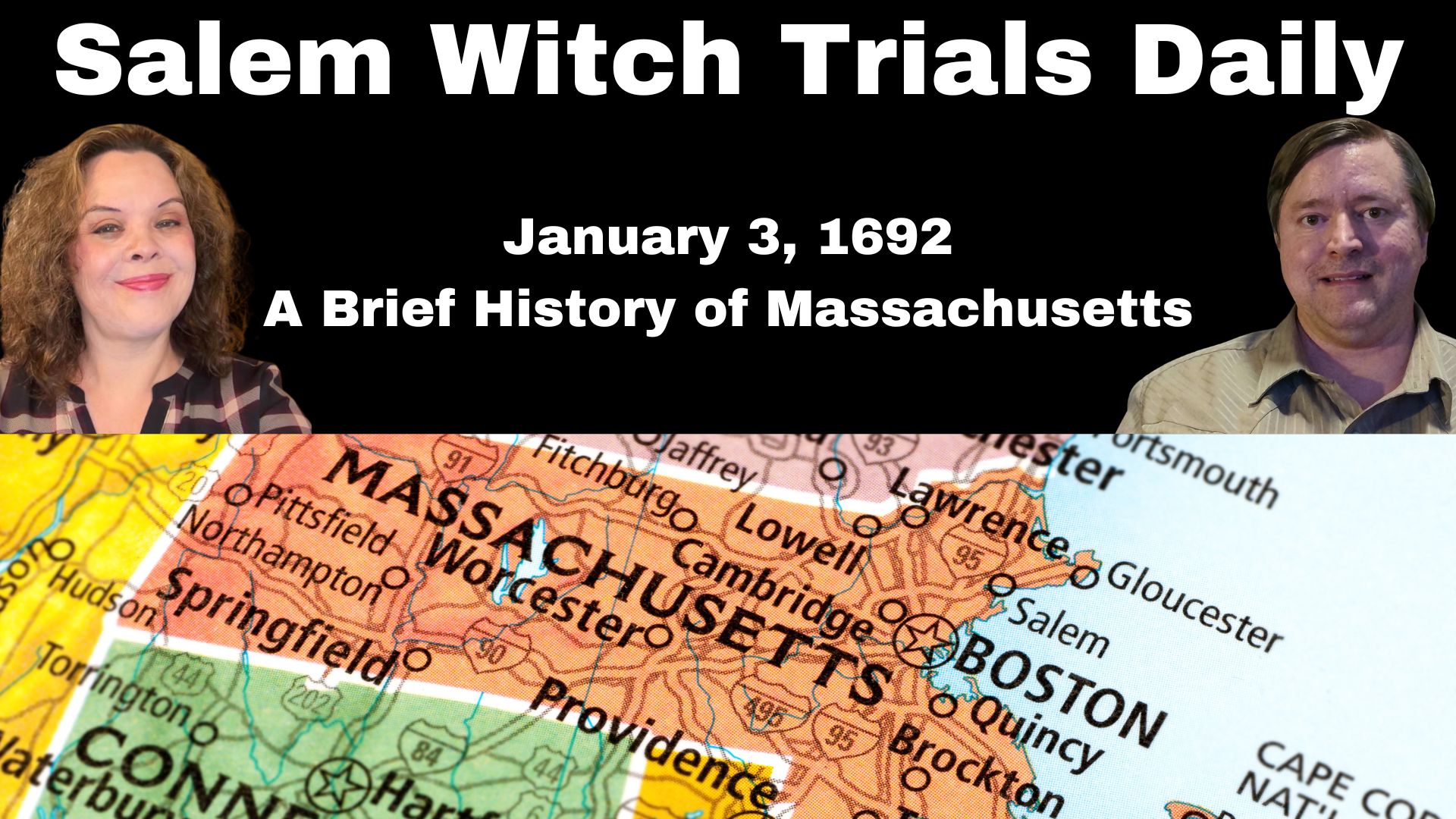
  • A Brief History of Massachusetts – January 3, 1692

    A Brief History of Massachusetts – January 3, 1692

    Watch Salem Witch Trials Daily

    Show Notes

    How did Massachusetts become what it was in 1692? We look into this question in today’s Salem Witch Trials Daily.

    We highlight the founding of Salem and Boston, the establishment of the Massachusetts Bay Colony, the colony’s first legal code, and more.

    Keep coming back every day as we continue to explore the witch trials and their context throughout the year.

    Links

    Select Salem Witch Trials Books:

    Transcript

    January 3 - The History of Massachusetts
    Josh Hutchinson: Salem, the Massachusetts Bay Colony's first city, celebrates its 400th anniversary this year, and this focus on the history of the city has us thinking, what about the history of the colony? How did Massachusetts become what it was in 1692? Welcome to Salem Witch Trials Daily for January 3rd. I'm Josh Hutchinson.
    Sarah Jack: I am Sarah Jack.
    Sarah Jack: For 10,000 years or more before the Europeans came, Massachusetts was occupied by Native Americans. In the 16th century, the Europeans came to New England to fish and to trap game where those Native Americans were living. A series of epidemics decimated the native population, especially along the coast where contact with the exotic, disease-carrying Europeans was very common.
    Sarah Jack: Then in the [00:01:00] 17th century, English colonists tried to start settlements in several locations. These ventures failed until 1620 when the Mayflower pilgrims landed at Plymouth.
    Josh Hutchinson: They formed Plymouth Colony and then in 1626 on Cape Ann, Salem was founded by Roger Conant, who had established a fishing village at Naumkeag, the site of a previous Native American settlement. Naumkeag means fishing place.
    Sarah Jack: You can see a statue of this founder of Salem Roger Conant, right outside of the Salem Witch Museum. People often mistake it for the statue of a witch or a generic puritan. It's specifically Roger Conant. In 1628, Massachusetts was founded by the Massachusetts Bay Company. So, at this point in time you had the Plymouth Colony in the South and Massachusetts Bay [00:02:00] Colony to the north of that. In 1629, King Charles I issued a charter so that the Massachusetts Bay Colony could govern itself. The town of Boston was founded in 1630 and it was made the seat of the colonial government, authorized by that charter.
    Josh Hutchinson: Yes. This was when they moved the capitol away from Salem, where they initially set up camp. And then in the 1630s, there was an explosion of immigration to New England, as approximately 20,000 Europeans came over to settle the colonies. In 1641, the first New England legal code was set down. This was called the Massachusetts Body of Liberties, and it set out the rights of the residents of [00:03:00] Massachusetts. Then in 1648, this book and other laws were put together into The Book of the General Laws and Liberties Concerning the Inhabitants of Massachusetts.
    Sarah Jack: And it wasn't long. Before there were accused witches between 1648 and 1691, many people were indicted in Massachusetts on witchcraft charges. Eight were convicted, five were executed, and two women were jailed or placed under house arrest.
    Josh Hutchinson: The one man who was accused, his conviction got overturned and then he fled to Rhode Island with his daughter. That was Hugh Parsons of Springfield. In 1684, the cherished charter of Massachusetts Bay Colony was revoked by King James II, throwing the colony into some [00:04:00] disarray.
    Josh Hutchinson: Then two years later, King James II established the Dominion of New England, which was a supercolony that ran all the way from what's now New Jersey, up to Nova Scotia, and included all of the New England colonies and New York under one royally appointed Governor, Edmund Andros, who was a very unpopular figure in New England, because he was very harsh on Massachusetts, in the opinions of the leaders and residents. He got overthrown two years later. The Glorious Revolution happened in England. This is when King William and Queen Mary came from the Netherlands to take the throne away from King James II. And while that was happening there, once the colonists got word of it, several weeks later, they stormed the Capitol in Boston and arrested Edmond Andros and [00:05:00] sent him back to England.
    Sarah Jack: From that time, 1688 to 1692, Massachusetts was led by an interim government resulting in jail overcrowding as the colony lacked courts to try suspects.
    Josh Hutchinson: In 1691, Massachusetts finally got the charter it had been working for years to regain, but this new charter was controversial.It included clauses like Massachusetts had to be tolerant of other religious beliefs. In addition to Puritanism, they had to tolerate the Anglicans and the Baptists and the Quakers, who they did not tolerate at all before this. So they were very upset.
    Sarah Jack: him.
    Josh Hutchinson: They were persecute, they executed Quakers just for being Quakers.
    Josh Hutchinson: But finally this charter, it was issued by King William in October, and then it arrived in the colony of Massachusetts the following [00:06:00] February. So February to May, you still have this kind of quasi legal status, because the new governor, he doesn't arrive until the middle of May, after the jails were already packed with witchcraft suspects. This is just a little introduction to the history of Massachusetts. I know we didn't go into a lot of detail, but tomorrow you can come back and we're gonna dig into the founding of Salem.
    Sarah Jack: The Salem Witch Trials Daily is presented by The Thing About Salem and The Thing About Witch Hunts podcasts. Join us every Sunday and Wednesday for deeper explorations of the Witch trials of the past and the witchcraft persecution of today.