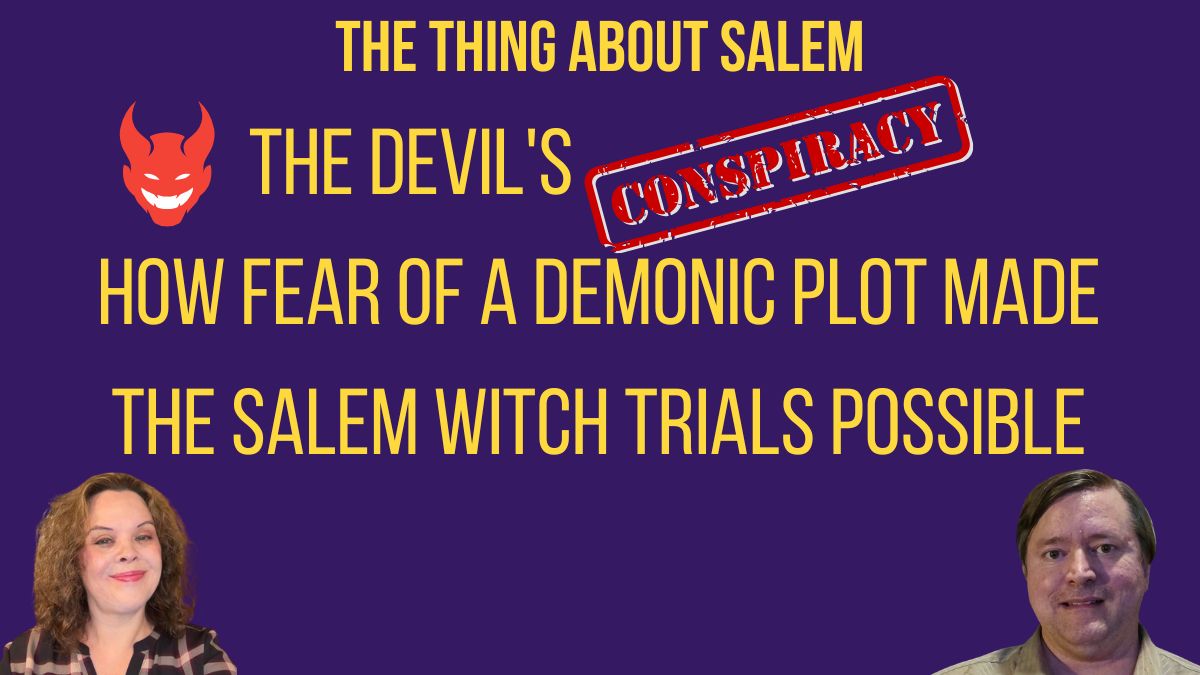
The Salem witch trials of 1692 were not driven by local grudges alone. Behind the arrests, examinations, and executions was a centuries-old theological framework that convinced educated elites, magistrates, and Puritan clergy that they were fighting a coordinated demonic war against the Christian church itself.
Josh Hutchinson and Sarah Jack trace the elaborated theory of witchcraft from its origins at the Council of Basel in the 1430s through the circulation of the Errores Gazariorum, the standardization of the witches’ Sabbath concept, and the mass distribution of the Malleus Maleficarum following the invention of the printing press. By the late 17th century, this framework had transformed witchcraft from a personal crime of harmful magic into an existential conspiracy — witches organized under the devil, sworn to pull down the kingdom of Christ and replace it with a kingdom of Satan.
In Salem, that theory played out in real time. Tituba’s confession named nine witches in the devil’s book. That number grew to forty, then a hundred, then three hundred alleged conspirators gathering in Samuel Parris’s own pasture to consume red bread and blood wine in mockery of the Christian sacraments. Reverend George Burroughs was accused of leading the diabolical assembly. Coerced confessions described a formal pact to destroy the churches. Cotton Mather, in Wonders of the Invisible World, traced the conspiracy back more than forty years — to executions in Connecticut and Massachusetts that included Alice Young, Margaret Jones, and the Carringtons.
This episode examines how fear of an anti-church conspiracy — not panic, but deliberate legal prosecution rooted in genuine theological terror — drove the witchcraft crisis and what that pattern of fear-driven scapegoating reveals about witchcraft accusation violence today.
Josh Hutchinson and Sarah Jack are co-hosts of The Thing About Salem, The Thing About Witch Hunts, and Salem Witch Trials Daily. Both are descendants of families who experienced the Salem witch trials.
The Salem Witch Trials of 1692 didn’t emerge from nowhere. They emerged from a library. This episode traces the centuries of theological and legal texts that shaped how Salem’s magistrates understood witchcraft, the demonic pact, and the infamous Devil’s book.
From a 15th-century inquisitor’s manual to a Scottish king’s royal obsession to a Boston minister’s bestseller, Josh and Sarah open the books that made Salem possible.
Books and Sources Covered
Malleus Maleficarum (1486) — Heinrich Kramer’s foundational witch-hunting manual codified the idea of a vast anti-Christian conspiracy sealed by a formal pact with the devil. It provided the theological and legal framework for prosecuting witchcraft across Europe for centuries.
Daemonologie (1597) — Written by King James VI of Scotland (later King James I of England), this royal text argued that witches entered the devil’s service through a pact alone. The king’s authority gave the work enormous cultural weight, and his framework for the devil’s covenant shaped New England Puritan thought directly.
A Discourse of the Damned Art of Witchcraft (1608) — William Perkins detailed the diabolical compact in legal terms, distinguishing between explicit verbal pacts and implicit ones inferred through action. He also established seven grounds for suspicion of witchcraft. During the Salem crisis, Cotton Mather specifically recommended judges follow the guidelines of Perkins and his successor Richard Bernard.
A Guide to Grand Jury-men (1627) — Richard Bernard’s practical manual for witch trial proceedings was among the texts Cotton Mather recommended to the Salem court.
The Discovery of Witches (1647) — Matthew Hopkins, the self-styled Witch Finder General, ran one of the most lethal witch-hunting campaigns in English history across East Anglia. His methods, his obsession with the witch’s mark, and the confessions he extracted helped cement the Devil’s book as a recognizable cultural image decades before Salem.
Hudibras (Samuel Butler, 17th century) — Butler’s satirical poem mocked Hopkins by portraying him as a secret witch himself, hanged for possessing the very Devil’s book he hunted. The satire is significant: it confirms the Devil’s book was already deeply embedded in the popular imagination.Memorable Providences Relating to Witchcrafts and Possessions (1689) — Cotton Mather’s account of the Goodwin children’s afflictions, attributed to an Irish woman named Goody Glover, circulated widely through New England. When Salem’s afflictions began in 1692, the symptoms closely mirrored the Goodwin case. Reverend Samuel Parris was in Boston during the Goodwin episode, meaning his household had direct familiarity with Mather’s template.
The Devil’s Book at Salem: First Appearances
By the time formal accusations began in 1692, the Devil’s book was already a recognized legal and theological concept. Its appearance in Salem testimony followed quickly:
February 27, 1692 — Ann Putnam Jr. claimed Sarah Good’s specter tormented her and pressured her to sign the Devil’s book. This is the first accusation involving the Devil’s book in the Salem crisis.
February 27, 1692 — Elizabeth Hubbard named Sarah Good and Sarah Osborne as tormenters, alleging Osborne’s specter urged her to write in the book.
March 2, 1692 — Tituba confessed to making her mark in the Devil’s book with blood and stated the book was already signed by nine witches, including Sarah Good and Sarah Osborne. Seven signers remained unidentified, located in Roxbury, Salem, and Boston.
March 14, 1692 — Abigail Williams claimed she was tempted to put her hand to the Devil’s book and saw Martha Corey at a Devil’s Sacrament. Mercy Lewis reported similar pressure to sign.
Notably, the physical description of the Devil’s book changed throughout testimony, varying in color, size, and material depending on the witness.
The Salem Witch Trials were the product of deliberate legal and theological machinery built over two centuries, not a sudden or unexplainable event
The concept of the demonic pact as formal contract was codified in print long before 1692
Cotton Mather’s 1689 work functioned as a near-immediate template for Salem’s afflictions
The Devil’s book served prosecutorial purposes by implying an organized conspiracy with many unnamed participants still at large
Sign the Petition
Five women were hanged in Boston between 1647 and 1688 and have never had their names cleared. Sign the petition at change.org/WitchTrials to support their exoneration.
About The Thing About Salem
The Thing About Salem offers bite-sized episodes exploring the Salem Witch Trials of 1692. Hosts Josh Hutchinson and Sarah Jack are descendants of witch trial victims and co-founders of End Witch Hunts, the only U.S. nonprofit dedicated to witchcraft accusation awareness.