Tag: salem witch trials daily

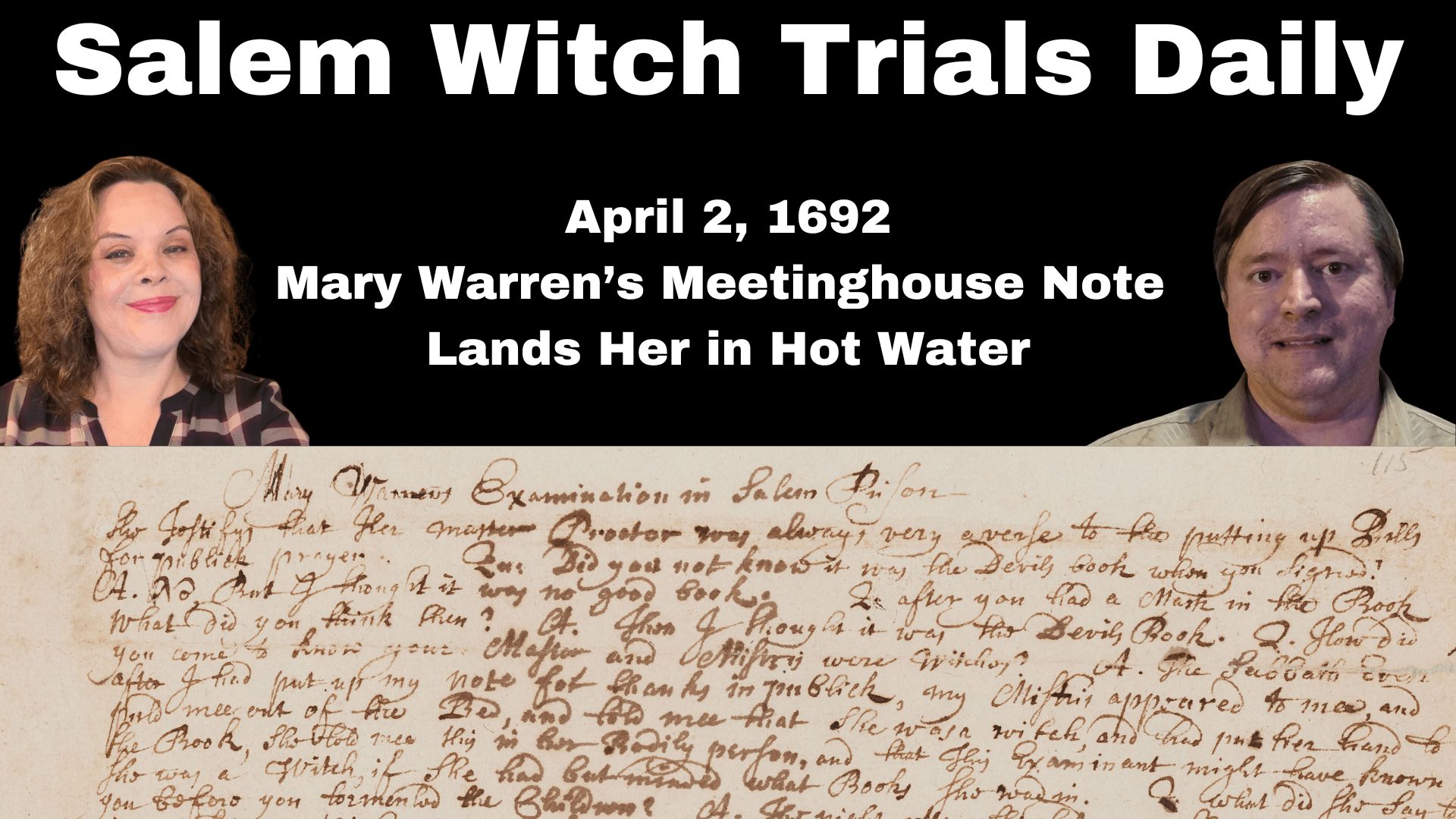
  • Mary Warren’s Meetinghouse Note Lands Her in Hot Water – Salem Witch Trials Daily – April 2, 1692

    Mary Warren’s Meetinghouse Note Lands Her in Hot Water – Salem Witch Trials Daily – April 2, 1692

    In this episode, we move beyond the fictionalized drama of Arthur Miller’s The Crucible to uncover the real Elizabeth Procter. Born into a family already shadowed by witchcraft accusations, Elizabeth faced the full weight of the 1692 panic. We trace her journey from a high-profile examination in front of the colony’s top officials to her harrowing months in prison.

    What You’ll Learn

    • The “Inheritance” of Suspicion: How Elizabeth’s grandmother, Ann Burt, influenced the community’s perception of her long before the trials began.
    • The High-Stakes Examination: Details of the April 11th hearing where Elizabeth stood her ground against the afflicted girls and the highest court in Massachusetts.
    • A Life-Saving Pregnancy: The legal reason Elizabeth survived the gallows while her husband, John, did not.
    • The Fight for Restitution: Elizabeth’s post-trial battle to reclaim her legal personhood and property after being declared “dead in the eyes of the law”.
    • Fact vs. Fiction: We debunk common myths regarding the Procter family’s ages and relationships that were popularized by 20th-century drama.

    Featured Quotes

    “I know nothing of it, no more than the child unborn.”


    Tune in to hear how one woman’s fierce determination allowed her to dismantle an unjust legal system and reclaim her life.

    Transcript

    Josh Hutchinson: Welcome to Salem Witch Trials Daily. I'm Josh Hutchinson.
    Sarah Jack: This is Sarah Jack. Today, Saturday, April 2, 1692. Elizabeth Procter and Rebecca Nurse's Spectors, allegedly afflict Abigail William's
    Josh Hutchinson: According to Abigail, this happened on several occasions in March and April. In testimony, accusers would often provide lists of dates like this when they had been attacked spectrally, just numbering the second, third, fourth, 17th of March, things like that. And this is one of the reasons why we go through the events day by day so that we understand what the daily life was like for those involved in the witch-hunt.
    Sarah Jack: Abigail describes these attacks saying she felt "grievously pinched" and "had also her bowels almost pulled out."
    Josh Hutchinson: The Elizabeth [00:01:00] Procter specter reportedly tempted Abigail with fine things in exchange for signing a book.
    Sarah Jack: Elsewhere in Salem Village, Mary Warren, who worked for the Proctors, had recovered from her affliction and now put a note at the meetinghouse asking for prayers of gratitude for her recovery.
    Josh Hutchinson: Stay tuned this month for the aftermath of Mary pinning this note. There will be serious drama.
    Sarah Jack: In the immediate wake of the note posting, according to Mary's later testimony, Elizabeth Procter appeared to Mary that night, pulled her out of bed and confessed that she was a witch and had signed the book.
    Josh Hutchinson: Mary said that quote, she told me this in her bodily person. This means that it wasn't Elizabeth's specter visiting her, it was Elizabeth herself.
    Sarah Jack: Occasionally, we see complaints referenced bodily attacks made by physical people, but as you'll see, [00:02:00] it is far more common to read of spectral assaults by the shapes of the witches.
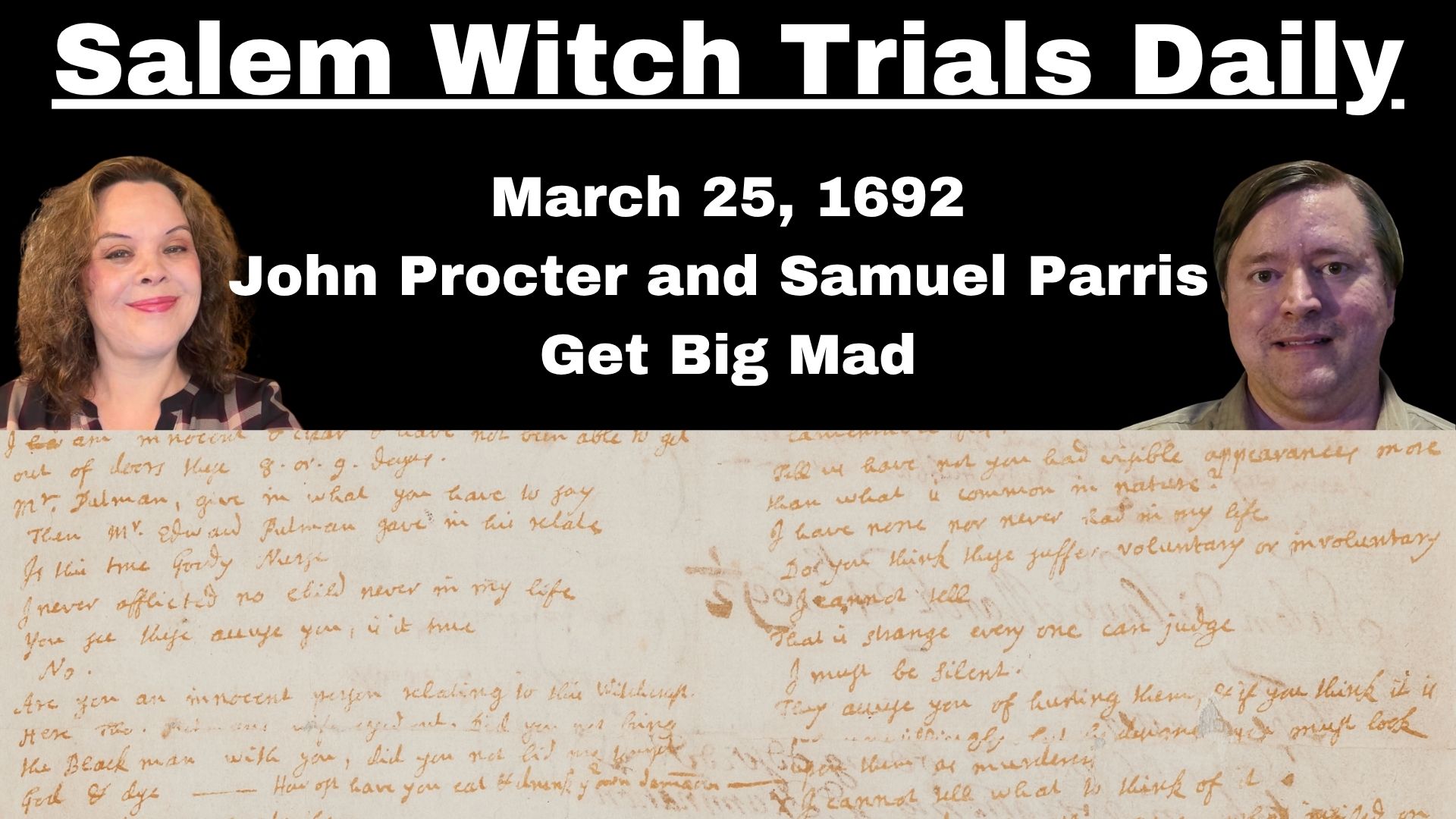
  • John Procter and Samuel Parris Get Big Mad: March 25, 1692

    John Procter and Samuel Parris Get Big Mad: March 25, 1692

    In this episode, we dig into Friday, March 25, 1692, as tensions surge in Salem Village and beyond. We discuss John Procter’s furious confrontation with Samuel Sibley at Walter Phillips’ Tavern over Mary Warren’s fits and his harsh skepticism toward the afflicted girls. Back in the village, we cover Ann Putnam Jr.’s reported violent spectral assault—attributed to Rebecca Nurse—with witnesses claiming visible bite marks and chain impressions, alongside Edward Putnam’s deposition against Nurse. In Salem Town, we examine Betty Parris’s severe seizures at Captain Stephen Sewall’s home and her account of a dark figure offering temptation, as well as the advice that seemed to end her fits. We also explore Rev. Samuel Parris’s discovery of Mary Sibley’s role in the witch cake and the church repentance he orchestrated.

    Transcript

    March 25, 1692: John Procter and Samuel Parris Get Big Mad

    Josh Hutchinson: Welcome to Salem Witch Trials Daily. I'm Josh Hutchinson.
    Sarah Jack: This is Sarah Jack. Today, we are diving deep into the events of Friday, March 25th, 1692. It's a day packed with terrifying spectral attacks, shocking physical evidence, and bubbling frustrations among the villagers.
    Josh Hutchinson: The day begins with some serious tension outside the village. Over at Walter Phillips' Tavern, right by the Cow House River, John Procter was on his way to Salem Village when he ran into Samuel Sibley. Procter asked how things were going at the village, and Sibley had grim news. Things were very bad last night.
    Sarah Jack: Is this Mary Sibley's husband?
    Josh Hutchinson: Yeah.
    Sarah Jack: Witch cake husband.
    Josh Hutchinson: Witch cake husband.
    Sarah Jack: And this directly impacted Procter, because his own maid, Mary Warren, was among those having fits. She had actually stayed [00:01:00] overnight in the village after attending court. Procter was absolutely furious. He rudely declared that he was going to "fetch the jade" and that he would have "rather paid 40 pence than let her go in the first place."
    Josh Hutchinson: Sibley was a bit surprised by this reaction, considering Mary was a witness, but Procter was having none of it. He warned that if the afflicted girls were allowed to continue their behavior, "we should all be devils in witches quickly." In his mind, the girls didn't need a court. He said they should rather be had to the whipping post.
    Sarah Jack: His anger didn't stop there. John Procter viciously fumed about the afflicted shouting, "hang them! Hang them!" He told Sibley his plan was to bring his maid home and literally thresh the devil out of her. He even bragged that when Mary's Fitz had first started, he kept her busy at the spitting wheel and threatened to beat her if she tried having fits again, which worked perfectly until he had to leave for a day.[00:02:00]
    Josh Hutchinson: It's a stark reminder that not everyone in the area was buying into the girls' claims, and some were becoming dangerously fed up. But while Procter was voicing his skepticism, things were getting violently physical back in Salem Village around 2:00 PM.
    Sarah Jack: The young Ann Putnam Jr. was allegedly attacked by a specter, but this wasn't just a invisible pinching or biting. The apparition of Rebecca Nurse supposedly lashed Ann with a chain. She was struck six times within half an hour.
    Josh Hutchinson: Her uncle, Edward Putnam, along with others witnessed actual bite marks and the physical impressions of chain links on the young girl's flesh. We also know that on this very day, Edward Putnam was formally deposed against Rebecca Nurse.
    Sarah Jack: Let's shift our focus away from the village and look at Salem Town. Betty Parris, the young daughter of Reverend Parris, was staying at the home of Captain Stephen Sewall. She was having [00:03:00] seizures so terrible that the Sewalls actually feared she was going to die.
    Josh Hutchinson: When she recovered enough from her fits to speak, Betty described being terrorized by the apparition of a great black man or a menacing dark shape. This entity was trying to bargain with her. He promised her that if she would be ruled by him, she could have absolutely anything she desired, and he would even take her to a golden city.
    Sarah Jack: Is this the first time we've heard Betty recount what she was experiencing directly?
    Josh Hutchinson: Yeah, this is the first we've heard from Betty. She hasn't done depositions. She had been in court early on, but we don't have any record of her saying anything in court.
    Sarah Jack: Yeah, This is a classic depiction of demonic temptation,but
    Sarah Jack: Minister Deodat Lawson reports that Mrs. Sewall stepped in with what he considered powerful advice. He said she explained to [00:04:00] Betty that that figure was the devil, that he was a liar from the beginning, and that Betty should tell him that exactly if he ever came back.
    Josh Hutchinson: This apparently worked, because we don't hear about Betty having fits again and she's not involved anymore in the trials or giving any testimony.
    Sarah Jack: I think it's interesting. If this is how it unfolded, here's Betty being given a defense instead of just panic. Oh, here's something in your tool belt you can use against the devil. Not just, oh, no, the devil's been here. You're harmed. I don't know.
    Josh Hutchinson: She basically banishes this, you know, probably, you know, imagined figure that she's seeing. She's able to tell it off and eventually it apparently goes away, 'cause she's not involved. But the real reason that she gets better is she's [00:05:00] isolated from the other afflicted people, so she's not influenced by them, and she doesn't feel like she has to conform to that group's behavior anymore.
    Josh Hutchinson: Back in Salem Village, Reverend Samuel Parris on this day finally uncovers who's responsible for the witch cake that was baked, the countermagic witch cake to identify the witch harming Betty and Abigail. He discovered it was Mary Sibley who was behind it, who's Samuel Sibley's wife, so we talked about him earlier, and now she's involved on March 25th as well. Parris brought her into his study and lectured her extensively, apparently, according to what he, he wrote in his own church record book. He rebuked her for her grand error of using diabolical means to find out the devil. [00:06:00] In Parris's eyes, even though his girls had been sick before, it was this witch cake charm that truly let all hell break loose in the community.
    Sarah Jack: Parris records that he drafted a paper describing the entire witch cake incident, the terrible effects it had, and her repentance.
    Sarah Jack: Yeah, so this document that Parris drafts, it's Mary Sibley's apology. He's the one writing it on her behalf, and he wants her to agree to it. So he gives her that opportunity. She cries, but she says yes, you can censure me in church, because that's what this is all about. He wants to publicly rebuke her behavior as a warning to the rest of his church that you don't play with the devil, because you're tempting him to come into the community and harm people.
  • Week 9: The Evil Hand and the First Accusations

    February 23 – March 1, 1692


    By the time three women were arrested at the end of this week, on March 1st, 1692, nearly everything that would define the Salem witch trials was already in motion. The legal framework existed. The theology was settled. The community had been primed by weeks of unexplained suffering and a physician who ran out of answers. What the examinations of Sarah Good, Sarah Osborne, and Tituba did was confirm what Salem Village had already decided to believe.

    This is the week that turned a household crisis into a hunt.

    February 23, 1692: Before Salem — Boston’s Forgotten Victims

    Massachusetts Bill H.5154, which would exonerate people accused of witchcraft in Boston and elsewhere around the Commonwealth, is now in the House Ways and Means Committee. The momentum is real, and the February 23rd episode makes the historical case for why it matters.

    Salem 1692 has long been treated as a beginning. It was not. Massachusetts had been executing people for witchcraft since 1648, a full forty-four years before the first Salem arrest. The fears, the evidence, the methods were already established in Boston before they exploded in Salem. You cannot understand Salem without understanding what came before it.

    The week opens not in Salem Village but in London, where Increase and Samuel Mather were entertained by a woman who told them her dead son’s ghost had visited her two weeks after his burial. Increase Mather recorded it carefully. He knew that ghosts could be devils manipulating grieving people. He had the case of Alice Lake in mind, a woman convicted of witchcraft in Boston around 1650, reportedly visited by the devil in the guise of her dead son who tempted her to witchcraft. Nathaniel Mather had written to Increase about that very incident in 1684.

    The first person executed for witchcraft in Massachusetts was Margaret Jones, a healer from Charlestown, hanged June 15th, 1648. She was accused after a quarrel with neighbors led to mischief befalling their livestock. Guards watched her using methods popularized by English Witchfinder General Matthew Hopkins and claimed to see a small child run from her. A neighbor, Alice Stratton, tried to defend her and was subsequently accused herself. Governor John Winthrop recorded in his journal that a great tempest struck Connecticut the very hour Jones was hanged.

    Just a few years later, in 1651, Elizabeth Kendall was convicted. She was accused by a nurse from Watertown of bewitching a child to death. Kendall was hanged despite maintaining her innocence. After her execution, it was revealed the child’s own parents did not suspect Kendall at all. They blamed the nurse for leaving the baby in the cold.

    A mother of four from Dorchester, Alice Lake, denied being a witch when accused around 1650, but confessed to having concealed a pregnancy in her youth. She believed she deserved death for that earlier sin, even while maintaining her innocence of witchcraft. Anne Hibbens was hanged in 1656, the widow of a wealthy Boston merchant and magistrate, her troubles rooted in a dispute over work done on her home by carpenters. She was executed, never having confessed. Minister John Norton later remarked that she was hanged for a witch only for having more wit than her neighbors.

    Then there was Goody Glover in 1688. An Irish Catholic laundress and Gaelic speaker, Goody Glover was accused after an argument with the Goodwin family over stolen laundry. When the Goodwin children suffered convulsions and fits, Glover was arrested. She was hanged November 16th, 1688, just four years before Salem. Cotton Mather wrote the primary account of her case in Memorable Providences and noted that he required an interpreter because she spoke Gaelic. Her execution directly shaped his thinking about witchcraft, thinking he brought with him to Salem.

    Three others were convicted but not executed. Hugh Parsons was a brickmaker from Springfield at the center of a witch panic that gripped the entire town. His wife Mary accused him of witchcraft and confessed to killing their child. Mary died in prison. Hugh was convicted, but the General Court overturned the verdict and he moved to Rhode Island. Eunice Cole faced accusations repeatedly from 1656 to 1680, was convicted at least once, whipped and jailed, and appears to have been imprisoned more than once. A New Hampshire exoneration effort for Cole in 2022 passed from committee through the house but failed in the Senate. Elizabeth Morse was convicted in 1680 and allowed to live under house arrest. Increase Mather included her case in An Essay for the Recording of Illustrious Providences.

    More than two hundred people were formally charged with witchcraft in Massachusetts between 1648 and 1693. Massachusetts has already amended a 1957 resolve twice, in 2001 and again in 2022, to fully exonerate Salem’s convicted. This bill will clear the names of those overlooked in the Boston trials.

    To help: sign the petition at change.org/witchtrials, contact your Massachusetts representative and senator, and share the episode.

    February 24, 1692: Under an Evil Hand

    Something had been wrong in the Parris household since January. Betty Parris, nine years old, and her eleven-year-old cousin Abigail Williams had begun behaving in ways no one could explain. They barked like dogs, quacked like chickens, made sounds like sheep, hid beneath tables, and alarmed their family by moving toward the hearths and wells in the house. The household turned to prayer, fasting, and medicine. Nothing worked.

    Around February 24th, a local physician widely believed to be Dr. William Griggs was called in to examine the girls. Minister John Hale later recorded what he found, or more precisely, what he did not find: at length, one physician gave his opinion that they were under an evil hand. No natural medical explanation. No diagnosis a physician could treat. Just two words that redirected an entire community from medicine to law.

    Hale was not alone in documenting what observers saw. His account described physical torments that defied ordinary explanation: these children were bitten and pinched by invisible agents. Their arms, necks, and backs turned this way and that way, and returned back again. So as it was impossible for them to do of themselves and beyond the power of any epileptic fits or natural disease to effect. Sometimes they were taken dumb, their mouths stopped, their throats choked, their limbs wracked and tormented so as might move a heart of stone to sympathize with them, with bowels of compassion for them.

    Minister Deodat Lawson, who would soon travel to Salem Village to witness the afflictions for himself, later recorded his own observations. The girls’ motions in their fits, he wrote, were preternatural, both as to the manner, which is so strange as a well person could not screw their body into and as to the violence also, it is preternatural being much beyond the ordinary force of the same person when they’re in their right mind. He also observed: the eyes of some of them in their fits are exceeding fast closed, and if you ask a question, they can give no answer, and I do believe they cannot hear at that time, yet do they plainly converse with the appearances, as if they did discourse with real persons.

    “Evil hand” terminology indicated diabolical influence. The devil had entered Salem in some form, whether afflicting the girls directly or working through a witch acting as his earthly agent. Hale recorded the community’s response with economy: the neighbors quickly took up and concluded they were bewitched. The diagnosis immediately shifted attention from medicine to the question of responsibility. Who was doing this?

    February 25, 1692: The Witch Cake

    While Reverend Parris and his wife were away attending a lecture, their neighbor and church member Mary Sibley decided to try and help. She went to Tituba and John Indian, the enslaved servants of the Parris household, and instructed them to bake a witch cake. According to historian Marilynne K. Roach, this happened on February 25th.

    The cake was not meant to be a treat but a tool of sympathetic counter magic. Tituba and John gathered rye flour and mixed it with the urine of the afflicted girls, baking the concoction in the ashes of the fireplace. In seventeenth-century folk belief, this practice relied on the idea that the witch had a sympathetic connection to her victims, and that her dark magic or effluvia remained inside the girls’ bodily fluids. By taking that urine, binding it into a cake, and feeding it to the family dog, the colonists believed they could manipulate the spell. Theories varied: some believed the dog chewing the cake would physically harm the witch and force her to cry out; others thought it would break the spell; some believed it might transfer the bewitchment to the dog itself.

    The folk magic did not cure the girls. Instead, it seemingly opened the floodgates for the Salem witch trials. The girls soon began naming their alleged tormenters. When Parris discovered this folk magic had happened while he was away, he was furious. In the Puritan worldview, utilizing folk magic was a sin, effectively going to the devil for help against the devil. Parris confronted Mary Sibley privately, then publicly reprimanded her before the congregation. His official stance: the devil hath been raised amongst us, and his rage is vehement and terrible.

    February 26, 1692: The First Witchcraft Accusation

    Sometime between February 26th and the end of the month, a group of neighboring ministers and gentlemen from Salem called upon Parris at the parsonage. The town of Beverly minister John Hale later reported that the visitors observed Betty and Abigail’s afflictions firsthand and concluded that the hand of Satan was involved. They were not prepared, however, to act on that conclusion. Parris should sit still and wait upon the providence of God to see what time might discover.

    Hale wrote that the men interviewed Tituba, who confessed to being involved in the witch cake affair. She told them her mistress in her own country was a witch and had taught her some means to be used for the discovery of a witch and for the prevention of being bewitched. She never said which country, so we do not know. Tituba said she herself was not a witch.

    On February 26th, the finger pointing began in the Parris household. Betty and Abigail named Tituba as the source of their afflictions. Elizabeth Hubbard and Ann Putnam Jr. later testified they had been afflicted by Tituba since the 25th of February, a day before anyone called her a witch out loud. After six weeks of sickness in the Salem Village parsonage, the first witch accusation had been leveled.

    February 27, 1692: The First Devil’s Book Accusation

    The devil’s book had been part of the theological imagination for two centuries before Ann Putnam Jr. claimed to have seen it. It appears in the Malleus Maleficarum, in King James I’s Demonology, and in the confessions extracted by English witchfinder Matthew Hopkins in 1640s East Anglia. By 1692, the mental image of a literal book carried spectrally from house to house and pressed into unwilling hands was as familiar to Salem’s ministers and magistrates as any passage of scripture. When it appeared in Salem, it arrived fully formed.

    On February 27th, Ann Putnam Jr. claimed that the specter of Sarah Good had grievously tortured her and vehemently attempted to get her to sign the Devil’s book. It was the first such accusation in the Salem crisis. In the Puritan worldview, the devil’s book was a collection of diabolical contracts. Individuals pledged their souls to Satan by signing their names or making a mark, often in their own blood or red ink. What struck observers then and historians since is how inconsistent the physical description of this book remained throughout the trials, constantly changing in color, shape, size, and material, depending on who was testifying.

    Elizabeth Hubbard also named both Sarah Good and Sarah Osborne as her tormentors and claimed she had been chased and frightened by a wolf while going to the Proctor’s home and tavern. Accusers believed the wolf was either Sarah Good shapeshifting into the animal, or a spectral beast that Good had specifically ordered to attack Hubbard.

    We know about this wolf incident because when Tituba was questioned on March 1st, Hathorne asked if Tituba had seen Good upon Hubbard, and Tituba replied: I did see her set a wolf upon her to afflict her. When the evidence against Good was later detailed, a note stated that Sarah Good appeared like a wolf to Hubbard going to Proctor’s.

    The concept of the devil’s book quickly escalated the witch hunt. During her March 1st examination, Tituba confessed to serving Satan and admitted she had made her mark in the devil’s book. Crucially, she testified that she saw nine names already written inside it. That detail confirmed fears of a widespread satanic conspiracy and triggered a desperate hunt to find the remaining witches who had signed the book.

    February 28-29, 1692: Tituba’s Visions and the First Warrants

    Heavy rains fell on this Sabbath. Governor Bradstreet, aging and unable to travel in the weather, did not make it to the meeting. In Salem Village, Betty, Abigail, Ann, and Elizabeth continued to suffer. According to historian Marilynne K. Roach, on the 29th in the parsonage, Tituba was reported supposedly being visited by the devil and four witches who instructed her to hurt the children or else. At prayer time, the devil and Sarah Good appeared again, this time with animal familiars in the shape of birds, cats, and a dog. Tituba reported that one bird had a human head that turned into Sarah Osborne and that Good and Osborne purportedly put Tituba on a pole and flew her to Thomas Putnam’s house, where they told her to kill Ann Putnam Jr. with a knife. In her story, Tituba described how when she refused to harm Ann, the witch specters told her they would cut her head off.

    Now Joseph Hutchinson, Thomas Preston, Thomas Putnam, and Edward Putnam filed a complaint against Tituba, Sarah Good, and Sarah Osborne, alleging they had afflicted Betty Parris, Abigail Williams, Ann Putnam Jr., and Elizabeth Hubbard. Salem magistrates issued warrants. The three women were to be brought to Ingersoll’s Tavern the following morning for their preliminary examinations.

    March 1, 1692: The First Salem Witch Examinations

    Constable George Locker arrested Sarah Good and Constable Joseph Herrick arrested Sarah Osborne and Tituba. Before questioning began, Hannah Ingersoll, wife of the local tavernkeeper, inspected all three for witches’ marks and found none. William Good then reported that his wife had a possible witches’ mark below her right shoulder.

    The crowd that gathered was too large for Ingersoll’s Ordinary. The examinations moved to the Salem Village meetinghouse. Magistrates John Hathorne and Jonathan Corwin presided. Ezekiel Cheever, son of Boston’s schoolmaster, was appointed to record the proceedings. Joseph Putnam kept his own account. What followed ran less like a legal proceeding than an interrogation, with Hathorne driving every question.

    Sarah Good was the first to be examined. Hathorne began with a series of leading questions. What evil spirit have you familiarity with? None, she said. Have you made no contract with the devil? No. Why do you hurt these children? I do not hurt them. I scorn it. Later, Hathorne asked why she went away muttering from Mr. Parris’s house. I did not mutter, but I thanked him for what he gave my child, she replied. Under pressure to name who was doing the hurting if not her, Good blamed Sarah Osborne.

    Hathorne asked Sarah Good’s husband William why he said his wife was a witch or would be one very quickly. William replied: she is not in this nature, but is her bad carriage to me. And indeed, I may say with tears that she is an enemy to all good.

    Osborne was interrogated with a similar line of questions. What evil spirit have you familiarity with? None. Have you made no contract with the devil? No, I never saw the devil in my life. Why do you hurt these children? I do not hurt them. Who do you employ then to hurt them? I employ nobody. When Hathorne told Osborne that Sarah Good had said it was she who hurt the children, Osborne replied: I do not know that the devil goes about in my likeness to do any hurt. That answer went to the heart of a debate that would run through the entire Salem crisis — whether the devil could assume the shape of an innocent person without their consent, and what that meant for the reliability of the testimony being heard.

    When it was Tituba’s turn, Hathorne pressed her directly. What evil spirit have you familiarity with? None. Why do you hurt these children? I do not hurt them. Who is it then? The devil for ought I know. Did you never see the devil? The devil came to me and did bid me serve him.

    Who have you seen? Four women, and sometimes they hurt the children. Who were they? Goody Osborne and Sarah Good, and I do not know who the others were. Sarah Good and Osborne would have me hurt the children, but I would not. I did also see a tall man of Boston. When did you see them? Last night at Boston. And did you hurt them? No, there is four women and one man. They hurt the children and then lay all upon me, and they tell me if I will not hurt the children, they will hurt me.

    Tituba’s claim that multiple witches were operating in Massachusetts, not only in Salem but also in Boston, was an alarming allegation. She then admitted that she had hurt the children, but only under the threat that she would be hurt even worse if she did not comply.

    The questioning continued. A man came to me and said, serve me. What service? Hurt the children, and last night there was an appearance that said, kill the children, and if I would not go on hurting the children they would do worse to me. What is this appearance you see? Sometimes it is like a hog and sometimes like a great dog. This appearance I did see four times. It is the black dog that said serve me, but she told him she was afraid. He said if she did not comply, he would do worse. I’ll serve you no longer, she said. Then he looked like a man and threatened her. This man had a yellow bird that he kept with him, and told her he had more pretty things that he would give her if she would serve him.

    Did you not pinch Elizabeth Hubbard this morning? The man brought her to me and made me pinch her. Why did you go to Thomas Putnam’s last night and hurt his child? They pull and haul me and make me go. How did you go? We ride upon sticks and are there presently. Why did you not tell your master? I was afraid. They said they would cut off my head if I told.

    Hathorne questioned Tituba about other creatures she had seen. She said she was visited by cats, a red one and a big black one the size of a small dog. Did the cats feed from her witches’ teats? No, never yet. I would not let them, but they had almost thrust me into the fire. What attendants hath Sarah Good? A yellow bird, and she would have given me one. It did suck her between her fingers. Goody Good and Goody Osborne told Tituba they had hurt magistrate Jonathan Corwin’s son and would have let her hurt him too, but she did not.

    Of Osborne, Tituba said she had a thing with a head like a woman with legs and wings, and another thing, hairy, going upright like a man with only two legs. Did you not see Sarah Good upon Elizabeth Hubbard last Saturday? I did see her set a wolf upon her to afflict her. What clothes does the man go in? He goes in black clothes, a tall man with white hair, I think. How do the women go? In a white hood and a black hood with a top knot. Do you see who it is that torments these children now? Yes, it is Goody Good. She hurts them in her own shape. Who is it that hurts them now? I am blind. I cannot see.

    After Tituba was questioned, she and Sarah Osborne were taken to Salem jail. Sarah Good, to be placed in Ipswich jail, spent the night under guard at the home of constable Joseph Herrick, who was distantly related to her.

    That same day, Salem Village residents held a meeting and appointed Captain John Putnam and Jonathan Putnam, his son, to send a petition to the General Court pressing for separation from Salem Town. The meeting also appointed Daniel Andrews to go to Salem Town and decline the town’s offer, which would have exempted villagers from maintaining town roads in exchange for the village maintaining its own poor.

    William Allen and John Hughes saw some sort of beast. When they approached, the beast transformed briefly into Tituba, Sarah Good, and Sarah Osborne, who quickly dematerialized. Elizabeth Hubbard reported that Good’s specter was afflicting her. With his cane, Samuel Sibley struck at the place where Elizabeth said the specter was, and she claimed that Sibley had nearly killed the supposed witch. Sarah Good escaped from her guards and cut her arm. Failing to get anywhere, she returned herself to custody.

    The Weekly Podcast: The Thing About Salem

    This week’s full-length Thing About Salem episode, How the Salem Witch Trials Began: The First Week of March 1692, extends the timeline from the final days of February through March 7, 1692. Josh and Sarah place the examinations in the broader context of everything that preceded them, tracing how the witch cake, the first complaints and warrants, and the dramatic proceedings of March 1 set a province on edge. The episode follows events day by day through March 7, including the examination testimony in detail, the devil’s book with nine signatures, and the spectral evidence debate that would shadow the entire crisis.

    Progress Tracker

    Salem Witch Trials Daily — Week 9 of 75 12% complete
    January 2026 May 2027
    Timeline milestone: February 23 – March 1, 1692. The first specific witchcraft accusation has been made. The first three suspects have been examined before a packed meetinghouse. Tituba has confessed and named nine conspirators. The Salem witch hunt is fully underway.

    Coming next week: The hunt for additional witches begins. New accusations multiply. The crisis that started in one parsonage begins to spread across the community.

    The bill to exonerate Boston’s forgotten witch trial victims is now in the House Ways and Means Committee.

    Sources and Links

  • Week 8 Blog: Salem Witch Trials Doctors, Families, Frontier, and the Fight to Survive (Feb. 16-22, 1692)

    February 16-22, 1692

    This week in Salem Witch Trials Daily covers a remarkable stretch of ground. Starting with the physicians who shaped colonial medicine and the diagnosis that set 1692 in motion, the week moves through the complex legacy of the Putnam family, the life and execution of John Proctor, the deep roots of frontier trauma in Maine and New Hampshire, and finally to the strategies the accused used simply to stay alive. Across seven days of content, one theme keeps returning: nothing about this crisis was simple, and very few people played only one role in it.


    February 16: Colonial Physicians and the “Evil Hand”

    On this date in 1692, physician William Griggs Sr. purchased a home and land in Salem Village for 71 pounds. He and his wife had already been living in Salem Village for at least two years before this purchase, having previously resided in Boston, Roxbury, and Rumney Marsh. Also in the household was his niece, Elizabeth Hubbard, who would become one of the central afflicted figures just days later, showing symptoms on February 25.

    Griggs is most remembered for what he did professionally in those first weeks of the crisis. It is widely believed that he was the physician who examined Betty Parris and Abigail Williams and declared them to be under an “evil hand.” That phrase was enormously consequential: it shifted the situation from a medical problem to a spiritual and legal one. It is worth noting, however, that the historical source behind this famous diagnosis does not actually name the physician. It remains possible that another Salem-area or Boston-area doctor made the determination.

    Governor John Winthrop of the Massachusetts Bay Colony was himself a physician. His son, John Winthrop Jr., was both a noted physician and an alchemist, and went on to serve as governor of Connecticut. His grandson, Waitstill Winthrop, also practiced medicine. In the Salem area specifically, the years just before 1692 saw the deaths of several practitioners: George Emery died in 1687, Daniel Weld in 1690, and the physician John Swinnerton also in 1690. Job Swinnerton Jr., John’s nephew, and his wife Esther were among the signers of the petition supporting Rebecca Nurse, showing that medical families were also embedded in village politics.

    One of the witch trial judges, Bartholomew Gedney, left behind sixty pounds worth of drugs and medicinal instruments at his death. He was mentioned during the trial of Martha Cory, who said that ointments found on her property came from Gedney’s recipe.

    Boston’s medical community also contributed a significant precedent. In 1688, Dr. Thomas Oakes diagnosed the Goodwin children of Boston, concluding, as Cotton Mather recorded in “Memorable Providences,” that nothing but “hellish witchcraft” could explain their symptoms. That case led to the trial and execution of Goody Glover, and it established a pattern of diagnosis that would echo through to 1692.

    Among the most striking windows into colonial medicine is the surviving remedy collection of Salem physician Zerubabel Endicott, who died in 1684. His prescriptions reflect the limits of medical knowledge in his era. For bloody flux, he recommended dried stone horse liver, baked in an oven used for bread and then powdered and administered by the spoonful in milk. For difficult childbirth, the prescription required a lock of virgin’s hair, specifically from a virgin half the age of the woman in labor, ground into a fine powder and combined with twelve ant’s eggs that had been dried in an oven after the bread was removed. This mixture was to be served in a quarter pint of red cow’s milk, with strong ale wort as a substitute if needed. These remedies were not seen as unusual for their time. When treatments like these failed, reaching toward supernatural explanations was not a great leap.


    February 17: The Putnam Family, a Complicated Legacy

    The Putnam family was one of the largest and most influential in Salem Village. Their name looms over the 1692 crisis, and it is tempting to reduce them to the role of villains. The historical record does not support that simplification.

    The family’s Massachusetts origins trace to John Putnam and Priscilla Gould, who were in Salem by 1641. Three of their sons established branches of the family that figure prominently in the trial record: Thomas, Nathaniel, and John Sr.

    Captain John Putnam Sr. and his wife Rebecca testified against George Burroughs, offering accounts of his family life from a time when he had lived with them. They also signed the petition in support of Rebecca Nurse. Their son Jonathan likewise testified against several people while signing the same Rebecca Nurse petition.

    Lieutenant Nathaniel Putnam testified against Sarah Buckley, Elizabeth Fosdick, Elizabeth Payne, and John Willard, yet he too signed the Rebecca Nurse character petition. His wife, Elizabeth Hutchinson, was the sister of Joseph Hutchinson Sr., who donated the land for the Salem Village meetinghouse. Nathaniel’s son Benjamin signed the Rebecca Nurse petition, and after the trials ended, Benjamin took in Dorothy Good, the young daughter of Sarah Good. When Benjamin died in 1715, his son Nathaniel, named after his grandfather, took Dorothy Good’s daughter, Dorothy Jr., in as an indentured domestic servant.

    The branch of the family that most shaped the crisis descended from Lieutenant Thomas Putnam, who died in 1686 and did not live to see the trials. His son Sergeant Thomas Putnam swore out complaints against thirty-five people, testified against seventeen, and recorded one hundred and twenty depositions, many of them from his own wife, daughter, and niece. Three women in his household were among the afflicted: his wife Ann Carr Putnam, his daughter Ann Putnam Jr., and their servant Mercy Lewis.

    Ann Putnam Jr. was the first person outside the minister’s household to show affliction symptoms. She was a persistent presence in the courtroom throughout 1692. In 1706, when she sought membership in the Salem Village Church, Minister Joseph Green read a public apology on her behalf while she stood beside him. She is the only accuser known to have offered a public apology for her role in the trials.

    Thomas’s sister Sarah signed the Rebecca Nurse petition. Another sister, Deliverance, married Jonathan Walcott and became stepmother to the afflicted girl Mary Walcott.

    Joseph Putnam, the half-brother of Sergeant Thomas and the son of Lieutenant Thomas Putnam’s second wife, Mary Veren, opposed the trials. An inheritance dispute had created friction between Joseph and the rest of the family: Joseph had inherited more than Sergeant Thomas believed was fair. According to tradition, Joseph kept a horse saddled at all times during the trials in case he or his wife needed to flee. He married Elizabeth Porter, connecting him to another of Salem Village’s prominent families. Joseph’s son Israel Putnam became a general in the Revolutionary War and was appointed major general by George Washington.

    The Putnam record shows a family divided: some members were among the most active accusers in 1692, while others signed defenses, opposed the proceedings outright, or later showed care for the survivors.


    February 18: John Proctor in the Salem Witch Trials

    On August 19, 1692, John Proctor was scheduled to be executed. That morning, he asked Reverend Nicholas Noyes to pray with him. Noyes refused, because Proctor would not confess to witchcraft. Proctor went to his death without a final prayer.

    John Proctor was born in England around 1632 and came to Massachusetts with his parents, settling in Ipswich. He married three times: first to Martha White or Jackson around 1652, then to Elizabeth Thorndike in 1662, and finally to Elizabeth Bassett in 1674. By 1692, he was approximately sixty years old. In 1666, he had rented a large property in Salem Farms, in what is now Peabody, outside the Salem Village parish line. The family attended worship in Salem Town rather than Salem Village.

    Historical records describe Proctor as a stern but not uncharitable man. He threatened to beat his servant Mary Warren to stop her fits, but he also forgave Giles Cory after Cory allegedly set fire to his house and stole his wood, eventually settling the matter over drinks.

    Elizabeth Proctor was John’s third wife and the granddaughter of Ann Burt of Lynn, who had herself been accused of witchcraft. That family association likely created vulnerability. In 1692, Elizabeth was accused by Ann Putnam Jr. and Mercy Lewis. At her examination on April 11, the afflicted girls claimed her specter was biting and choking them. Elizabeth’s response was recorded: “I take God in heaven to be my witness, and I know nothing of it, no more than the child unborn.”

    John attended the examination to support his wife. During the proceedings, the accusers turned on him, claiming his specter was attacking them. He was arrested on the spot, becoming the first male suspect taken into custody in the Salem crisis. His arrest grew directly from his decision to defend his wife, not from any romantic entanglement, a crucial distinction from Arthur Miller’s fictional account in “The Crucible.”

    While imprisoned, Proctor wrote to five leading ministers in Boston on July 23, 1692. In that letter, he argued that the trials were conducted unfairly and compared the magistrates to the Spanish Inquisition. He described the torture of Martha Carrier’s sons and of his own sons, who were tied neck and heels in an attempt to force confessions. Thirty-two neighbors signed a petition attesting to the Proctors’ Christian character, and another twenty signed a separate petition for the court.

    Both John and Elizabeth were convicted. John was hanged on August 19 alongside George Jacobs Sr., John Willard, Martha Carrier, and George Burroughs. Robert Calef recorded that Proctor conducted himself with dignity at the gallows, forgiving those who had acted against him.

    Elizabeth’s survival came down to biology and timing. She was pregnant, and the law would not execute an unborn child for the alleged crimes of its mother. She pleaded her belly, a stay of execution was granted, and she waited in prison while her husband was hanged. On January 27, 1693, she gave birth to a son named John in that same prison. A death warrant was eventually signed for her too, but Governor Phips issued a reprieve before it could be carried out. The trials had reached into every corner of the Proctor family: three of their children, Benjamin, Sarah, and William, had also been accused.

    Sheriff George Corwin seized the family’s goods, including food and cattle, leaving the children without resources. After the crisis, Elizabeth engaged in legal disputes with her stepchildren over the estate and had to petition to recover her dower rights. She remarried in 1699. The family’s attainder was reversed in 1711 and restitution was paid in 1712.

    Family tradition holds that John Proctor’s body, like others executed that day, was thrown into a crevice at Proctor’s Ledge, but that his family later recovered it and buried it on his farm.


    February 19: The Northern Frontier and the Salem Crisis

    On this date in 1692, Massachusetts sent Captain James Converse and Captain Enoch Greenleaf with soldiers to York, Maine, and dispatched Major Elisha Hutchinson to take command of colonial forces there. Three of the men who would later sit as judges on the Court of Oyer and Terminer, Waitstill Winthrop, William Stoughton, and Samuel Sewall, accompanied Hutchinson as far as the ferry out of Boston.

    The connection between the Maine frontier and the Salem crisis is not coincidental. Historian Mary Beth Norton and others have argued that the frontier war directly fed into the witch panic. Refugees fleeing violence in Maine poured south into Essex County, Massachusetts, bringing severe trauma with them.

    Sorry about that! Here’s the Mercy Lewis paragraph:

    Mercy Lewis carried Maine with her everywhere she went. Born around 1673 in Falmouth at Casco Bay, she had not just heard about the frontier raids, she had survived them, watching members of her family be killed in attacks that left her with nowhere safe to land. She eventually found work as a servant for George Burroughs in Maine, the same man who would later be dragged to Salem and hanged as the supposed ringleader of the witches. By 1692, she was living in Sergeant Thomas Putnam’s home alongside Ann Putnam Jr. and Ann Carr Putnam. All three were among the afflicted. 

    George Burroughs himself had deep ties to the frontier. He had served as a minister in Maine in the 1670s, then in Salem Village from 1680 to 1683, and returned to Falmouth until 1689. After the fall of Fort Loyal in 1690, he moved to Wells, Maine. In 1692, the accusers named him the ringleader of the witches, the organizing force above and behind all the others. He was apprehended in Wells and transported to Massachusetts, where he was tried and executed.

    Abigail Hobbs, a teenager from Topsfield, had also lived in Maine. When she was examined after her arrest in April 1692, she said she had met the devil at “the Eastward,” referring to  Main. She confessed to signing a covenant with the devil, spent nights in the woods, threatened to raise the dead, and spoke familiarly about “Old Nick” as her acquaintance, 

    Beyond the direct connections through individual people, the frontier shaped the psychological environment. Puritans understood the northern wilderness as enemy territory inhabited by military adversaries and the devil alike. The political instability of the era also played a role in New Hampshire, which had formally separated from Massachusetts to become a royal colony around 1679 and 1680. That period of uncertainty coincided with a cluster of witchcraft accusations in Hampton.

    New Hampshire’s witchcraft history included Jane Walford of Portsmouth, accused in 1648, who fought back by suing her accusers for slander and winning. Eunice Cole, known as Goody Cole, of Hampton was accused at least three times between the 1650s and 1680s. In 1938, the town of Hampton held a ceremony attended by approximately three thousand people to publicly rehabilitate her reputation. Participants burned copies of her court records, mixed the ashes with soil, and buried them in an urn.

    In 1682, George and Alice Walton in Great Island, New Hampshire, reported that their tavern was struck by flying stones for four straight months. This “stone throwing devil,” or lithobolia, emerged in the context of a long-running property dispute between the Waltons and their neighbor Hannah Jones. When the stones began, they accused her of witchcraft.


    February 20: Salem Figures with Ties to Falmouth

    Several people central to the 1692 crisis had lived in or near Falmouth, the settlement at Casco Bay that is now Portland, Maine.

    George Burroughs served as a minister in Maine in the 1670s, then in Salem Village from 1680 to 1683, and then in Falmouth again from 1683 to 1689. He survived multiple attacks by Wabanaki and French forces and relocated to Wells, Maine, months before Fort Loyal fell in May 1690. In 1692, he was accused of being not merely a witch but a conjurer and ringleader, above the rank of ordinary accused. He was taken from Wells and executed in Salem on August 19.

    Mercy Lewis was born around 1673 in Falmouth. Her grandparents, George Lewis and Ann Awards Lewis, had migrated from England to Maine in the mid-1640s. On August 11, 1676, Falmouth was attacked by Wabanaki and French forces. Both of Mercy’s grandparents were killed, two of her uncles were killed, two aunts were captured, and many cousins were killed or taken. Mercy, her parents, and her siblings escaped to an island in Casco Bay before making their way south to Massachusetts.

    On September 21, 1689, a second major attack struck Falmouth. Mercy’s parents are believed to have been killed then, as they do not appear in records afterward. Mercy survived and found shelter at Fort Loyal. The following spring, in 1690, the fort itself was attacked, and Mercy’s uncle Thomas Cloyce was killed. Thomas was the brother of Peter Cloyce, who was married to Sarah Towne Cloyce, one of the accused. Thomas’s wife was Susanna Lewis, Mercy’s father’s sister, meaning Mercy and Sarah Cloyce were connected through this family network.

    Abigail Hobbs, approximately fifteen years old at the time of her arrest in April 1692, had also lived at Casco Bay four years earlier. Her confession described meeting the devil in the Maine woods, first when a man came to her, and separately when a cat offered her a book to sign. She said she had also made a separate agreement with men who came to her, promising to serve them for two years. Witnesses described Abigail as disrespectful to her father and stepmother, both of whom were also arrested. Her stepmother also confessed to witchcraft.


    February 21: The Fall of Fort Loyal

    In May 1690, two years before the Salem crisis, a military disaster unfolded in Falmouth that sent shockwaves through New England and whose consequences followed into 1692.

    Boston’s colonial leadership had grown impatient with a defensive posture in King William’s War. Governor Bradstreet and the council were planning an offensive, including Sir William Phips’s expedition against Port Royal in Acadia, a public-private venture in which merchants and soldiers would share in captured wealth. While pursuing that plan, the council also sent two men north to assess conditions in Maine: John Hathorne and Jonathan Corwin, both of whom would later serve as magistrates in the Salem proceedings.

    When Hathorne and Corwin reached Maine in April 1690, they found the frontier defenses severely depleted. Some garrisons had no soldiers at all. At Falmouth, however, Captain Simon Willard commanded sixty men stationed at Fort Loyal. Hathorne and Corwin inspected the situation and reportedly encouraged the frontier settlers to be vigilant, but the council ultimately concluded that Willard’s soldiers were no longer needed there.

    On May 15, Willard marched his sixty men out of Fort Loyal following orders. At daybreak on May 16, a force of four hundred to five hundred Wabanaki and French soldiers attacked. Captain Sylvanus Davis recorded what followed: a five-day siege, during which the attackers burned all the houses, until the defenders were forced to negotiate. The French promised the English quarter and liberty to march to the nearest English town. After surrender, that agreement was broken. Davis reported that wounded captives were murdered, and only he and a few others were taken to Canada. Approximately two hundred people were lost.

    Historian Mary Beth Norton has argued that had Hathorne and Corwin strongly advocated for keeping Willard’s soldiers at Fort Loyal, the council likely would not have withdrawn them. The outcome was catastrophic.

    The settlements east of Wells were effectively abandoned. Refugees flooded into Portsmouth and surrounding areas. The news struck New England as calamitous: one contemporary wrote that God had come against them with a French axe accompanied by hatchets. Thomas Danforth told desperate Maine residents that if Jesus could not help them, he certainly could not. Meanwhile, in Boston, the grief was tempered by news that Phips’s raid on Port Royal had succeeded and that plunder was forthcoming.

    The same men who left the frontier defenseless in 1690, Hathorne, Corwin, Sewall, and Stoughton, would sit in judgment of the accused in 1692. The trauma they had helped create, and the survivors it had displaced, were already settling into Salem Village.


    February 22: How the Accused Tried to Survive

    Witchcraft in 1692 Massachusetts was a capital offense, and every person brought to trial before the Court of Oyer and Terminer was convicted: twenty-seven out of twenty-seven. At least twenty-five people died, nineteen by hanging, one by pressing, and five from the conditions of the jails. Even those who were acquitted, like Lydia Dustin, could die in a cell if they could not pay the fees required for release.

    Given those conditions, the accused and their families and communities developed strategies to stay alive.

    The most counterintuitive was confession. Of the fifty-five people who confessed to witchcraft in 1692, only one was executed, and that individual had recanted the confession before being hanged. Confession did not mean the charges were dropped; it moved confessors to the back of the trial queue. Eight confessors were ultimately condemned to die but were saved by a last-minute reprieve from Governor Phips. If the court had continued sitting past September 1692, those reprieves might never have come.

    Pregnancy provided another avenue. Both Elizabeth Proctor and Abigail Faulkner Sr. received stays of execution because they were pregnant. The law did not permit the execution of an unborn child for the alleged crimes of the mother. Elizabeth Proctor survived only because the court stopped sitting before her case was reopened after she gave birth.

    A spiritual route worked in the case of Dorcas Hoar. Four ministers petitioned Governor Phips on her behalf, requesting one month for her to prepare spiritually before execution. That request was filed one day before the final round of executions. During the month’s grace period, the governor disbanded the court, and Dorcas received a reprieve in January 1693.

    Some accused tried to deflect attention by accusing others. Allen Toothaker, whose father had died in jail and whose mother, sister, and cousins were imprisoned, accused his own aunt Martha Carrier of witchcraft. The historical record does not preserve his reasons, but the outcome was that he was not accused himself.

    Presenting as an afflicted person rather than an accused person was another approach. John Indian, whose wife Tituba was among the first arrested, had helped bake the witch cake that was one of the early attempts to identify the source of the afflictions. He subsequently began showing affliction symptoms himself. Mary Warren shifted sides twice: first afflicted, then briefly claiming the other girls were lying, then returning to the afflicted role after being accused herself. The charges against her were never pursued.

    Petitions and character witnesses offered another form of defense. Rebecca Nurse, John Proctor, and Mary Esty all had petitions submitted on their behalf, some signed by dozens of neighbors, ministers, or community leaders. Mary Esty wrote an eloquent plea to the court. None of these strategies, in the heat of 1692, was sufficient to prevent conviction at trial.

    The most effective approach proved to be fleeing. Author Marilynne K. Roach identified twenty-one individuals who escaped before, during, or after arrest. Losing property to confiscation was a real cost, but those who reached New York, where the governor was offering protection to refugees from the Salem proceedings, kept their lives. Since everyone who stood before the court was convicted, not being present was the most reliable path to survival.

    Timing mattered enormously. Those held past September 22, 1692, the date the court stopped sitting, were far more likely to survive. For many of the accused, it was not strategy or justice or evidence that determined their fate. It was whether the crisis ended before their case came to trial.


    Your Progress

    Week 8 of ~75 weeks | ~11% Complete | January 2026 – May 2027


    Sources for Week 8

    This Week’s Content

    Episode Show Notes and Links

    Primary and Reference Sources

    Secondary Sources

    Podcasts and Websites

  • Where Can I Learn More About the Salem Witch Trials?

    Where Can I Learn More About the Salem Witch Trials?

    Show Notes

    Salem Witch Trials Daily Course – How It Works | Day-by-Day History Education

    Description:

    Welcome to our YouTube channel! Discover a revolutionary way to learn about the Salem Witch Trials through our daily video series. This comprehensive course follows the actual 1692-1693 timeline, bringing you history as it happened day by day. In this informational episode, learn how our unique course structure works and see a sample daily lesson.

    Subscribe to our YouTube channel for daily videos throughout 2026-2027 as we follow the historical timeline!

    What You’ll Get on This Channel: ✅ Daily bite-sized video lessons (just a few minutes each) ✅ 75-week journey through the complete 1692-1693 timeline ✅ Watch on YouTube as we release them or binge full weeks ✅ Companion resources at AboutSalem.com

    Beyond YouTube: 📚 Weekly workbooks with activities and challenges 📝 Blog posts recapping each week’s content 🎙️ The Thing About Salem podcast 🏆 Achievement badges to track your progress

    Course Features: 📚 Researched from primary sources 📝 Fill-in-the-blank summaries and reflection questions ✍️ Citation practice and character journal prompts 📖 Vocabulary building and quote analysis 🎯 Four weekly challenges to grow your expertise ⏱️ Watch at your own pace as all YouTube videos remain available

    The Salem Witch Trials by the Numbers: • 156+ formal accusations • 30 convictions • 20 executions • Started January 1692 in Minister Samuel Parris’s household • Legal proceedings: February 1692 – May 1693

    Perfect for:

    • History students and educators
    • Homeschoolers seeking structured curriculum
    • History enthusiasts wanting deep knowledge
    • Descendants honoring family connections
    • Anyone interested in colonial American history

    👍 Like this video if you’re excited to learn about the Salem Witch Trials! 🔔 Subscribe and hit the notification bell so you don’t miss daily uploads! 💬 Comment below: Are you planning to do the full course or just follow along casually?

    Get the Full Course Experience: Visit AboutSalem.com to download this week’s workbook, read the blog, and access all resources.

    Course Hashtags: #SalemDailyStudent #SalemWeek2 #SalemDailyResearcher #SalemDailyGrad


    Keywords:

    • What happened during the Salem Witch Trials
    • How to learn about Salem Witch Trials
    • Salem Witch Trials documentary YouTube
    • Best Salem Witch Trials course online
    • What caused the Salem Witch Trials in 1692
    • Salem Witch Trials history lessons
    • How many people died in Salem Witch Trials
    • Where did the Salem Witch Trials happen
    • Salem Massachusetts witch trials explained
    • How long did the Salem Witch Trials last
    • Who was accused in the Salem Witch Trials
    • Salem Witch Trials for students
    • Learn American colonial history
    • Homeschool history curriculum Salem
    • What to know about Salem Witch Trials

    Traditional Keywords: Salem Witch Trials course, Salem Witch Trials history, 1692 witch trials, colonial America education, history course online, Salem Massachusetts history, witch trials documentary, American history lessons, homeschool history curriculum, Salem Village 1692, YouTube history channel, educational YouTube

    Connect With Us: 🌐 Website: AboutSalem.com 🎙️ Podcast: The Thing About Salem 📱 Share your progress: #SalemDailyStudent ▶️ Subscribe to our YouTube channel for daily history lessons!

    This nonprofit educational project brings you meticulously researched history accessible to all learners. Whether you’re doing the full course with workbooks or just following the daily YouTube videos, you’re part of a community exploring this pivotal moment in American history.

    New videos uploaded daily following the 1692 timeline!


    Salem Witch Trials | History Education | Online Course | Colonial America | Massachusetts History | Educational Videos | YouTube History Channel | History Curriculum

    Links

    Salem Witch Trials Daily Videos & Course

    The Thing About Salem Website

    ⁠The Thing About Witch Hunts YouTube⁠

    ⁠The Thing About Witch Hunts Website

    Sign the Petition: MA Witch Hunt Justice Project

    www.massachusettswitchtrials.org

    Support the nonprofit End Witch Hunts Podcasts and Projects

    Transcript

  • Salem Witch Trials Daily Course Week 1: Setting the Stage for Salem

    January 1-4, 2026

    Welcome to Week 1 of Salem Witch Trials Daily! Whether you’re working through the full course or just following along, this is where it all begins.

    We’re covering the events of 1692-1693 day by day, following the actual timeline. This week sets the foundation for understanding how America’s largest witch panic could happen.


    This Week’s Content

    Daily Videos (Salem Witch Trials Daily YouTube Playlist)

    • January 1: Introduction to Salem Witch Trials Daily
    • January 2: Five Contributing Factors
    • January 3: The History of Massachusetts
    • January 4: Salem’s Founding
    Salem Witch Trials Daily YouTube Playlist

    Weekly Podcast

    The Thing About Salem: “What harm were Salem’s supposed witches actually accused of causing?”


    The Scope of the Salem Witch Trials

    The Salem Witch Trials produced at least 156 formal accusations, 30 convictions, and 20 executions. Some sources suggest accusers named more than 200 people as witches, though not all were prosecuted. It started in mid-January 1692 in the household of Salem Village Minister Samuel Parris. His nine-year-old daughter Betty and eleven-year-old niece Abigail Williams began behaving strangely. They barked like dogs, quacked like ducks, and flapped around like geese pretending to fly. Doctors couldn’t diagnose what was wrong. Strangely, Betty and Abigail were the only ones in a household of eight to exhibit these symptoms. The parents didn’t get sick. Betty’s siblings didn’t get sick. One of the enslaved individuals in the household, John Indian, eventually showed symptoms, but not right away. This mysterious illness in the minister’s house would spark a panic that consumed the colony.


    Five Factors That Created the Perfect Storm

    Universal Belief in Witchcraft: Belief in witchcraft was nearly universal in 1692. Even trial critics didn’t refute the existence of witches. Those defending accused witches believed in witchcraft. This wasn’t just a Puritan thing or a Massachusetts thing. It was universal across Europe and the colonies, regardless of denomination.

    War and Sickness: King Philip’s War in the 1670s was the deadliest war per capita in what is now the United States. King William’s War was being fought in the 1690s in northern New England. War brought trauma, death, and displacement. A smallpox outbreak accompanied King William’s War. Soldiers attempting to invade Quebec came home sick, bringing smallpox with them. This epidemic would later factor into witchcraft accusations.

    Economic Collapse: The wars ravaged the economy. Colonial debt was massive. Massachusetts started printing money for the first time to pay war costs. Taxes were high, burdening residents already suffering direct financial losses from the wars. Property destruction, loss of income, and economic precarity created anxiety.

    Social Tensions: War refugees flooded into Massachusetts, particularly Essex County where Salem is located. This influx of displaced people heightened existing tensions between neighbors. Economic precarity amplified conflicts.

    Religious Anxieties: Many Massachusetts ministers felt the colony was spiritually backsliding. By 1692, this was the third and fourth generation since the founders. Ministers believed the current generation lacked the strong faith of those who first settled in the 1620s and 1630s. Locally in Salem Village, intense controversy surrounded Minister Samuel Parris. For two decades, the community squabbled over ministers. No one lasted more than a few years. In 1692, at least half the community opposed Parris.

    These five factors created an environment ripe for panic.


    Massachusetts: From Native Land to Colonial Crisis

    For more than 10,000 years, Native Americans occupied what is now Massachusetts. In the 16th century, Europeans came to fish and trap game. A series of epidemics from 1616 to 1619 decimated the coastal native population where contact with disease-carrying Europeans was common. English colonists tried several settlements before the Mayflower pilgrims successfully established Plymouth Colony in 1620. In 1626, Roger Conant founded Salem at Naumkeag, a former Native American settlement. The name means “fishing place.”

    In 1628, the Massachusetts Bay Company founded Massachusetts Bay Colony. King Charles I issued a charter in 1629 allowing the colony to govern itself. Boston was founded in 1630 and became the colonial capital, displacing Salem. The 1630s brought massive immigration. About 20,000 Europeans poured into New England, creating new towns around Salem. Between 1648 and 1691, Massachusetts prosecuted many witchcraft cases. Eight people were convicted, five were executed, and two women were jailed or placed under house arrest.

    In 1684, King James II revoked Massachusetts’s charter, throwing the colony into disarray. Two years later, he established the Dominion of New England, a supercolony running from New Jersey to Nova Scotia under one royal governor, Edmund Andros. Andros was unpopular and harsh. When the Glorious Revolution happened in England in 1688 (King William and Queen Mary taking the throne from James II), colonists stormed Boston’s capitol, arrested Andros, and sent him back to England. From 1688 to 1692, Massachusetts operated under an interim government. Courts couldn’t function properly, leading to jail overcrowding as suspects couldn’t be tried.

    Massachusetts finally got a new charter in 1691, but it was controversial. The colony had to tolerate other religious beliefs besides Puritanism. They had to accept Anglicans, Baptists, and Quakers. Previously, they had persecuted these groups, even executing Quakers. The charter was issued in October 1691 but didn’t arrive until February 1692. The new governor didn’t arrive until mid-May. By then, jails were already packed with witchcraft suspects.


    Salem: From Capital to Divided Town

    Salem was founded in 1626 by Roger Conant, who led 20 families from Cape Ann to settle at Naumkeag. You can see a statue of Conant outside the Salem Witch Museum today. In 1628, the Massachusetts Bay Company bought out the previous holdings. John Endicott was appointed governor and sailed to New England with 100 colonists, establishing his government in Salem. Roger Conant was granted 200 acres in exchange for surrendering leadership. After this peace was forged, the community was renamed Salem, from shalom, the Hebrew word for peace.

    The First Church in Salem formed in August 1629. In colonial Massachusetts, a church was a body of people, not a building. Members met in private homes until 1635 when the first church building was constructed. In 1629, John Winthrop succeeded Endicott as governor. In 1630, Winthrop and 700 colonists reached Salem in 11 ships. But Winthrop didn’t stay. He and most new arrivals relocated to found Boston, making it the new capital.

    As immigration exploded, new towns were created around Salem. Salem itself originally included what are now Beverly, Marblehead, Manchester, Wenham, Topsfield, Danvers, Middleton, Peabody, and Swampscott. These communities gradually split off. Most of Salem’s population lived near the bustling port. Others resided to the west in Salem Farms, which included a small settlement called Salem Village. Salem Village’s history and disagreements with the town of Salem are crucial for understanding the local dynamics during the witch hunt.


    This Week’s Podcast: What Witches Were Accused of Doing

    The Thing About Salem: “What harm were Salem’s supposed witches actually accused of causing?”

    Understanding what people believed witches could do is essential for understanding why accusations were believed. According to 17th century belief, witches were recruited by Satan. This diabolical witchcraft theory developed in 15th century Europe. All witchcraft was believed to come from Satan. All powers granted to witches came from him. Witches betrayed God by abandoning his church for Satan’s church. Satan marked his recruits with a witch’s mark or teat hidden on their body. Several Salem accused were physically inspected and found to have supposed marks. New witches signed the devil’s book in their own blood, echoing how Puritan church members signed covenants. Witches were baptized by Satan in rivers. They gathered at sabbats where they drank blood wine and ate red bread, mocking Christian sacrament.

    In New England, Satan’s purpose was tearing down the Christian Church. The witches supposedly wanted to begin in Salem Village where conflict was rampant. They intended to spread across New England and return the land to the devil. Witches attacked Christ’s kingdom by creating chaos. They afflicted people through maleficium (harmful magic), causing sickness like Betty Parris and Abigail Williams experienced. Many murders were blamed on witches. Witnesses reported seeing ghosts of murder victims dressed in winding sheets, demanding justice. Witches spoiled food, destroyed crops, attacked livestock, and raised storms. They could separate their specters from their bodies. These spirits traveled great distances to harm people, animals, and property. Accused witches were shackled in jail because colonists believed metal prevented specters from roaming free. It apparently didn’t work.

    Witches had familiar spirits, usually animals or strange amalgamations. These familiars assisted witches and fed through witch’s teats. Witches could shapeshift, know the future, read private conversations, and use poppets to inflict pain on enemies. The devil promised rewards like money and fashionable clothing to recruits. He never delivered and utterly failed to protect his servants from trial and execution.


    Where We Are in the Timeline

    Week 1 of ~75 weeks | 1% Complete | January 2026 – May 2027

    We’re in the setup phase. January 1-4, 1692. All the conditions are in place, but the trials haven’t started yet. This is the calm before the storm.

    Next week, we dive deeper into Salem Village’s conflicts and Minister Samuel Parris’s controversial ministry. We move closer to mid-January when Betty and Abigail’s symptoms become impossible to ignore.


    Key People to Remember

    Betty Parris (age 9): Minister’s daughter whose symptoms started the panic

    Abigail Williams (age 11): Minister’s niece who exhibited the same symptoms

    Samuel Parris: Salem Village’s controversial minister facing opposition from half his congregation

    Roger Conant: Salem’s founder who surrendered power for land and peace

    John Endicott: First governor who established Massachusetts Bay Colony’s government in Salem


    Join the Course

    This isn’t just a video series. It’s a comprehensive course researched from primary sources by Josh Hutchinson and Sarah Jack.

    Course students get:

    • Weekly workbooks with activities, exercises, and challenges
    • Fill-in-the-blank summaries and reflection questions
    • Citation practice and character journal prompts
    • Vocabulary building and quote analysis
    • Achievement badges tracking your progress
    • A special descendant track for those with ancestral connections

    Everyone can:

    • Watch the daily videos
    • Read these weekly blogs
    • Listen to the podcast
    • Follow along at your own pace

    Whether you dive deep or follow casually, you’re welcome here.

    Week 1 workbooks


    Share Your Progress

    Course students: Post your badges!

    #SalemStudent (started the course)
    #SalemWeek1 (completed Week 1)
    #SalemDescendantPathStudent (if you have ancestral connections)

    Use #SalemDailyStudent #SalemWeek1 #ThingAboutSalem #SalemDailyYoutube #SalemDescendantPath to connect with others on this journey.


    Join the Conversation

    What do you think happens next? When doctors can’t explain Betty and Abigail’s symptoms, and the community is dealing with war trauma, economic collapse, social tensions, and religious anxiety, what does Salem Village do?

    Drop your predictions in the comments.

    See you next week.

    #SalemDailyStudent #SalemWeek1 #ThingAboutSalem #SalemDailyYoutube


    Sources & Further Reading

    This week’s content draws from primary sources and the following recommended books:

    Bernard Rosenthal, ed., Records of the Salem Witch-Hunt
    https://bookshop.org/a/90227/9781107689619

    Emerson W. Baker, A Storm of Witchcraft: The Salem Trials and the American Experience
    https://bookshop.org/a/90227/9780190627805

    Marilynne K. Roach, The Salem Witch Trials: A Day-by-Day Chronicle of a Community Under Siege
    https://bookshop.org/a/90227/9781589791329

    Mary Beth Norton, In the Devil’s Snare: The Salem Witchcraft Crisis of 1692
    https://bookshop.org/a/90227/9780375706905

    Sidney Perley, The History of Salem, Massachusetts
    https://archive.org/details/historyofsalemma01perl/page/80/mode/2up

    Primary Sources:
    People Accused of Witchcraft in 1692: http://www.17thc.us/primarysources/accused.php

    First Church in Salem History:
    https://www.firstchurchinsalem.org/history
    https://www.firstchurchinsalem.org/the-long-history


    Connect & Support

    Watch & Listen

    Salem Witch Trials Daily (YouTube):
    https://www.youtube.com/playlist?list=PLIz3vKHO9eBqIfjWd4e0mZpuXlrxzaE-3

    The Thing About Salem Podcast:
    https://aboutsalem.com
    Weekly episodes exploring Salem Witch Trials topics

    The Thing About Witch Hunts Podcast:
    https://aboutwitchhunts.com
    Historical witch trials and modern witch hunt news

    Take Action

    MA Witch Hunt Justice Project:
    Sign the petition for justice and exoneration
    www.change.org/witchtrials
    Learn more: https://massachusettswitchtrials.org/

    Support Our Work

    This course is created by the nonprofit End Witch Hunts. Your donations support primary source research, educational content, and advocacy for those facing witch accusations today.

    Donate: https://endwitchhunts.org/donate/