We compare Robert Eggers’ 2015 film The Witch to 17th-century New England witchcraft folklore and the 1692 Salem Witch Trials court transcripts, showing how Caleb’s climactic deathbed scene reflects the content of witness testimony. From hag-riding to animal familiars and a folk test for witchcraft, this scene is packed with elements straight from witch trials.
We link Caleb’s final words and actions with accounts from figures such as Tituba, Abigail Hobbs, Mary Warren, and Susannah Sheldon.
Project 1692: Beverly’s Hidden Salem Witch Trials Story with Descendant Tour Guide Roger Herson
Crowds flood Salem, Massachusetts each October, but across the river, Beverly holds key Salem Witch Trials history—home to Reverend John Hale’s later writing and to figures and events often mislabeled as “Salem” stories. We talk with lifelong North Shore guide and 12th-generation Massachusetts native Roger Herson, a descendant of the trials (including Thomas Oliver, husband of Bridget Bishop), who leads visitors through court records to replace folklore with documented truth. Roger shares how DNA research revealed multiple ancestral ties to the accused, why original documents matter, and what common misconceptions persist—about Bridget Bishop, Sarah Bishop, alleged stepchild accusers, and John Hale’s influence. He highlights Beverly’s overlooked roles, from William Griggs’s residence to Dorcas Hoar’s complex story, and previews Historic Beverly’s Thursday-night Project 1692 walking tours as a quieter, research-grounded alternative to Salem’s October crush.
Andover’s Witch Hunt: Coerced Confessions, Family Betrayals, and the Touch Test
45 of the total 150–200 accused witches in the Salem Trials came from a single town that bordered Salem—Andover, where nearly 10% of the town population was accused of witchcraft and a lethal rumor spread: confess and live. Grounded in the real1692 examination transcripts and contemporary accounts from writers like Robert Calef, we trace how Martha Carrier’s May 1692 arrest ignited a wider dragnet, then how Elizabeth Ballard’s sudden illness brought Ann Putnam Jr. and Mary Walcott to Andover and triggered the infamous meetinghouse touch test rooted in beliefs about effluvia. As coerced confessions multiplied, family networks collapsed under pressure—from Ann Foster and the Mary Laceys to the torture-driven confessions of Carrier’s sons—and accusations surged through Reverend Francis Dane’s kin, fueling sensational claims of diabolical plots.
Why Did Ann Putnam Jr. Accuse? Evolutionary Behavioral Reconstruction and the Human Story Behind Salem We welcome producer-director Tom Phillips and evolutionary anthropologist Dr. Hogan Sherrow to explore the psychological research informing Phillips’ project Aftermath and to confront a question that has lingered for more than 330 years: why 12-year-old Ann Putnam Jr., a central accuser in the Salem witch trials and the only known accuser to publicly apologize, did what she did. Using Sherrow’s “evolutionary behavioral reconstruction,” they examine Ann as a human being shaped by life history, Puritan cultural context, family pressures, possible mental or behavioral conditions, and the community’s belief in the devil as an everyday reality. They discuss how children’s networks, prior witchcraft cases, and Samuel Parris’s library may have supplied models to imitate, how grief and household instability may have acted as triggers, and how Ann’s courtroom influence helped reverse Rebecca Nurse’s verdict, while weighing whether Ann was deluded, mistaken, manipulated, or lying and scrutinizing the language and signature of her 1706 apology.
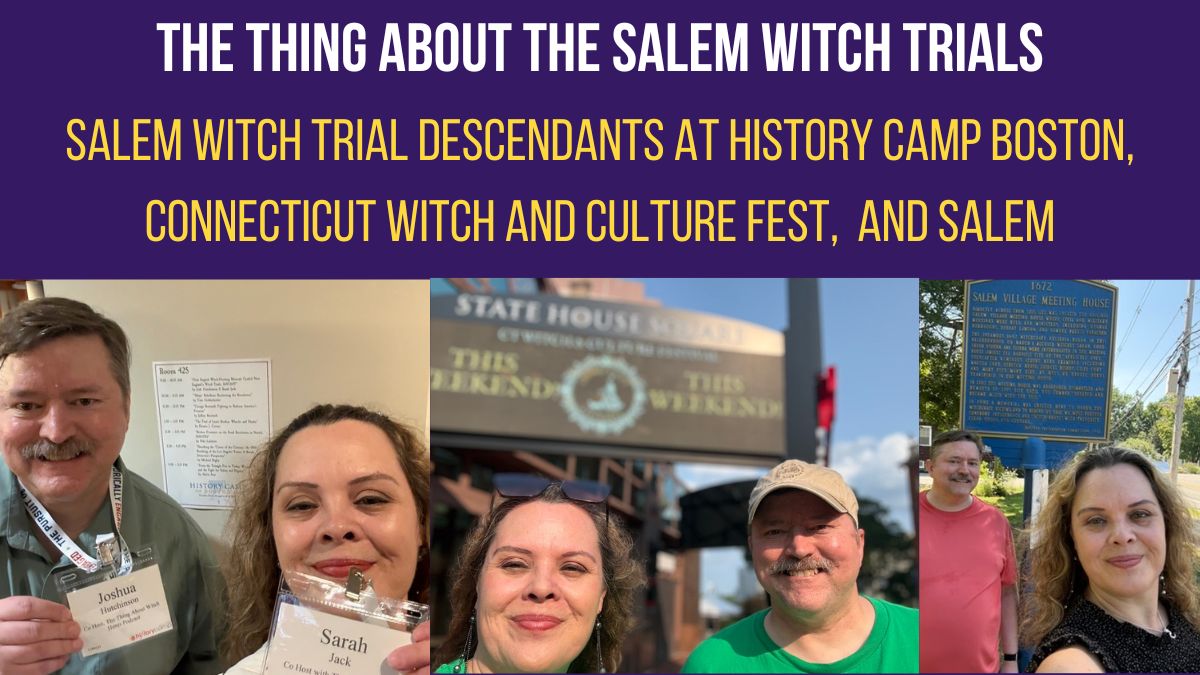
We share highlights from our New England trip for The Thing About the Salem Witch Trials, including visiting key Salem Village and Danvers sites with our colleague Mary Louise Bingham, paying respects at the Danvers Witch Trial Victims Memorial, and standing together as descendants of Mary Esty at her home site. We reflect on places central to 1692, such as the Samuel Parris parsonage site, the meetinghouse replica at the Rebecca Nurse Homestead, Ingersoll’s Tavern property, Essex Street, the Salem 400 exhibit, Charter Street Cemetery, and the Salem Witch Trials Memorial. We also recount presenting at sold-out History Camp Boston on how English witch-hunting manuals shaped deliberate New England legal proceedings, and staffing a history and remembrance booth at the Connecticut Witch and Culture Festival with tribute cloth signings, remembrance ceremonies, volunteer presentations, and connections to World Day Against Witch Hunts and modern anti-witch-hunt advocacy.
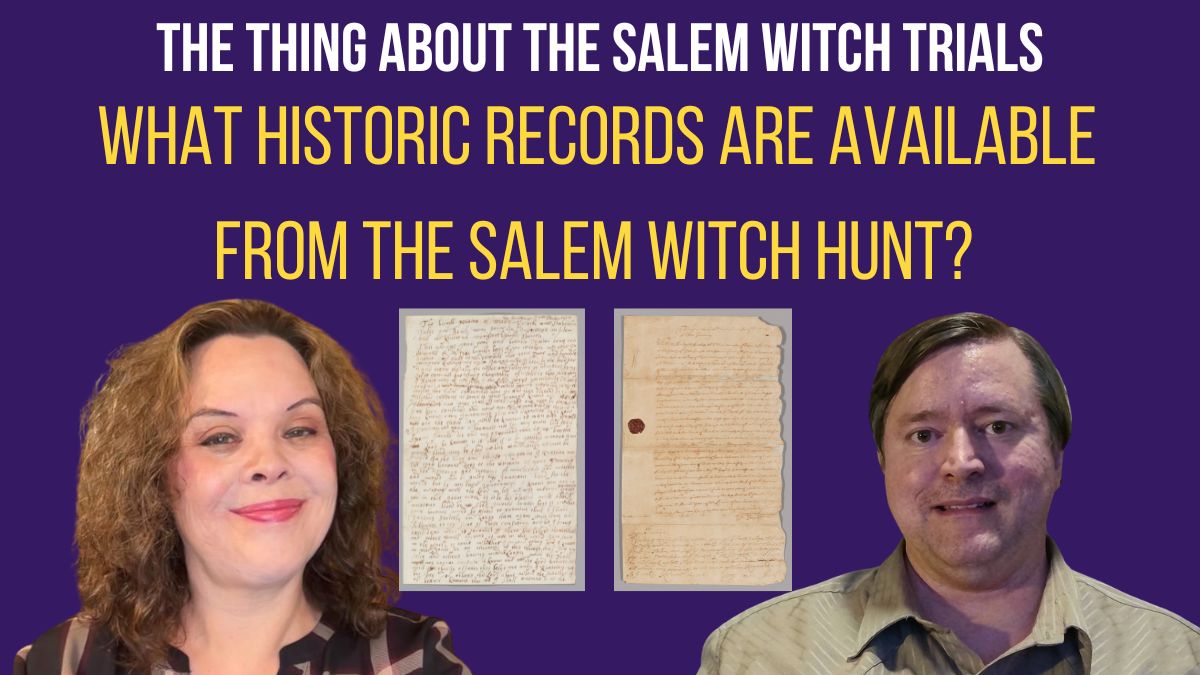
We dig into the biggest surprise at the heart of the 1692 Salem Witch Trials: the official Court of Oyer and Terminer record book is gone, and what people call “trial records” are mostly pretrial examinations, warrants, depositions, bills, diaries, and printed observers’ accounts. We explain how magistrates like John Hathorne and Jonathan Corwin shaped the surviving dialogue-style transcripts, why those documents get mistaken for trial proceedings, and what sparse trial records typically looked like by comparing to the surviving 1693 Superior Court files. We trace how writers such as Cotton Mather, Robert Calef, Thomas Brattle, John Hale, Increase Mather, and others preserved competing narratives, and how Samuel Sewall’s diary fills crucial gaps. We spotlight the decade-long scholarly effort behind the 2009 Records of the Salem Witch-Hunt, the myths it overturns (including confessors being tried and executed), and how New England and even Scotland show how missing records can distort history for centuries.
Chapters
00:00 What Records Survive 01:09 Examinations Not Trials 03:07 How Trials Worked 04:31 Published Accounts Clash 06:31 Proving Records Existed 08:37 Where Records Went Missing 09:52 Scribes Shape History 11:38 Records of the Salem Witch Hunt 13:58 Myths the Paperwork Busts 14:44 Beyond Salem and Abroad 16:59 Other Sources and Daily Paper 18:20 The Devil’s Book That Never Was 19:50 Voices of the Accused 20:26 Why Records Matter
The Toothaker Family: Folk Magic, Witchfinding, and Tragedy in the Salem Witch Trials
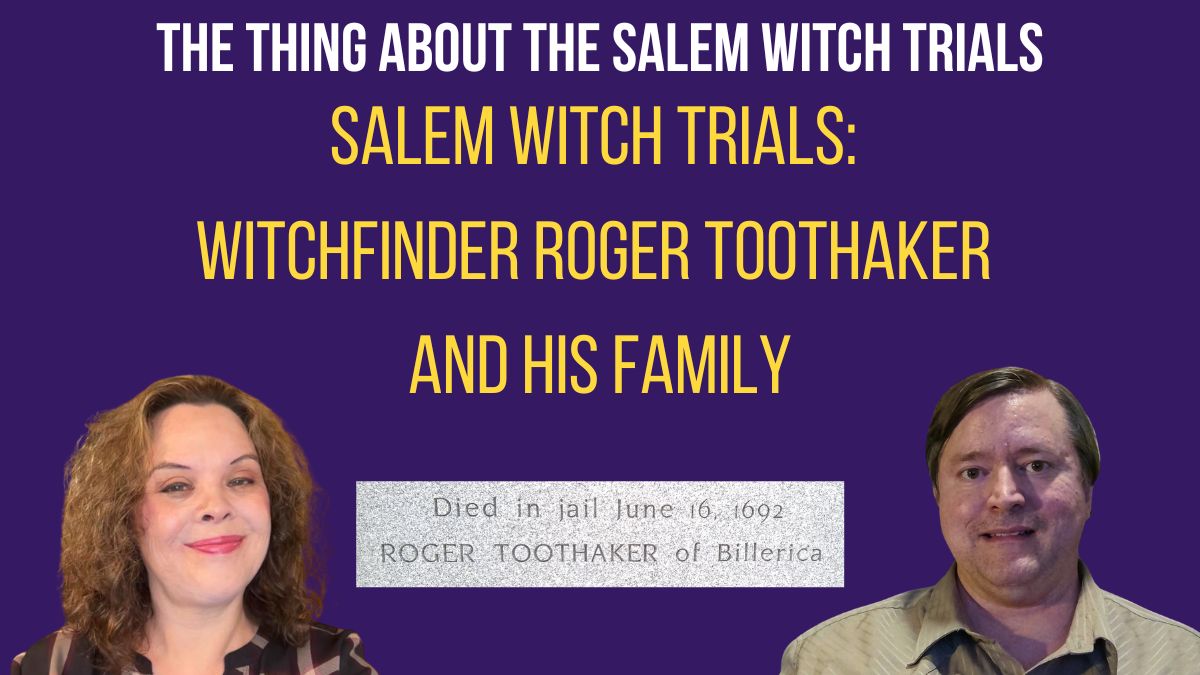
A folk healer known as “Dr. Toothaker,” Roger Toothaker was the only male healer/physician accused of witchcraft in 17th-century New England, and his story pulls our Salem Witch Trials podcast into a web of witchfinding, fear, and family fallout. After leaving his wife Mary Allen Toothaker and their children behind in Billerica, Roger was arrested in May 1692 for allegedly afflicting Salem Village girls and died in Boston jail; testimony linked him to diagnosing victims under an “evil hand” and to a “witch bottle” said to kill a witch. Soon Mary Toothaker and their young daughter Margaret were accused, and daughter Martha Toothaker Emerson was jailed after dramatic examinations and spectral allegations, while son Allen testified against aunt Martha Carrier. Though Mary and Martha were ultimately cleared, war violence later killed Mary and took Margaret captive, underscoring how folk magic, Andover/Salem Village accusations, and ties to Carrier made the Toothakers prime targets.
Chapters
00:00 Meet the Toothakers 00:13 Roger’s Early Life 01:05 Healer Turned Accused 01:51 Testimony and Witch Bottle 03:05 Mary and Margaret Accused 04:07 Roger Dies in Jail 05:01 Martha Emerson Arrested 06:59 Specters and Confession 08:04 Mary Toothaker Confesses 09:25 Allen Testifies Against Carrier 10:20 Acquittals and Release 10:54 War and Aftermath 11:47 Legacy and Reading List
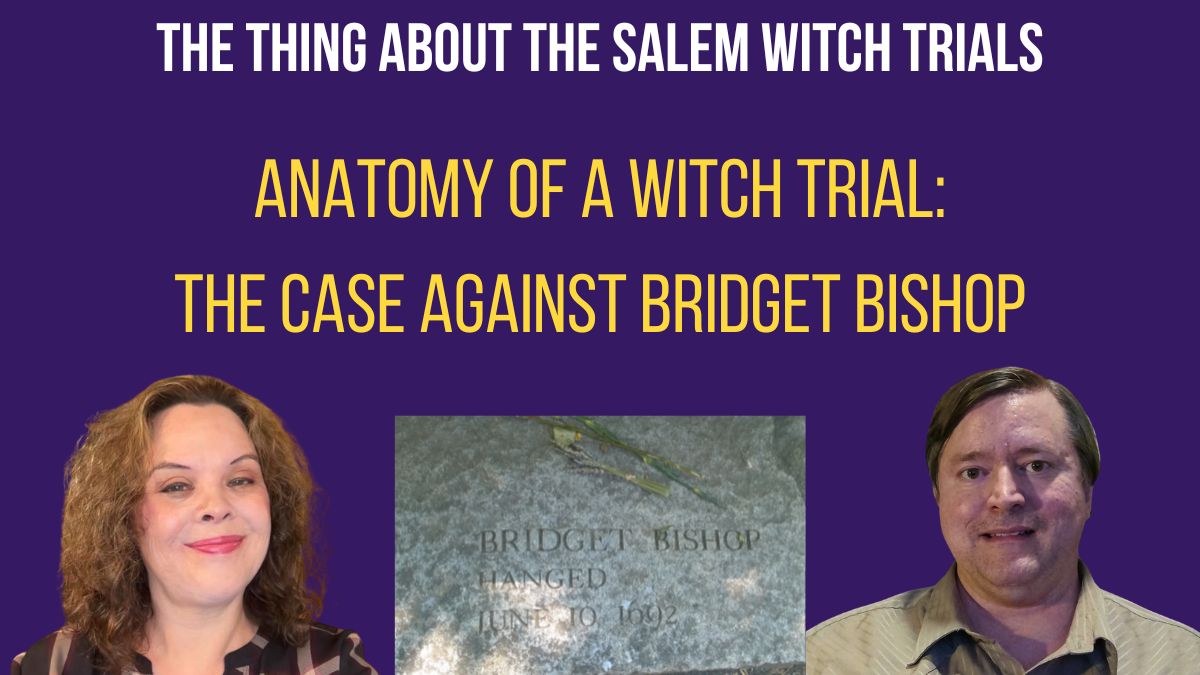
We dig into original Salem Witch Trials documents to map, step by step, how Bridget Bishop moved from first mention to execution—and how “evidence” worked in 1692. Using the arrest warrant (April 18, 1692), competing examination records by Ezekiel Cheever and Samuel Parris, and a trail of statements, depositions, and jail paperwork, we trace the case built on spectral evidence, old grievances framed as supernatural harm, and accusations drawn from other prisoners’ confessions. We follow Bridget through transfers between Salem and Boston jails, the June 2 physical search for “witches’ teats,” five indictments for afflicting the core afflicted girls, and the death warrant ordering her hanging on June 10. We also track the long aftermath, from missed restitution efforts to her eventual naming in Massachusetts’ 2001 exoneration act.
Chapters of “Anatomy of a Witch Trial: The Case Against Bridget Bishop”
Step into Salem in 1692 as we follow Bridget Bishop from her life in Salem Town to the courtroom that condemned her. She was the first person executed in the Salem Witch Trials, convicted on testimony about specters, poppets, an “unnatural mark,” and long-running neighborhood quarrels—despite insisting she had never harmed the accusers and did not even know them. We trace her documented history from England to Massachusetts, her three marriages, earlier accusations that faded for lack of evidence, and the legal machinery that made her case the opening death sentence for the Court of Oyer and Terminer. We also confront how Bridget has been misremembered, explore modern portrayals like Cry Innocent and screen adaptations, and highlight memorials, exoneration, and the living legacy of her descendants.
Chapters
00:00 Bridget Bishop Introduced
00:40 Life Before 1692
02:24 Arrest And Examination
04:47 Spectral Evidence Piles Up
06:08 Trial And Execution
07:04 Myths And Mixups
07:36 Remembering Bridget Today
09:02 Stage And Screen Portrayals
09:57 Memorials And Exoneration10:49 Legacy And Descendants
Court of Oyer and Terminer: The Spectral Evidence Engine Behind the Salem Witch Trials
Follow us into the urgent creation of Massachusetts’ Court of Oyer and Terminer on May 27, 1692, as Governor William Phips confronted a new charter that wiped out the old court system, overcrowded jails, and a surging wave of witchcraft arrests. We break down why this special court was formed, who sat on it—elite magistrates led by Chief Justice William Stoughton—and how Salem’s cases were largely judged by men from outside Salem. The action turns on one explosive issue: spectral evidence, the court’s primary tool that drove a 100% conviction rate in witchcraft trials before Phips dissolved it in October 1692. We then track the shift to the Superior Court of Judicature, where spectral evidence no longer proved guilt, convictions collapsed, reprieves halted executions, and the remaining prisoners were ultimately released in 1693.
Chapters
00:00 Welcome and Overview 00:32 Why a Special Court 02:06 Meet the Judges 03:43 Earlier Witch Trial Experience 05:10 Spectral Evidence Explained 06:26 Ministers Weigh In 06:49 Oyer and Terminer Results 08:01 Superior Court Replaces It 11:04 Reprieves and Stoughton Fury 12:29 Wrap Up and Next Episode
William Phips was the last person anyone should have trusted with one of the most consequential legal crises in American history. No formal education. No legal training. No political experience.The man who put him in charge of Massachusetts was Increase Mather, the most powerful Puritan minister in colonial New England.
Phips arrived at the Salem witch trials as governor of Massachusetts Bay with a life behind him that had nothing to do with governance. There was a Spanish shipwreck, a knighthood, a failed military campaign, and a financial disaster that forced the colony to print currency for the first time. By the time he sailed into Boston Harbor in May 1692, the jails were already full of the accused, the Court of Oyer and Terminer was waiting to be built, and the pressure to act was immense.
Josh Hutchinson and Sarah Jack examine the full arc of William Phips, the contradictions he embodied, the power he held during the Salem witch trials of 1692, and what he did and did not do with it.
What You Will Learn:
The kind of man Puritan New England handed its witch trials to
What it took to become the most powerful man in Massachusetts without ever learning to write
How a man who could not read until age 21 came to control the Salem witch trials
The Spanish shipwreck that launched a political career
Why New England’s most powerful minister chose an illiterate treasure hunter for governor
The military disaster that forced Massachusetts to print money for the first time
What the ministers actually told Phips about the witchcraft cases
From Witch Trials to Revolution: Salem Village on the Front Lines
We connect Salem’s darkest legacy to the opening clash of American independence with historian Dan Gagnon, Danvers resident and author of A Salem Witch: A Biography of Rebecca Nurse. Our conversation brings the Revolution into the very streets of Salem and Salem Village (today’s Danvers), where coercive acts, a moved provincial capital, troops on the Salem Common, and General Gage’s presence near the Rebecca Nurse Homestead turned imperial policy into daily reality. Tensions surge as the Massachusetts legislature outmaneuvers Gage in Salem, town meetings defy his bans, and crowds force him to release arrested patriots. The action escalates with Leslie’s Retreat—an armed standoff over a raised bridge—and then the Lexington Alarm, as Danvers militia (including descendants of witch-trial families) race to Menotomy for some of the day’s most savage fighting.
Every April 30, bonfires burn across Europe on the same night witches were said to gather on a mountaintop and make their covenant with the devil. That image did not stay in Europe. It crossed the Atlantic, embedded itself in colonial New England theology and law, and by 1692 it was being sworn to in witchcraft trials that sent nineteen people to their deaths. In this episode, hosts Josh Hutchinson and Sarah Jack follow that thread from a German mountain to a Danvers pasture — and the path runs straight through a Maypole, a folk magic discovery hidden inside a colonial home, a decades-old grudge over rancid butter, and a pear tree that has been standing since before the trials began and is still standing right now.
In this episode, you will learn:
Why Walpurgis Night and the Salem witchcraft sabbath descriptions share the same historical roots
How one colonial settler’s May Day celebration became a theological threat to Puritan authority
What a single word in William Bradford’s writing reveals about how Puritans understood folk magic and social control
Why witchcraft gathering testimony carried such evidentiary weight in colonial Massachusetts courts — decades before Salem
How one man’s actions in the 1620s left a thread running directly through the 1692 witch trials
What a 400-year-old pear tree in a Danvers parking lot has to do with the Salem witch trials
The Thing About the Salem Witch Trials is part of the End Witch Hunts podcast network. Learn more at endwitchhunts.org.
ESPN has a history podcast, and they used it to cover the Salem Witch Trials on the 50th anniversary of the ergot theory. Hosts Josh Hutchinson and Sarah Jack, descendants of Salem Witch Trial victims, respond to Stupiracy’s April 2nd episode on whether moldy rye bread caused the accusations of 1692.
What you will learn:
What the ergot theory is and why it has circulated for 50 years
How the historical symptoms from Salem do not match ergotism
Who was executed and who died in jail during the Salem Witch Trials of 1692
Why the devil, not bread mold, was the legal framework driving the prosecutions
The witch legends and actual 1692 witch trials in ESPN’s own backyard in Connecticut
Hosted by Josh Hutchinson and Sarah Jack of The Thing About Witch Hunts Podcast. Learn more at www.aboutwitchhunts.com
On April 19, 1692, Salem witch trials magistrates conducted their busiest day of examinations yet. Four accused witches appeared before the court in colonial Massachusetts. Two confessions were recorded. And the Puritan legal proceedings that would lead to nineteen executions shifted into a dangerous new phase.
In this episode of The Thing About the Salem Witch Trials, Josh Hutchinson and Sarah Jack break down the examinations of Giles Cory, Abigail Hobbs, Mary Warren, and Bridget Bishop using the firsthand courtroom notes of Samuel Parris and Ezekiel Cheever. If you love American history, colonial history, or the true story behind one of the most dramatic legal crises in Puritan New England, this episode is for you.
In this episode you’ll learn:
What Giles Cory said under examination, why his answers about a cow house drew the magistrates’ suspicion, and how the afflicted responded to Giles Cory’s every movement in the courtroom
How Abigail Hobbs became the first confessor since Tituba, what her confession revealed about life on the colonial Maine frontier, and why Abigail Hobbs’ testimony produced the first legal accusation against Sarah Wildes of Topsfield
What Mary Warren claimed about the afflicted accusers that the Salem witch trial court chose to ignore, and why Mary Warren’s examination collapsed across four separate appearances before the magistrates
How Bridget Bishop defended herself against charges of witchcraft in 1692, what the cuts in Bridget Bishop’s coat had to do with spectral evidence, and why her answer about not knowing what a witch was became a trap that led to her hanging
The Thing About the Salem Witch Trials is hosted by Josh Hutchinson and Sarah Jack of End Witch Hunts nonprofit and The Thing About Witch Hunts podcast. For day-by-day coverage of the 1692 Salem witch trials, follow Salem Witch Trials Daily podcast.
What does the American Red Cross have to do with the Salem Witch Trials? The answer runs through one of the most defiant women of 1692.
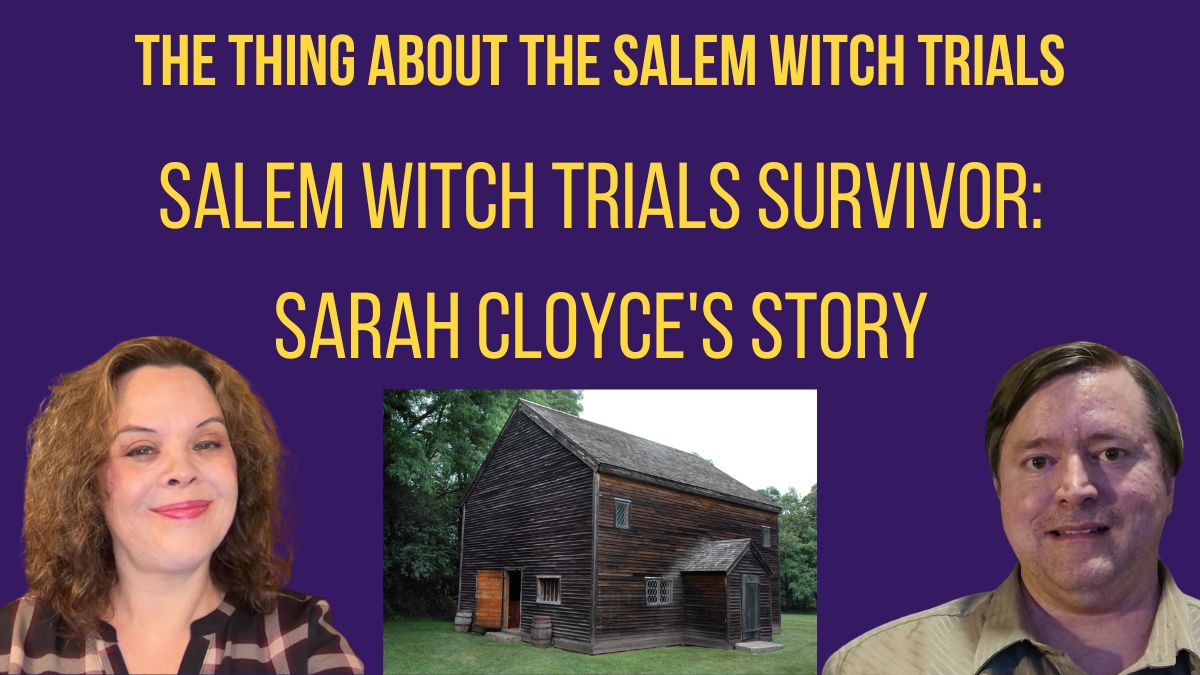
Sarah Cloyce was the youngest of the three Towne sisters, the sibling who survived when Rebecca Nurse and Mary Easty did not. Born in Salem in 1642, Sarah lived a relatively ordinary Puritan life until March 1692, when her sister Rebecca was arrested for witchcraft and Reverend Samuel Parris delivered a sermon that changed everything. Sarah’s response, walking out of the meetinghouse and reportedly slamming the door behind her, put a target on her back. Eight days later, she was formally accused.
Josh Hutchinson and Sarah Jack tell the full story of Sarah Cloyce’s accusation, her examination at the Salem Town meetinghouse on April 11, 1692, and her nine months of imprisonment in chains before the charges against her were finally dismissed in January 1693. They also cover the joint petition Sarah authored with her sister Mary Easty while both were imprisoned, Peter Cloyce’s remarkable devotion to his wife throughout her ordeal, and the family’s journey west to what would become Framingham, Massachusetts, where Salem End Road still marks the path the witch trial refugees traveled.
And that famous descendant? Sarah Cloyce’s daughter Hannah married Samuel Barton, and five generations later, Clara Barton, founder of the American Red Cross, was born in Oxford, Massachusetts on Christmas Day 1821.
What You Will Learn:
What one act in a church doorway made Sarah Cloyce a target of the accusations
What role the afflicted claimed she played at the devil’s sacrament
Why one of the most active accusers of 1692 held back when it came to Sarah
What her husband did during her nine months of imprisonment that set him apart
Why Sarah survived when her sisters did not
Where Sarah and the other Salem refugees went, and what they left behind
How Sarah Cloyce’s bloodline connects directly to one of the most celebrated women in American history
The Thing About the Salem Witch Trials is hosted by Josh Hutchinson and Sarah Jack, descendants of Salem Witch Trial victims. New episodes every week.
Also mentioned: the PBS miniseries Three Sovereigns for Sarah (1985) starring Vanessa Redgrave, authors Antonio Stuckey and Janice C. Thompson, and Salem Witch Trials Daily, the companion daily podcast.
She accused 16 people, was named a victim in 13 indictments, and may have been the most powerful force driving the Salem witch trials of 1692. So why does history overlook Mercy Lewis?
What You’ll Learn
Why some historians consider Mercy Lewis the ringleader among the afflicted girls
How surviving the Wabanaki wars shaped her role in the Salem witch trials
The full content of her April 1st visions, including the biblical passages a glittering multitude sang
What she claimed George Burroughs offered her on top of a high mountain
How her near-death episode sent the Marshal of Essex County riding through the night to re-arrest Mary Esty
Why former employers testified she was a pathological liar
At 19, Mercy Lewis was a maidservant in the Thomas Putnam household, carrying the trauma of war, probable orphanhood, and displacement from Maine. Her visions were among the most vivid and theologically detailed of the entire crisis. Her accusations helped send people to the gallows.
Were those visions vivid dreams, trauma responses, or deliberate fabrications? Josh Hutchinson and Sarah Jack dig into the evidence.
Follow 1692 day by day on Salem Witch Trials Daily Podcast. Resources and episodes at www.aboutsalem.com.
The Salem witch trials of 1692 were not driven by local grudges alone. Behind the arrests, examinations, and executions was a centuries-old theological framework that convinced educated elites, magistrates, and Puritan clergy that they were fighting a coordinated demonic war against the Christian church itself.
Josh Hutchinson and Sarah Jack trace the elaborated theory of witchcraft from its origins at the Council of Basel in the 1430s through the circulation of the Errores Gazariorum, the standardization of the witches’ Sabbath concept, and the mass distribution of the Malleus Maleficarum following the invention of the printing press. By the late 17th century, this framework had transformed witchcraft from a personal crime of harmful magic into an existential conspiracy — witches organized under the devil, sworn to pull down the kingdom of Christ and replace it with a kingdom of Satan.
In Salem, that theory played out in real time. Tituba’s confession named nine witches in the devil’s book. That number grew to forty, then a hundred, then three hundred alleged conspirators gathering in Samuel Parris’s own pasture to consume red bread and blood wine in mockery of the Christian sacraments. Reverend George Burroughs was accused of leading the diabolical assembly. Coerced confessions described a formal pact to destroy the churches. Cotton Mather, in Wonders of the Invisible World, traced the conspiracy back more than forty years — to executions in Connecticut and Massachusetts that included Alice Young, Margaret Jones, and the Carringtons.
This episode examines how fear of an anti-church conspiracy — not panic, but deliberate legal prosecution rooted in genuine theological terror — drove the witchcraft crisis and what that pattern of fear-driven scapegoating reveals about witchcraft accusation violence today.
Josh Hutchinson and Sarah Jack are co-hosts of The Thing About Salem, The Thing About Witch Hunts, and Salem Witch Trials Daily. Both are descendants of families who experienced the Salem witch trials.
The Salem Witch Trials of 1692 didn’t emerge from nowhere. They emerged from a library. This episode traces the centuries of theological and legal texts that shaped how Salem’s magistrates understood witchcraft, the demonic pact, and the infamous Devil’s book.
From a 15th-century inquisitor’s manual to a Scottish king’s royal obsession to a Boston minister’s bestseller, Josh and Sarah open the books that made Salem possible.
Books and Sources Covered
Malleus Maleficarum (1486) — Heinrich Kramer’s foundational witch-hunting manual codified the idea of a vast anti-Christian conspiracy sealed by a formal pact with the devil. It provided the theological and legal framework for prosecuting witchcraft across Europe for centuries.
Daemonologie (1597) — Written by King James VI of Scotland (later King James I of England), this royal text argued that witches entered the devil’s service through a pact alone. The king’s authority gave the work enormous cultural weight, and his framework for the devil’s covenant shaped New England Puritan thought directly.
A Discourse of the Damned Art of Witchcraft (1608) — William Perkins detailed the diabolical compact in legal terms, distinguishing between explicit verbal pacts and implicit ones inferred through action. He also established seven grounds for suspicion of witchcraft. During the Salem crisis, Cotton Mather specifically recommended judges follow the guidelines of Perkins and his successor Richard Bernard.
A Guide to Grand Jury-men (1627) — Richard Bernard’s practical manual for witch trial proceedings was among the texts Cotton Mather recommended to the Salem court.
The Discovery of Witches (1647) — Matthew Hopkins, the self-styled Witch Finder General, ran one of the most lethal witch-hunting campaigns in English history across East Anglia. His methods, his obsession with the witch’s mark, and the confessions he extracted helped cement the Devil’s book as a recognizable cultural image decades before Salem.
Hudibras (Samuel Butler, 17th century) — Butler’s satirical poem mocked Hopkins by portraying him as a secret witch himself, hanged for possessing the very Devil’s book he hunted. The satire is significant: it confirms the Devil’s book was already deeply embedded in the popular imagination.Memorable Providences Relating to Witchcrafts and Possessions (1689) — Cotton Mather’s account of the Goodwin children’s afflictions, attributed to an Irish woman named Goody Glover, circulated widely through New England. When Salem’s afflictions began in 1692, the symptoms closely mirrored the Goodwin case. Reverend Samuel Parris was in Boston during the Goodwin episode, meaning his household had direct familiarity with Mather’s template.
The Devil’s Book at Salem: First Appearances
By the time formal accusations began in 1692, the Devil’s book was already a recognized legal and theological concept. Its appearance in Salem testimony followed quickly:
February 27, 1692 — Ann Putnam Jr. claimed Sarah Good’s specter tormented her and pressured her to sign the Devil’s book. This is the first accusation involving the Devil’s book in the Salem crisis.
February 27, 1692 — Elizabeth Hubbard named Sarah Good and Sarah Osborne as tormenters, alleging Osborne’s specter urged her to write in the book.
March 2, 1692 — Tituba confessed to making her mark in the Devil’s book with blood and stated the book was already signed by nine witches, including Sarah Good and Sarah Osborne. Seven signers remained unidentified, located in Roxbury, Salem, and Boston.
March 14, 1692 — Abigail Williams claimed she was tempted to put her hand to the Devil’s book and saw Martha Corey at a Devil’s Sacrament. Mercy Lewis reported similar pressure to sign.
Notably, the physical description of the Devil’s book changed throughout testimony, varying in color, size, and material depending on the witness.
The Salem Witch Trials were the product of deliberate legal and theological machinery built over two centuries, not a sudden or unexplainable event
The concept of the demonic pact as formal contract was codified in print long before 1692
Cotton Mather’s 1689 work functioned as a near-immediate template for Salem’s afflictions
The Devil’s book served prosecutorial purposes by implying an organized conspiracy with many unnamed participants still at large
Sign the Petition
Five women were hanged in Boston between 1647 and 1688 and have never had their names cleared. Sign the petition at change.org/WitchTrials to support their exoneration.
About The Thing About Salem
The Thing About Salem offers bite-sized episodes exploring the Salem Witch Trials of 1692. Hosts Josh Hutchinson and Sarah Jack are descendants of witch trial victims and co-founders of End Witch Hunts, the only U.S. nonprofit dedicated to witchcraft accusation awareness.
This special Podcasthon 2026 episode of The Thing About Salem brings together two stories separated by more than three centuries. Hosts Josh Hutchinson and Sarah Jack share a clip from End Witch Hunts’ International Women’s Day panel featuring Maimunat Mohammad, a woman from Niger State, Nigeria, who grew up in a community that accused her mother of witchcraft after her father’s death. Her account is followed by the story of Dorothy Good, a four-year-old girl jailed during the Salem witch trials of 1692 after her mother, Sarah Good, was accused and hanged.
The parallel is not coincidental. It is the point. Podcasthon is a global event where podcasts raise money for nonprofits. This episode is End Witch Hunts’ contribution to that effort, and it makes the case for why the work of this organization matters now.
What Podcasthon is and how it supports nonprofit work
Who Maimunat Mohammad is and what her family endured after her father’s death
How witchcraft accusations spread beyond the accused person to children and family members
What happened to Dorothy Good, one of the youngest people detained during the Salem witch trials
How the experience of accusation affects a person’s sense of self over time
Why End Witch Hunts connects historical witch trials to contemporary witch hunting
Keywords
Salem witch trials, Dorothy Good Salem, witchcraft accusations Nigeria, End Witch Hunts nonprofit, Podcasthon 2026, Salem witch trial children, Sarah Good Salem, Maimunat Mohammad Nigeria, witch hunting today, witch trial descendants, advocacy for accused witches, Leo Igwe Advocacy for Alleged Witches Nigeria, witch hunt survivors, witchcraft accusation family, Salem 1692, charitable giving witch hunt nonprofit, how to support End Witch Hunts, witch trial history and human rights, contemporary witch hunting, Colorado nonprofit witch hunts
Support End Witch Hunts
End Witch Hunts is a U.S.-based 501(c)(3) nonprofit based in Colorado. It produces two weekly podcasts, advocates for legislative recognition of witch trial victims, and partners with advocates working on the ground in countries where witchcraft accusations cause harm today.
For International Women’s Day and Women’s History Month, The Thing About Salem takes a deep look at one of the Salem witch trials’ most fascinating and misrepresented figures: Tituba Indian. Who was she, and why have writers, scholars, and storytellers kept returning to her story for two centuries?
Joining Josh and Sarah is Samaine Lockwood, associate professor of English at George Mason University and the 2026 Fenwick Fellow, whose forthcoming book traces Tituba’s transformation as an American cultural figure from 1820 to the present.
In this episode, you’ll discover:
Why Tituba is largely absent from 19th-century Salem novels, and what her absence reveals about race and citizenship in post-Civil War America
How wrongfully accused white women in historical fiction were shaped into symbols of ideal democratic citizenship, while Tituba was cast as their opposite
Which overlooked novels and authors are essential to understanding how Salem has been reimagined across American literary history
Why Black feminist writers like Ann Petry and Maryse Conde were the first to place Tituba at the center of the story, and why that matters
What Samaine’s research trip to Salem will examine about how Tituba is represented in today’s memorial and tourist spaces
This episode also includes an invitation to the live International Women’s Day panel Justice for Women Accused of Witchcraft in Africa, taking place Sunday, March 8th at 6:30 PM GMT. Join Dr. Leo Igwe, Chief Magistrate Safiya Musa Salihu, Dr. Barrister Dise Ogbise Goddy Harry, broadcast journalist Hauwa Mundi, and Maimonat Mohammad for a conversation on gender, justice, and witchcraft accusations today. Register at endwitchhunts.org/iwd.
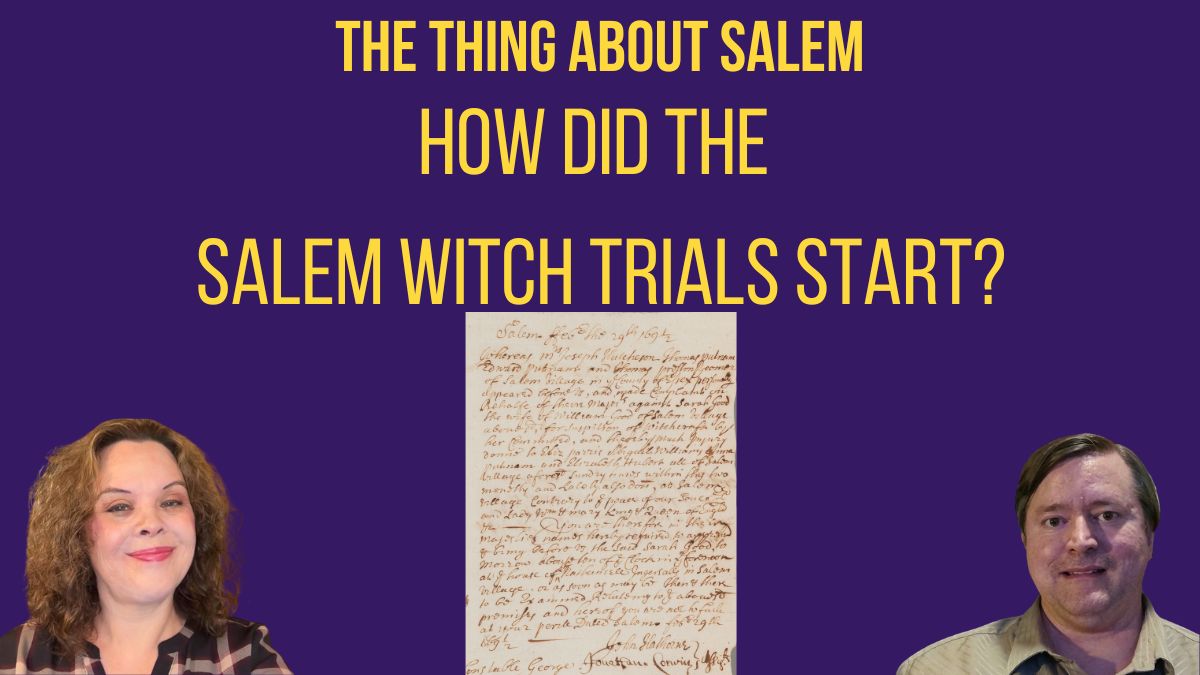
How the Salem Witch Trials Began: The First Week of March 1692 | The Thing About Salem
It’s early March 1692, and Salem Village is about to change forever. In this episode of The Thing About Salem, Josh Hutchinson and Sarah Jack cover the explosive first week of the Salem Witch Trials, from the very first arrests to the courtroom confessions that transformed a local crisis into a full-blown witch hunt.
The episode opens with a recap of the pivotal final days of February 1692, when a physician’s diagnosis, a desperate folk magic ritual, and a gathering of ministers set the stage for what was coming. By February 29, the waiting was over. Complaints were filed, warrants were issued, and three women were headed to examination.
March 1, 1692 marks a critical moment in the Salem Witch Trials. Magistrates John Hathorne and Jonathan Corwin questioned the accused in the packed Salem Village meeting house, and what happened inside those walls would send shockwaves through Massachusetts Bay Colony and fuel months of accusations to come.
The episode traces events day by day through March 7, showing exactly how a handful of afflicted girls, a contested diagnosis, and one dramatic confession set an entire province on edge.
In this episode:
Day-by-day events from March 1 through March 7, 1692
The witch cake and what it was meant to do
The first complaints and arrest warrants of the Salem Witch Trials
The examinations of Sarah Good, Sarah Osburn, and Tituba before magistrates Hathorne and Corwin
Tituba’s confession and the Devil’s book with nine signatures
The Putnam Family’s Role in the Salem Witch Trials
No family is more associated with the Salem Witch Trials than the Putnams. And for good reason. One man in this family filed complaints against 35 people. His wife, his daughter, and their maid were all among the afflicted. The depositions, the courtroom drama, the relentless momentum of accusation after accusation. The Putnams were not bystanders to any of it.
So it would be easy to close the book on them there. Villains. Next chapter.
Except the same family also signed the petition defending Rebecca Nurse. Some members testified against the accused in the morning and put their names on her defense in the afternoon. One branch quietly took in Dorothy Good in the years after the trials, when almost no one else would. And one Putnam kept his horse saddled for months, ready to ride at a moment’s notice, because he was openly opposing the trials and he knew what that could cost him.
In This Episode
Three branches of the Putnam family, three generations, and a cast of individual’s history has flattened into footnotes. Josh and Sarah trace who accused, who defended, who did both, and who walked a quieter path that history almost forgot. The story of Ann Putnam Jr. and the only public apology to come out of the entire crisis. The Putnam descendants who shaped American history long after 1692. And the harder question underneath all of it: when a community turns on itself, what does it take to be one of the people who helped it happen, and what does it take to be one of the people who doesn’t?
About The Thing About Salem
The Thing About Salem takes the Salem Witch Trials seriously as history. That means going beyond the names everyone knows, sitting with the complexity, and treating the people involved as real human beings rather than symbols. Hosted by Sarah Jack and Josh Hutchinson, the podcast draws on decades of research, firsthand expertise, and a genuine commitment to getting it from the records. New episodes every week.
History remembers Tituba—but she wasn’t the only enslaved woman caught in Salem’s 1692 witch hunt. Meet Candy of Barbados, whose courtroom testimony turned Puritan assumptions upside down.
When magistrates asked if she was a witch, Candy gave an answer that indicted the entire colony: “Candy no witch, Barbados. This country, mistress give Candy witch.” Then she brought cheese and grass into the courtroom as proof.
What followed was one of the strangest examinations of the summer—complete with burning rags, forced grass-eating, and an enslaved woman accusing the woman who held her in bondage of witchcraft. Discover the story of resistance, strategy, and survival that the history books rarely tell.
This episode examines the story of Mary Black, an enslaved woman accused of witchcraft in April 1692, and the complex household she lived in. Mary Black was owned by Nathaniel Putnam, a politically active Salem Village leader who opposed Reverend Parris before the trials began and later defended Rebecca Nurse—yet left no documented advocacy for the enslaved woman in his own household.
What You’ll Learn
The racial dimensions of the Salem witch trials and how court records identified accusers differently
How Mary Black’s experience contrasts with white accused women who had community defenders
Nathaniel Putnam’s complex role: opposing Parris, defending Rebecca Nurse, while owning Mary Black
The stark silences in historical sources around enslaved and women of color in colonial New England
Mary Black’s examination, nine-month imprisonment, and eventual clearing by proclamation
Key Figures Discussed
Mary Black – African enslaved woman accused April 21, 1692
Nathaniel Putnam – Mary’s owner, Salem Village political leader
Rebecca Nurse – white woman Nathaniel defended
Keywords: Salem witch trials, Mary Black, enslaved women, Nathaniel Putnam, racial history, colonial New England, 1692, Tituba, Rebecca Nurse, Salem Village
The Court of Oyer and Terminer operated for less than five months in 1692, but the nine judges who sat on that bench sentenced nineteen people to death by hanging and allowed another man to be pressed to death under stones. This episode goes judge by judge, revealing the real men who wielded power without accountability during the Salem witch trials.
What You’ll Learn:
Discover the legal framework that made the Salem witch trials possible, from the Body of Liberties of 1641 to the constitutional crisis that created this special court. Learn how the 1604 English Witchcraft Act shifted prosecution from proving actual harm to proving a diabolical pact with the Devil, and how spectral evidence became the cornerstone of convictions despite warnings from ministers like Cotton Mather and Increase Mather.
Meet William Stoughton, the chief justice who sent juries back to reconsider acquittals and later raged when executions were halted. Hear about John Hathorne’s aggressive interrogations that terrorized the accused, and why his descendant Nathaniel Hawthorne added a W to distance himself from the family legacy. Find out why Samuel Sewall became the only judge to publicly apologize and observe an annual day of fasting for the rest of his life, and why Nathaniel Saltonstall resigned from the court in protest after the first execution.
Why It Matters:
These weren’t faceless figures of history. They were educated men with families and church connections who had acquitted accused witches years earlier but chose to accept unreliable evidence in Salem.
The Salem Witch Trials became a publishing phenomenon before they even ended. Discover how writers raced to document the crisis in real time, defying colony-wide publication bans to get their accounts into print.
This episode explores the groundbreaking early writings about Salem, from Minister Deodat Lawson’s eyewitness account published just two weeks after his 1692 visit to Salem Village, to the fierce theological debates that followed. Learn how these documents shaped public opinion, influenced the trials’ outcome, and preserved crucial historical evidence.
What You’ll Learn
Early Crisis Documentation Former Salem Village minister Deodat Lawson captured the panic at its peak, describing violent fits, spectral accusations, and the chaos that erupted in church services. His March 1692 narrative became the first published account of the unfolding crisis.
The Evidence Debate Samuel Willard’s mysterious dialogue challenged the very foundations of spectral evidence. When is supernatural testimony trustworthy? Can the Devil frame innocent people? These questions divided the colony.
Three Voices, Three Visions October 1692 brought competing perspectives: Thomas Brattle’s scathing critique of court procedures, Cotton Mather’s defense of the trials as spiritual warfare, and Increase Mather’s theological bombshell that changed everything.
The Standard That Stopped the Trials Increase Mather’s famous principle that ten guilty should escape rather than one innocent person be condemned transformed the legal landscape overnight. Discover how one theological argument dismantled an entire prosecution system.
Voices of Regret and Rage John Hale’s humble admission of misguided zeal contrasted sharply with Robert Calef’s response to the writings of Cotton Mather. Thomas Maule offered yet another interpretation, seeing divine judgment rather than satanic attack.
Why This Episode Matters
These primary sources reveal how communities process crisis in real time. They show the power of written words to challenge authority, preserve truth, and change minds. From eyewitness terror to philosophical reflection, these documents chart the emotional and intellectual journey of a society reckoning with its own actions.
Perfect for history enthusiasts, researchers, and anyone interested in how evidence standards, media influence, and public opinion intersect during moments of social panic.
Keywords
Salem Witch Trials books, Deodat Lawson narrative, spectral evidence debate, Increase Mather Cases of Conscience, Cotton Mather Wonders Invisible World, Thomas Brattle letter, Robert Calef criticism, John Hale apology, Thomas Maule Quaker perspective, witch trial publications, 1692 primary sources, Salem witch panic documentation, early American publishing, colonial Massachusetts writings, historical witch trial accounts
Subscribe
Join us for daily episodes exploring Salem Witch Trials history and weekly deep dives on The Thing About Salem podcast.
The same world where Newton’s physics coexists with spectral evidence. Where a ship captain faces witchcraft charges because he couldn’t save a town from military raid. Where an opera about fairies premieres the same day a minister is arrested for consorting with the devil.
1692 reveals a world caught between eras. The Scientific Revolution is rewriting reality itself while courtrooms still accept dreams as proof. Empires are consolidating power and centralizing judicial systems, yet some places double down on persecution. The Enlightenment is dawning, but the darkness hasn’t lifted everywhere.
War, piracy, earthquake, massacre, resistance, revolution. The globe is in upheaval, and the choices different societies make in response tell us everything about who holds power and who gets blamed when things go wrong.
Salem wasn’t an isolated outbreak of superstition. It was one response among many to a world transforming faster than people could comprehend.
Explore colonial America history, the Early Modern Period, and the global context of the Salem witch trials.
Keywords:
What happened in 1692 around the world
What was happening in 1692 besides Salem witch trials
Salem Witch Trials Daily Course – How It Works | Day-by-Day History Education
Description:
Welcome to our YouTube channel! Discover a revolutionary way to learn about the Salem Witch Trials through our daily video series. This comprehensive course follows the actual 1692-1693 timeline, bringing you history as it happened day by day. In this informational episode, learn how our unique course structure works and see a sample daily lesson.
Subscribe to our YouTube channel for daily videos throughout 2026-2027 as we follow the historical timeline!
What You’ll Get on This Channel: ✅ Daily bite-sized video lessons (just a few minutes each) ✅ 75-week journey through the complete 1692-1693 timeline ✅ Watch on YouTube as we release them or binge full weeks ✅ Companion resources at AboutSalem.com
Beyond YouTube: 📚 Weekly workbooks with activities and challenges 📝 Blog posts recapping each week’s content 🎙️ The Thing About Salem podcast 🏆 Achievement badges to track your progress
Course Features: 📚 Researched from primary sources 📝 Fill-in-the-blank summaries and reflection questions ✍️ Citation practice and character journal prompts 📖 Vocabulary building and quote analysis 🎯 Four weekly challenges to grow your expertise ⏱️ Watch at your own pace as all YouTube videos remain available
The Salem Witch Trials by the Numbers: • 156+ formal accusations • 30 convictions • 20 executions • Started January 1692 in Minister Samuel Parris’s household • Legal proceedings: February 1692 – May 1693
Perfect for:
History students and educators
Homeschoolers seeking structured curriculum
History enthusiasts wanting deep knowledge
Descendants honoring family connections
Anyone interested in colonial American history
👍 Like this video if you’re excited to learn about the Salem Witch Trials!🔔 Subscribe and hit the notification bell so you don’t miss daily uploads! 💬 Comment below: Are you planning to do the full course or just follow along casually?
Get the Full Course Experience: Visit AboutSalem.com to download this week’s workbook, read the blog, and access all resources.
Traditional Keywords: Salem Witch Trials course, Salem Witch Trials history, 1692 witch trials, colonial America education, history course online, Salem Massachusetts history, witch trials documentary, American history lessons, homeschool history curriculum, Salem Village 1692, YouTube history channel, educational YouTube
Connect With Us: 🌐 Website: AboutSalem.com 🎙️ Podcast: The Thing About Salem 📱 Share your progress: #SalemDailyStudent ▶️ Subscribe to our YouTube channel for daily history lessons!
This nonprofit educational project brings you meticulously researched history accessible to all learners. Whether you’re doing the full course with workbooks or just following the daily YouTube videos, you’re part of a community exploring this pivotal moment in American history.
New videos uploaded daily following the 1692 timeline!
Salem Witch Trials | History Education | Online Course | Colonial America | Massachusetts History | Educational Videos | YouTube History Channel | History Curriculum
What Were Witches Actually Accused of Doing in Salem?
Signing a mysterious book with blood. Attending midnight gatherings in the minister’s pasture. Shape-shifting into wolves. Sending spirits through jail cell walls despite iron shackles. The accusations against Salem’s alleged witches painted a picture of organized supernatural conspiracy that went far beyond what most people imagine.
But what did colonists actually believe witches were doing? How did the Devil supposedly recruit his servants? Why were investigators searching bodies for hidden marks? What made everyday misfortunes like spoiled milk or a bad dream transform into evidence of murder? And how did witnesses claim to see ghostly victims and impossible creatures with mixed animal parts?
The accusations reveal an elaborate belief system where witches weren’t just casting spells. They were waging war against the Christian church itself, plotting to return New England to Satan’s control one village at a time.
What’s in This Episode:
• How Satan allegedly recruited and marked his followers • The role of spectral evidence in convicting the accused • Why metal shackles were believed necessary but didn’t work • What investigators looked for during physical examinations • The supposed plot to establish the Devil’s kingdom in Salem Village • How poppets, familiars, and fortune-telling became criminal evidence • Why witnesses testified to seeing ghosts in winding sheets
Key Topics:
Salem Witch Trials, witchcraft accusations 1692, spectral evidence, Devil’s book, maleficium, witch marks and teats, familiars, poppets, Salem sabbats, Tituba confession, Bridget Bishop, Martha Carrier, George Burroughs, Rebecca Nurse, diabolical witchcraft, colonial New England, Samuel Parris, 17th century witch hunts
Discover the Answer:
What could transform your neighbor into a suspected servant of Satan? Join Josh Hutchinson and Sarah Jack to find out.
When Rebecca Nurse and Mary Esty wrote petitions from their jail cells in 1692, they couldn’t have known their words would inspire descendants 333 years later to continue the fight for justice.
Sarah Jack has now testified twice for her ancestors’ exonerations. In 2023, she stood before Connecticut’s Joint Committee on Judiciary on behalf of her ancestor Winifred Benham, part of a successful effort to absolve all the accused witches in Connecticut. Then in November 2025, she testified in Massachusetts for another ancestor, Mary Hale, Winifred’s mother, who was accused in the Boston Witch Trials.
While Massachusetts has systematically cleared names from the Salem trials over centuries, eight people convicted in Boston have been overlooked. House Bill 1927 seeks to finally exonerate these eight, including Mary Hale, and acknowledge hundreds more accused across the state whose lives were destroyed by accusations.
The act of speaking up spans generations. Family members in the 1600s risked being accused themselves by defending loved ones. Descendants petitioned through the 1700s and 1900s. In 2022, Elizabeth Johnson Jr. became the last Salem conviction cleared. Now it’s time for Boston’s victims to receive the same justice.
What’s in This Episode:
• The power of petitions across 333 years of seeking justice • Sarah Jack’s experiences testifying in Connecticut and Massachusetts • The history of witch trial exonerations from 1711 to 2022 • How Connecticut successfully cleared all their accused witches • Why eight Boston victims remain convicted while Salem cases were resolved • What you can do to support Massachusetts House Bill 1927 before the committee deadline
Key Topics:
Witch trial exonerations, Massachusetts House Bill 1927, Connecticut witch trials resolution, Boston Witch Trials, Winifred Benham, Mary Hale, Rebecca Nurse, Mary Esty, descendant testimony, historical justice, Joint Committee on Judiciary, Elizabeth Johnson Jr., Salem Witch Trials
Take Action:
The committee is still accepting written testimony through the end of January. Learn how you can add your voice at massachusettswitchtrials.org
Enjoy this author interview with New York Times bestselling author Kathleen Kent. Kathleen shares how she discovered her descent from Salem Witch Trials victim Martha Carrier and transformed that family history into her acclaimed debut novel, The Heretic’s Daughter.
Martha Carrier was executed on August 19, 1692, after refusing to confess to witchcraft. Accused of causing a deadly smallpox epidemic in Andover, Massachusetts, she stood her ground even when her own children were tortured into testifying against her. Today she’s remembered as a woman who wouldn’t confess to something she didn’t do.
In this conversation, Kathleen discusses her writing process, the challenges of bringing historical figures to life, and offers invaluable insights for aspiring historical fiction writers.
About Kathleen Kent
Kathleen Kent is a New York Times bestselling author whose books include The Heretic’s Daughter (winner of the David J. Langum Sr. Award for American Historical Fiction), The Traitor’s Wife, The Outcasts, and her Edgar Award-nominated crime trilogy. She is a member of the Texas Institute of Letters and teaches writing workshops for aspiring novelists.
Episode Highlights
How Kathleen discovered her connection to Martha Carrier
The research process behind The Heretic’s Daughter
Martha Carrier’s story
Advice for aspiring historical fiction writers
Balancing historical accuracy with compelling storytelling
Keywords
Salem Witch Trials, Martha Carrier, Kathleen Kent, The Heretic’s Daughter, historical fiction writing, Andover witch trials, Salem history, writing advice, Colonial America
More than 150 people were accused of witchcraft in Salem, Massachusetts in 1692. Had the Court of Oyer and Terminer tried them all, they may all have been hanged.
They sat chained in dungeons to prevent their specters from roaming. They watched as friends and neighbors were dragged to the gallows. As the body count rose, the terror must have reached unimaginable levels. And yet the accusations kept coming.
How did an entire community participate in its own destruction?
In this essential introduction to The Thing About Salem, hosts Josh Hutchinson and Sarah Jack explore what made Salem different from every other witch hunt in American history. The mystery isn’t what ailed the afflicted girls. Why were people at the highest levels of society accused right alongside the usual suspects?
This episode reveals the forces that turned Salem Village into America’s deadliest witch hunt: warfare closing in on Massachusetts settlements, economic devastation, the collapse of political and religious certainty, and the kind of existential terror that makes the unthinkable seem reasonable.
When a seventh grader reached out with questions for their National History Day documentary, podcast hosts Josh Hutchinson and Sarah Jack knew they’d been asked something special. The student’s thoughtful inquiries became the foundation for this episode of The Thing About Salem.
This wasn’t just another school assignment. The questions this student asked revealed a depth of engagement that many adults never reach when studying 1692. They saw past the surface story to the human complexity underneath, the kind of questions that don’t have easy answers but force you to truly reckon with what happened in Salem.
We knew immediately these questions needed to be shared. They’re the kind that make history stop being about memorizing events and start being about understanding people, choices, and consequences that still echo today.
Sometimes the best teachers are the ones still in school.
Keywords: Salem Witch Trials, National History Day, student history project, Rebecca Nurse, Joseph Hutchinson, Bridget Bishop, family history research, witch trial education, historical questions, Salem descendants, Tituba, Abigail Williams
In May 1692, one of Boston’s most respected citizens walked into a Salem courtroom—and the accusers couldn’t even identify him. Captain John Alden Jr., son of Mayflower passengers and decorated war hero, seemed an unlikely target for witchcraft accusations. But his connections to Native Americans and the French made him dangerous in the eyes of wartime Massachusetts.
What happened when Salem’s witch hunt reached beyond the village to pull in a prominent Bostonian with impeccable colonial credentials? This episode examines how Captain Alden’s examination revealed the absurdity and danger of the spectral evidence system and how his escape became one of the trial period’s most dramatic moments.
From his parents’ legendary Plymouth courtship to his own flight from justice, Captain Alden’s story shows us who could be accused, who could survive, and what it took to navigate Salem’s machinery of suspicion.
Episode Highlights:
John Alden Sr. and Priscilla: The last surviving Mayflower passenger and the marriage that inspired Longfellow
Captain Alden’s controversial fur trading and the rumors that made him a target
The chaotic May 31st examination where accusers needed prompting
The touch test, the sword, and the claims of “Indian Papooses”
His September escape to Duxbury and surprising return
Key Figures: Captain John Alden Jr., John & Priscilla Alden, Judges Bartholomew Gedney and John Richards, Rev. Samuel Willard, Robert Calef
The Thing About Salem examines the people, places, and events of the 1692 Salem witch trials. New episodes weekly.
When you think “Massachusetts witch trials,” you think Salem, 1692. But what if we told you that 44 years before Salem, Massachusetts was already executing people for witchcraft in Boston?
Between 1648 and 1693, more than 200 people were formally charged with witchcraft across Massachusetts. In 1957, the state cleared 31 Salem victims. But Boston’s victims have been forgotten.
On November 25, 2025, Bill H.1927 goes before the Massachusetts Joint Committee on the Judiciary to finally exonerate 8 individuals convicted of witchcraft in Boston and recognize everyone else who suffered accusations across Massachusetts.
Co-hosts Josh Hutchinson and Sarah Jack, descendants of Salem witch trial victims and co-founders of the Connecticut Witch Trial Exoneration Project, explain why Salem’s story is incomplete without Boston—and how YOU can help Massachusetts finish the job.
Before Salem: Boston’s Forgotten Victims
Five women were executed in Boston:
Margaret Jones (1648) – First person executed for witchcraft in Massachusetts, 44 years before Salem
Elizabeth Kendall (1651)
Alice Lake (1651)
Ann Hibbins (1656)
Goody Glover (1688) – Executed just 4 years before Salem, her case influenced Cotton Mather
Three others were convicted but not executed:
Hugh Parsons (1651)
Eunice Cole (1656-1680) Eunice was brought to court on witchcraft accusations over and over!
Cotton Mather was deeply involved in Goody Glover’s 1688 trial in Boston. Her execution influenced his thinking about witchcraft—thinking he brought to Salem just four years later.
The same fears, the same accusations, the same injustice—Boston laid the groundwork for what happened in Salem.
When Massachusetts cleared Salem’s victims in 1957, they left Boston’s victims behind.
What Bill H.1927 Does:
✅ Exonerates the 8 individuals convicted of witchcraft in Boston between 1647-1688
✅ Recognizes all others who suffered accusations across Massachusetts
✅ Completes the work Massachusetts started in 1957 when they cleared Salem’s victims
✅ Acknowledges that Salem wasn’t the beginning—Boston was
✅ Costs nothing – zero fiscal impact
How You Can Help RIGHT NOW:
1. Sign the Petition: Change.org/witchtrials – Over 14,000 signatures and growing
2. Contact Massachusetts Representatives: Email or call members of the Joint Committee on the Judiciary before November 25th
3. Submit Written Testimony: Even if you can’t attend in person, your voice matters
4. Share This Episode: Help spread the word before the November 25th hearing
Why Salem’s Story Is Incomplete Without Boston:
For decades, we’ve told the story of Salem 1692 as if it appeared out of nowhere. But Massachusetts had been executing people for witchcraft since 1648.
The fears, the evidence, the methods—all of it was already established in Boston before it exploded in Salem.
You can’t understand Salem without understanding Boston.
Connecticut Showed It Could Be Done:
Josh and Sarah co-founded the Connecticut Witch Trial Exoneration Project and launched their podcast in 2022 to support the legislative effort. With help from listeners like you, Connecticut passed House Joint Resolution 34 in May 2023 with overwhelming bipartisan support, absolving 11 individuals and recognizing all others who suffered accusations.
You were part of Connecticut’s success from the beginning. Now Massachusetts needs you to help finish what they started in 1957.
Key Facts:
Boston’s first execution was in 1648—44 years before Salem
Goody Glover’s 1688 execution influenced Cotton Mather just 4 years before Salem
More than 200 people were formally charged with witchcraft in Massachusetts (1648-1693)
Massachusetts cleared 31 Salem victims in 1957, but left Boston’s victims behind
Massachusetts has already amended the 1957 Resolve twice (2001 and 2022)
Bill H.1927 simply continues this established pattern with zero fiscal impact
The November 25th Hearing:
When: November 25, 2025 Where: Massachusetts State House, Joint Committee on the Judiciary What: Public testimony on Bill H.1927
Even if you can’t attend, you can submit written testimony or contact committee members.
Why This Matters Today:
When we clear the names of historical victims, we acknowledge that witch hunting is not a relic of the past—it continues in the same form globally. The same patterns of accusation, fear, and injustice that started in Boston in 1648 and exploded in Salem in 1692 continue in witch hunts around the world today.
The Thing About Salem Co-hosted by Josh Hutchinson and Sarah Jack Descendants of Salem witch trial victims Co-founders of the Connecticut Witch Trial Exoneration Project A project of End Witch Hunts nonprofit organization
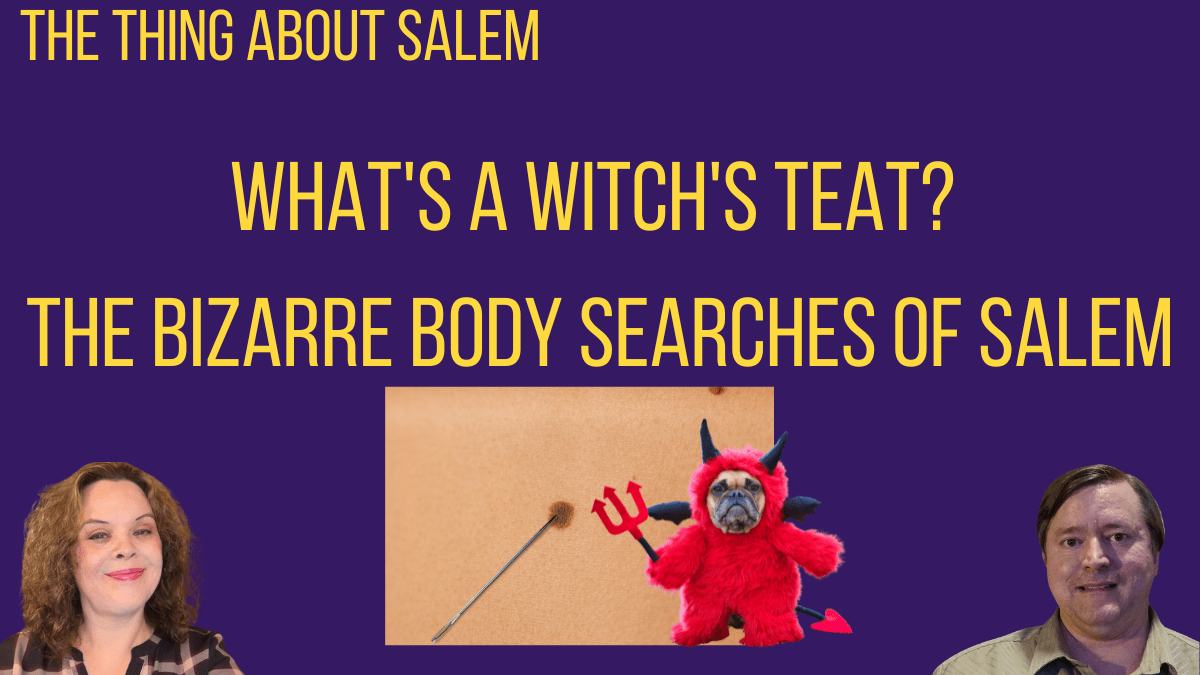
In this episode of The Thing About Salem, co-hosts Sarah Jack and Josh Hutchinson examine one of the most invasive and degrading practices used during the Salem Witch Trials: the search for witch’s marks and devil’s teats. Discover how this invented “evidence” was used to convict innocent people—including the hosts’ ancestors.
What You’ll Learn:
The Origins of Witch Mark Theory
How English legal writers like Michael Dalton (1618) and William Perkins created detailed instructions for finding “devil’s marks”
Why Richard Bernard claimed these marks appeared in “secretest parts” requiring invasive searches
The shocking truth: none of this evidence appears in the Bible
Familiar Spirits in Salem
Cotton Mather’s definition of familiar spirits as “devils in bodily shapes”
Strange creatures described in testimony: hairless cats with human ears, rooster-monkey hybrids, and hairy upright beings
How these supposed demons were believed to feed from witch’s teats
The Salem Examinations
Documented searches of accused witches including Rebecca Nurse, Bridget Bishop, and Elizabeth Procter
George Jacobs Sr.’s brutal examination with pins driven through his flesh
Four-year-old Dorothy Good’s traumatic examination and the “flea bite” used as evidence
Why some marks disappeared between examinations—and what that tells us
Dehumanizing Practices
The invasive nature of stripping and examining prisoners in their “most intimate areas”
How postpartum scarring from childbirth was twisted into evidence of witchcraft
Why the Court of Oyer and Terminer convicted all 27 people tried in 1692—whether marks were found or not
Modern Connections As Robert Calef pointed out in More Wonders of the Invisible World, witch marks weren’t biblical—they were man-made tests designed to find guilt. This pattern continues in modern witch hunts worldwide, where accusers still decide what constitutes “evidence” against innocent victims.
Perfect for listeners interested in:
Salem Witch Trials history
Colonial American history
Wrongful convictions and false evidence
Women’s history and bodily autonomy
Modern witch hunts and human rights
Historical witchcraft accusations
Legal history and justice reform
Featured Historical Sources:
William Perkins, A Discourse of the Damned Art of Witchcraft
Michael Dalton, The Countrey Justice (1618)
Richard Bernard, The Certainty of the World of Spirits
Cotton Mather, Wonders of the Invisible World
Robert Calef, More Wonders of the Invisible World
Deodat Lawson, A Brief and True Narrative
Original Salem Witch Trial examination records
About the Hosts: Sarah Jack and Josh Hutchinson are descendants of Salem witch trial victims and co-founders of End Witch Hunts, a nonprofit addressing modern witch hunts globally. Together, they co-host The Thing About Salem and The Thing About Witch Hunts (265+ episodes).
Support Our Work: Learn more about modern witch hunts and how to help at EndWitchHunts.org
How does a town infamous for executing twenty people for alleged diabolical witchcraft rebrand itself as “Witch City”? Salem spent centuries trying to forget 1692, then something changed. Join descendants Sarah and Josh as they uncover the surprising story of how grief, guilt, and capitalism collided to transform Salem into America’s Halloween capital. From the first witch-themed business to the controversy over memorializing victims, this is the untold story of who chose to remember, who profited, and what got lost along the way.
What You’ll Discover:
Why did Salem stay silent about the trials for over 150 years, and what finally broke that silence? Who made the first move to capitalize on witch trial history (the answer might surprise you)? When the city had a chance to build a memorial in 1892, why did descendants of the accusers fight so hard against it? And how did a fish company, a souvenir spoon, and a Knights Templar march help pave the “yellow brick road” to Witch City?
Keywords:
Salem witch trials | Witch City | Salem Massachusetts | Halloween tourism | dark tourism | historical memory | commercialization of tragedy | Salem history | 1692 witch hunt | American history | New England | modern witchcraft | Pagan community | tourism | memorialization | historical injustice | colonial America | Arthur Miller | The Crucible | Haunted Happenings
About The Thing About Salem:
Sarah and Josh are descendants of Salem witch trial victims investigating how their ancestors’ tragedy became a tourism empire, and what that transformation reveals about memory, commerce, and identity.
What happens when an entire city becomes Halloween for a month?
Salem’s Haunted Happenings started with the Salem Witch Museum as one weekend in 1982. Now it’s a month-long community event of costumes, crowds, street performers, and pure October magic.
This episode captures the spirit of it all—the performers who show up year after year, the locals that go ALL OUT, the Grand Parade that kicks it off, and the chaotic, joyful energy that makes October in Salem unlike anywhere else.
What to expect:
How a single weekend became a month-long phenomenon
The vibe, the crowds, the performers
Costumes that stop you in your tracks
Why “don’t drive in Salem in October” is essential advice
The magic (and reality) behind the Halloween capital of the world
Whether you’re planning your first visit or you’ve been coming back every October, this one’s about what makes Haunted Happenings unforgettable.
🎃 Ready for Salem’s October?
Keywords: Haunted Happenings, October Salem, Salem Massachusetts Halloween, Salem October events, Haunted Happenings Grand Parade, Salem Halloween capital, The Thing About Salem podcast
Discover the shocking truth about ghosts in the Salem Witch Trials of 1692. This isn’t your typical ghost story. These supernatural encounters were used as courtroom evidence that sent innocent people to the gallows. Join hosts Josh Hutchinson and Sarah Jack as they explore the different types of apparitions that appeared in Salem testimony, from murdered wives seeking vengeance to protective angels revealing hidden crimes.
Some Featured Historical Cases
– George Burroughs. Former minister accused by ghostly wives appearing in winding sheets
– Ann Putnam Jr.’s Testimony: Multiple ghost sightings including murdered wives, children, and victims
– Martha Carrier’s Examination. Thirteen ghosts appearing as evidence against her
– Spectral Evidence. How ghost testimony became critical courtroom evidence leading to convictions
The Role of Ghosts as Legal Evidence
Learn how supernatural testimony functioned in 1692 trials.
Historical Figures Mentioned
George Burroughs, Ann Putnam Jr., Bridget Bishop, John Willard, Martha Carrier, Rebecca Nurse, Mary Bradbury, Giles Corey, Mary Easty, Susannah Sheldon, Mary Walcott, Elizabeth Hubbard
The Salem Irony
The ultimate twist: In 1692, innocent people were executed for supposedly appearing as ghosts. Today, tourists pay for ghost tours hoping to encounter those same spirits. Salem, Massachusetts—where historical tragedy became supernatural entertainment.
Episode Hosts
– Josh Hutchinson- Co-host, The Thing About Salem
– Sarah Jack – Co-host, The Thing About Salem
Keywords
Salem Witch Trials, ghost evidence, spectral evidence, 1692 Salem, Ann Putnam Jr., George Burroughs, Salem ghosts, witchcraft trials, historical ghosts, Salem Massachusetts, witch trial testimony, supernatural evidence, colonial America, Salem history, ghost tours Salem
What connects a 2014 internet horror tragedy to the fear of 1692 Salem? In this captivating 15-minute clip from our full conversation, Josh and Sarah—along with Ain’t it Scary? with Sean and Carrie podcast —draw haunting parallels between the young girls involved in the Slender Man stabbing case and the afflicted girls of the Salem witch trials.
How do fear, belief, and community pressure transform young people into actors in real-world tragedies? From oppressed accusers in colonial Massachusetts to pre-teens acting on digital folklore. A thought-provoking exploration of monsters, morality, and the girls who became part of history’s shocking moments.
Episode Highlights
🔮 Girls Under Pressure – Comparing the afflicted girls of Salem to the Slender Man crime perpetrators ⚖️ Belief Gone Wrong – When fear of something unseen leads to tragedy 🎃 Monster or Victim? – Society’s struggle to categorize young people who do terrible things 👻 The Power of Narrative – How stories—whether Puritan theology or internet creepypasta—drive real-world actions 🕯️ Panic Then and Now – What the Salem trials teach us about modern viral panic
About Our Returning Guests
Sean & Carrie host Ain’t it Scary with Sean and Carrie, where a skeptic and a believer explore the unknown, unsolved, unbelievable, and just plain weird. With their passion for history and uncovering truth, they bring complementary perspectives to every mystery they tackle.
Keywords
Slender Man, Salem witch trials, afflicted girls, creepypasta, true crime, digital folklore, witch hunts, moral panic, paranormal podcast, horror podcast, Ain’t it Scary, historical parallels, Salem Massachusetts, youth violence, folklore
Listen & Subscribe
Don’t wander off the path—subscribe to The Thing About Salem and join us every episode as we explore the trials, mysteries, and untold stories of Salem and beyond.
Also check out: Ain’t it Scary with Sean and Carrie wherever you listen to podcasts!
In this episode of ‘The Thing About Salem,’ hosts Josh Hutchinson and Sarah Jack explore the various ways the Salem Witch Trials have been depicted in films and TV shows over the decades. They discuss the historical and fictional elements in productions like ‘The Crucible,’ ‘Maid of Salem,’ the ‘Bewitched’ TV series, and ‘Hocus Pocus,’ highlighting how these portrayals have shaped and transformed Salem’s image in popular culture. The episode also covers works such as ‘The Chilling Adventures of Sabrina’ and ‘Three Sovereigns for Sarah,’ emphasizing the ongoing cultural fascination with this dark chapter in American history.
00:00 Introduction to Salem in Pop Culture
01:04 Maid of Salem and The Crucible
02:37 Salem Witch Trials miniseries and Hocus Pocus
05:01 Bewitched and Sabrina the Teenage Witch
10:07 The Chilling Adventures of Sabrina and Three Sovereigns for Sarah
13:49 Conclusion: The Legacy of Salem in Pop Culture
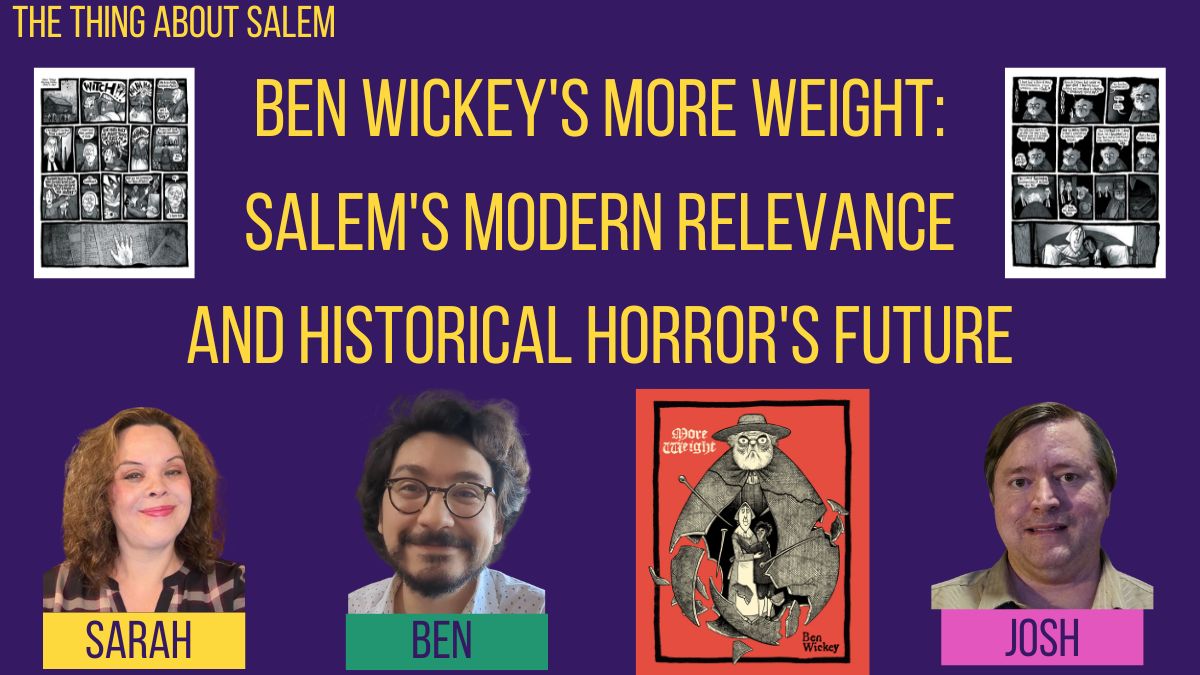
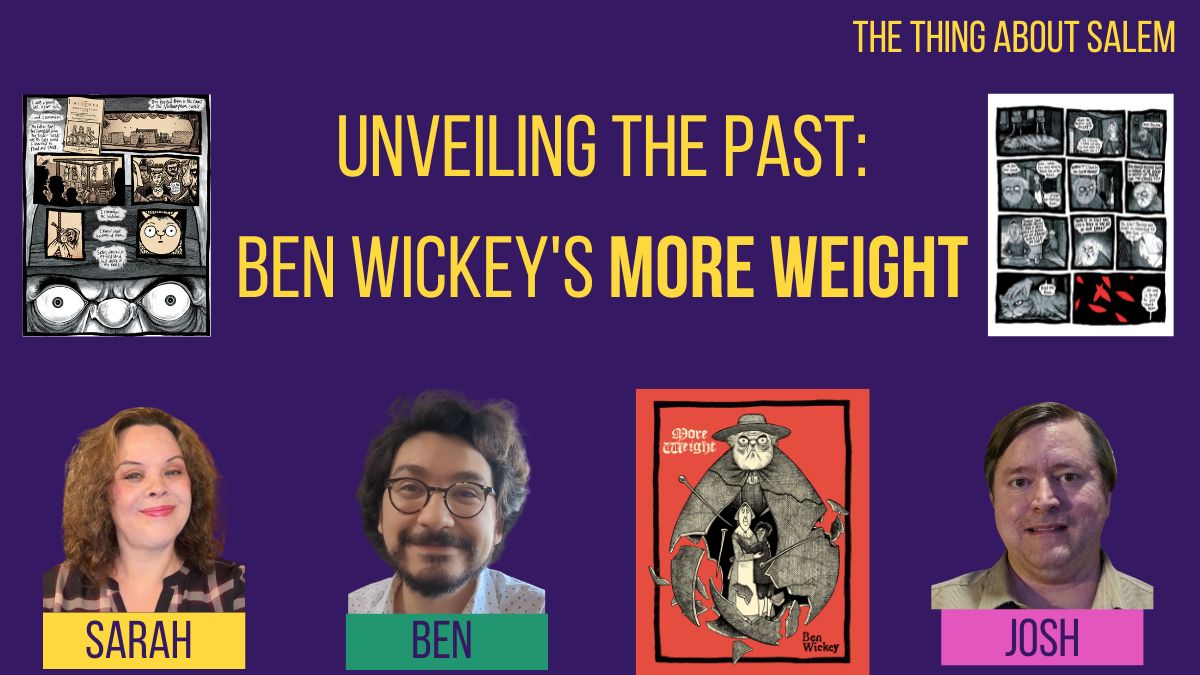
The Thing About Salem concludes our exclusive three-part series with Ben Wickey as we explore the modern implications of his debut graphic novel More Weight: A Salem Story in Part 3. With the book released September 23, we examine why this Salem Witch Trials story resonates powerfully with contemporary readers.
Wickey discusses Salem’s modern identity and how his work addresses the town’s complex relationship with its tragic past. We explore the visual challenges of depicting historical horror, his artistic influences including Alan Moore’s impact on his creativity, and why he chose a mature rating for responsible storytelling about historical brutality.
What aspects of the 1692 witch trials feel most relevant today? We discuss modern witch hunts, the importance of authentic historical narratives in pop culture, and how Wickey’s ancestral connection influenced his approach to Salem’s psychological darkness.
This final installment reveals why critics are calling this an “appalling masterpiece” and how More Weight will reshape how we understand Salem’s legacy for future generations.
Keywords: Ben Wickey, Salem modern relevance, More Weight final review, contemporary witch hunts, Alan Moore influence, Salem today historical horror
The Thing About Salem continues our conversation with Ben Wickey in Part 2 of our three-part series about his groundbreaking graphic novel More Weight: A Salem Story, releasing next week. This installment focuses on the heart of Wickey’s narrative: the psychological transformation of Giles Corey.
We explore Corey’s devastating journey from testifying against his wife Martha to his defiant final moments uttering “more weight” as stones crushed him to death. Wickey reveals his meticulous research using historical documents and his innovative dual-timeline narrative featuring Nathaniel Hawthorne interludes that bridge past and present.
As a Mary Easty descendant, Wickey discusses the emotional weight of bringing his ancestor’s story and Salem’s broader tragedy to authentic life. We examine how he balanced historical brutality with responsible storytelling, his striking use of color and its absence, and why maintaining historical accuracy was crucial to honoring the victims’ memory.
This is essential listening for anyone interested in Salem Witch Trials history and how graphic novels can illuminate our darkest chapters.
With his highly anticipated debut graphic novel “More Weight: A Salem Story” releasing, Massachusetts-born author Ben Wickey joins us for an exclusive pre-launch interview about this Alan Moore-praised “appalling masterpiece.” The Edward Gorey Award-winning artist’s first solo work tells the harrowing tale of Giles Corey, the only person pressed to death under stones during the infamous 1692 Salem Witch Trials.
What makes this upcoming graphic novel release extraordinary? Beyond Wickey’s stunning and unmatched visual storytelling that brings historical horror to visceral life, he is a descendant of Salem Witch Trial victim Mary Easty, bringing deeply personal perspective to this decade-long project that Publishers Weekly compared to “From Hell.”
We explore the pre-release excitement, Wickey’s meticulous research using historical documents, and his innovative dual-timeline narrative featuring Nathaniel Hawthorne interludes. Using the graphic novel format, Wickey cuts through pop culture mythology to restore the genuine horror and humanity of Salem’s history.
Discover how Corey transformed from testifying against his wife Martha to defiantly uttering his final words “more weight,” and why this Salem witch hunt story will captivate readers everywhere.
Not all witch trials were the Salem Witch Trials. To truly understand the infamous Salem Witch Trials of 1692-1693, we must examine the broader context of witch hunting that swept through colonial America. This episode explores the extensive history of witch trials in British North America that preceded and influenced the Salem events, revealing how witch hunts affected dozens of communities across New England and beyond.
Key Topics Covered
The Context Behind Salem
Why Salem didn’t happen in a bubble
European influence on colonial witch trials
How English writings shaped Salem court decisions
The role of European witchcraft tales in accuser testimonies
Pre-Salem Witch Trials in New England (1647-1691)
Connecticut Witch Trials
Alice Young of Windsor – First execution, May 26, 1647
How the Goodwin children became the model for Salem’s afflicted
Witch Trials Beyond New England
Virginia
First accusation: Joan Wright (1626)
William Harding conviction (1656)
Grace Sherwood, “Witch of Pungo” – water ordeal trial (1706)
Maryland
Multiple accusations investigated
Rebecca Fowler execution (1685)
John Cowman conviction
Maine, New Hampshire & Vermont
Goody Cole trials across jurisdictions
Massachusetts Bay control influence
Salem’s Wider Impact
The 1692-1693 Salem Witch Trials affected numerous communities:
Andover
Boston
Maine and New Hampshire territories
Connecticut spinoff: Katharine Branch case (1692)
Episode Highlights
First witch trial execution in colonial America: Alice Young, 1647
Total colonial witch trial scope: Over 65 indictments across multiple colonies
Geographic spread: From Connecticut to Maine, Virginia to Maryland
Timeline: 45+ years of witch trials before Salem
Legal precedents: How earlier trials shaped Salem procedures
Resources & Further Learning
Check out the hosts’ companion podcast: The Thing About Witch Hunts for deeper dives into European witch trial history and modern witchcraft persecution worldwide.
SEO Keywords
Salem Witch Trials, colonial witch trials, New England witch hunts, Alice Young witch trial, Connecticut witch trials, Massachusetts witch trials, Goody Glover, Cotton Mather, Grace Sherwood, Hartford Witch Panic, colonial America witchcraft, pre-Salem witch trials, New England history, colonial justice system
The Thing About Salem podcast explores the real history behind one of America’s most infamous events. New episodes dive deep into the social, legal, and cultural factors that led to the Salem Witch Trials of 1692-1693.
What caused the Salem Witch Trials? It wasn’t moldy bread, mass hysteria, or girls dabbling in magic. Join hosts Josh and Sarah (whose ancestors lived through these events) as they uncover the real forces that created one of America’s darkest chapters.
What You’ll Discover
The Real Causes: Multiple explosive factors that turned Salem into a powder keg
Political Chaos: How governmental instability set the stage for tragedy
Community Tensions: The deadly mix of wealth gaps, frontier trauma, and religious conflict
The Spark: What actually triggered the first accusations in January 1692
Modern Relevance: Why these lessons matter for recognizing witch hunts today
Key Topics Explored
✓ Belief systems that made witchcraft accusations believable ✓ Political upheaval following the revocation of Massachusetts’ Royal Charter ✓ Controversial judicial decisions like allowing “spectral evidence” ✓ Economic anxieties from King William’s War and previous conflicts ✓ European witchcraft beliefs that influenced New England thinking ✓ The snowball effect that made accusations spiral out of control
Why This Episode Matters
Learn the complex, interconnected causes behind one of history’s most misunderstood events. Discover how fear-mongering, scapegoating, and abandoning rational thinking can lead entire communities astray—and why these patterns still matter today.
Perfect for history buffs, true crime fans, and anyone who wants to separate Salem facts from fiction in just 15 minutes.
What happens when your only defense against a death sentence is a handwritten letter? In 1692 Salem, petitions became lifelines for the accused, their families, and entire communities caught in the witch trial hysteria.
In this episode, we explore:
Mary Easty’s remarkable final petition that prioritized saving others over herself
The creative legal strategies colonists used to challenge “spectral evidence”
How torture was used to extract confessions (and documented in writing)
The economic reality of having family members imprisoned for witchcraft
Community petitions that reveal the social chaos engulfing entire towns
Why some people recanted their confessions—and what that tells us about coercion
From character witness statements to desperate pleas from prison, these historical documents reveal the human cost of mass hysteria and the courage it took to speak truth to power with nothing but ink and parchment.
Plus: The meaningful modern connection—how middle schoolers in 2022 successfully petitioned to clear a victim’s name, and why there’s still a bill before Massachusetts legislature today.
Perfect for history buffs, true crime fans, and anyone fascinated by how ordinary people navigate extraordinary circumstances.
Keywords: Salem witch trials, historical petitions, spectral evidence, Mary Easty, colonial justice system, Massachusetts history
The thing about witch hunts is what happens after can be just as revealing as the hunt itself. After 20 executions and over 150 arrests, Salem had a serious PR problem on its hands. How do you explain away one of colonial America’s most notorious legal disasters? Simple: you control who gets to tell the story.
But here’s the thing about cover-ups—they rarely go according to plan. Join us as we dive into Salem’s messy aftermath, where the real question wasn’t who practiced witchcraft, but who was willing to admit they’d been wrong. Because the thing about truth is it has a funny way of surfacing, even when powerful people are trying their hardest to bury it.
What if history’s most infamous witch hunt could have been stopped with just a few different decisions? We’re examining the pivotal moments between January 1692 and May 1693 when someone—anyone—could have pumped the brakes on Salem’s runaway train of accusations.
From the shocking arrest of four-year-old Dorothy Good to Martha Carrier’s unfortunate promotion to “Queen of Hell,” we’ll explore how escalating choices transformed a local crisis into colonial America’s most notorious legal disaster. We’ll meet the key players who either fanned the flames or tried to douse them—including Cotton Mather’s mixed messages and Governor Phips’ late-in-the-game reality check.
Join us as we dissect the moments when cooler heads could have prevailed and discover how 45 residents of unlucky Andover got swept up in accusations that would make even the devil blush. Sometimes it takes a village—or several villages—to create a catastrophe.
Josh and Sarah tell the TL;DR version of the story of the Salem Witch Trials of 1692-93, where 156 people faced formal accusations and over 1,000 became entangled in a legal system that had lost its moral compass. They examine what transformed a small Massachusetts community into the epicenter of mass persecution, from the unprecedented scale of the proceedings to the types of people targeted. This wasn’t just colonial paranoia—it was a perfect storm of social tensions, legal failures, and human frailty that contemporaries recognized as extraordinary even by their own standards. The hosts discuss why Salem continues to captivate us centuries later, serving as both historical cautionary tale and enduring reminder of how quickly justice can derail when fear takes the wheel.
Sarah Good’s final words to the minister who demanded her confession—”God will give you blood to drink”—would echo through Salem long after her death. In a community where everyday foods like butter, bread, and pudding became evidence of witchcraft, the line between nourishment and damnation blurred beyond recognition. Explore how Salem’s fears transformed the most basic human need into suspicions of a pact with the devil, from spoiled butter that doomed a sea voyage to cheese found in an accused witch’s pocket.
Christopher Reeve proved that heroism isn’t about superpowers—it’s about perseverance. That’s the gift every Salem descendant carries, but you don’t have to share their bloodline to share their lesson. Salem teaches us about the price of silence, the power of standing up, the importance of questioning authority. Those aren’t genetic traits—they’re human ones.
Hosts Josh and Sarah explore their own ancestral connections to the trials and reveal how descendants of Salem’s victims number in the millions today.
We kick off with a midnight ride that would make Paul Revere jealous—except instead of warning about the British, townspeople were frantically summoning help for a girl supposedly being tortured by a witch’s specter. But before you roll your eyes and mutter “mass hysteria,” consider this: What if the Salem Witch Trials weren’t the product of unhinged women with wandering uteruses (yes, that’s a real historical medical theory), but rather ordinary people responding to extraordinary fear in disturbingly familiar ways?
Join us as we trace witch panics from Springfield to Hartford, uncovering a pattern that’s less “crazy town” and more “calculated legal proceedings.” We’ll explore why dismissing these events as hysteria might be the most dangerous mistake we can make—especially when the same human behaviors that fueled 17th-century witch hunts are alive and well in. Spoiler alert: We’re not as evolved as we think we are.
Fair warning: Contains references to wandering uteruses, midnight rides, and uncomfortable parallels to contemporary society.
We look at the reported use of oomancy—egg divination—allegedly preceding the Salem Witch Trials. The discussion centers around a haunting account from Reverend John Hale about an afflicted girl who used an egg and glass to divine her future, only to see a coffin appear in the reflection. This ominous vision allegedly led to her eventual death, serving as what Hale callously called “a just warning” about dabbling with divination.
The hosts explore the ancient origins of divination practices, tracing them back thousands of years to early civilizations. The episode examines various divination methods documented in Salem records, including the sieve and scissors technique, key and Bible, and other techniques for fortune telling. Several fascinating Salem cases come to light, including Samuel Wardwell’s admitted fortune telling abilities and Dorcas Hoar’s reputation as a local fortune teller who specialized in predicting the deaths of men. The hosts share intriguing testimonies from neighbors who witnessed these practices firsthand, revealing how common divination was in 17th-century New England communities.
Throughout the episode, the hosts address common myths about Salem, including the popular but inaccurate image of girls gathering in circles for magic sessions. They also explore the mystery of which afflicted girl Hale was referring to in his account, as her identity remains unknown to this day.
Join Josh and Sarah as they uncover the surprisingly relatable human desire to glimpse the future, one cracked egg at a time. Connect with them on Patreon at patreon.com/aboutsalem to continue the conversation about Salem’s divination practices and their modern echoes.
You’ve heard the theory: ergot-poisoned rye bread caused hallucinations that sparked the Salem witch trials. It sounds so logical, so scientific, so… wrong.
When the afflicted girl Elizabeth Hubbard accused alleged witch Sarah Good of witchcraft through spectral torture – pinching, pricking, and demanding she sign the devil’s book – was she describing a fungal poisoning? Or something far more complex?
Join Josh Hutchinson and Sarah Jack as they finally address one of the most popular silver bullet “explanations” for the Salem Witch Trials. They’ll show you why this tidy medical explanation crumbles: convulsive ergotism is actually a syndrome with a constellation of symptoms and variables.
This episode will sharpen your critical thinking. The ergot theory’s problems show us how easily we can be drawn to explanations that sound scientific but don’t actually fit the evidence and why we need to dig deeper than the theories that simply make us feel better about difficult history.
In Salem, people were hanged based on crimes no one else could see.
In Salem, accusers claimed to see the ghostly “shapes” of their neighbors tormenting them from miles away. These spectral attacks left real bruises, real terror, and real questions: Could the Devil impersonate innocent people? Why did Connecticut reject this evidence decades earlier while Salem embraced it with deadly consequences?
From midnight visitations to courtroom chaos, discover how testimony about invisible crimes became the most dangerous evidence in American legal history.
The shadows cast by Salem’s trials reach far beyond 1692—and the question of what we’re willing to believe based on what we cannot see remains as relevant as ever.
What happens when a few cryptic accusations transform into elaborate tales of midnight gatherings with the Devil himself? In Salem, the introduction of witches’ sabbath stories didn’t just add fuel to the fire—it created an inferno that would consume an entire community. These stories reveal how panic spreads and conspiracies grow, transforming neighbors into enemies and turning familiar landscapes into theaters of supernatural warfare.
Episode Highlights:
European Origins of Sabbath Stories • In the western Alps in the 1430s, stories spread after religious conferences • Originally called the “Synagogue of Satan,” not sabbath or sabbat • 1669 Swedish trials in Elfdale Province featured children confessing to journeys to Blockula • Accused described calling “Antecessor come and carry us to Blockula” three times at crossroads • The Devil appeared in a gray coat, red and blue stockings, and distinctive high-crowned hat with red beard
Salem’s Transformation • European sabbath tales were fresh in colonial minds when Salem’s hunt began •Stories evolved from simple accusations into vast conspiracy narratives
Impact on the Witch Hunt • Each confession built upon previous stories, creating coherent mythology • Details seemed to confirm worst fears about supernatural conspiracy • Stories recorded as evidence and treated as truth by authorities • Transformed the scope from individual accusations to community-wide threat
Related Content: Join us on Patreon for bonus episodes and behind-the-scenes content
Arthur Miller’s timeless play, The Crucible, transformed the Salem Witch Trials into America’s most powerful allegory for McCarthyism. When The Crucible premiered in 1953, Miller—who would later marry Marilyn Monroe—created a dramatized version of Salem that exposed the dangerous parallels between witch hunts and communist hysteria.
Hosts Josh and Sarah explore Miller’s deliberate historical changes and why he chose fiction over fact to reveal deeper truths about accusation, confession, and moral courage under pressure.
The episode breaks down how Miller’s allegory connected Salem’s witch trials to 1950s Red Scare tactics, showing why both historical moments reveal the same pattern. Whether fearing witchcraft or communism, communities turn on perceived traitors through panic and make false accusations.
Explore The Crucible’s lasting cultural impact from high school literature classes to multiple film adaptations. Whether you’re studying the play for school, preparing for a performance, or simply curious about its enduring relevance, this episode explains why Miller’s work remains essential reading in our current age of political polarization.
Perfect for students, theater enthusiasts, and anyone seeking to understand how The Crucible connects Salem’s 1692 tragedy to timeless themes of integrity, community panic, and moral choice that still resonate today.
Explore one of the more bizarre forms of evidence used to convict witches in colonial America. When the Salem Witch Trials judges accepted poppets as deadly proof of witchcraft, they turned dolls and rags into evidence that cost innocent people like Bridget Bishop their lives. The judges admitted all kinds of evidence that wouldn’t survive five minutes in a modern courtroom, including poppets—dolls crafted with malicious intent—that were allegedly used to afflict targets from afar.
The hosts reveal how law enforcement searched accused witches’ homes for “pictures of clay or wax,” turning up everything from rag dolls stuffed with goat hair to knotted handkerchiefs filled with cheese and grass. In the most shocking cases, judges conducted live magical experiments in their own courtrooms while watching the “afflicted” witnesses writhe in apparent agony, then using these theatrical displays as evidence to send people to the gallows.
Listeners discover the tragic stories behind Salem’s most infamous poppet cases, like those involving Bridget Bishop, Candy, and Abigail Hobbs, who claimed the devil personally delivered poppets to her. The episode also explores pre-Salem cases like Goody Glover. This is another chapter in understanding how Salem became America’s most infamous example of justice gone terribly wrong.
In the inaugural episode of The Thing About Salem, hosts Josh Hutchinson and Sarah Jack take you inside the Salem Witch Trials, focusing on the early events that triggered the infamous witch-hunt. Discover how Tituba became the unwitting catalyst for America’s most infamous witch hunt. This isn’t the sanitized version you learned in school or saw in The Crucible—this is the raw, documented truth about three pivotal days that changed history forever.
When 9-year-old Betty Parris and 11-year-old Abigail Williams began barking like dogs and trying to walk into fireplaces in January 1692, their desperate community turned to folk magic—baking a grotesque “witch cake” made with the girls’ urine and feeding it to a dog. This bizarre ritual, unique in all of New England’s witch trial records, appeared to succeed when the girls began naming witches the very next day. Their first target was Tituba, the enslaved indigenous woman in their own household—the most vulnerable person in Salem Village and the unwitting catalyst who would spend 15 months in jail as the witch trials exploded across Massachusetts.
Listeners are provided with a detailed account of the strange behaviors exhibited by Parris’s daughter Betty and niece Abigail, the mysterious witch cake baked by Mary Sibley, and the subsequent accusations against Tituba, Sarah Good, and Sarah Osborne. The podcast also highlights Tituba’s lasting impact and a commemorative brick in her honor at the House of the Seven Gables. The episode is the first in a weekly series exploring different facets of the Salem Witch Trials.